THE CLASSIC COLLECTION✦The golden fleeceCLASSIC FREE BOOKS
The golden fleece
A. L. O. E.
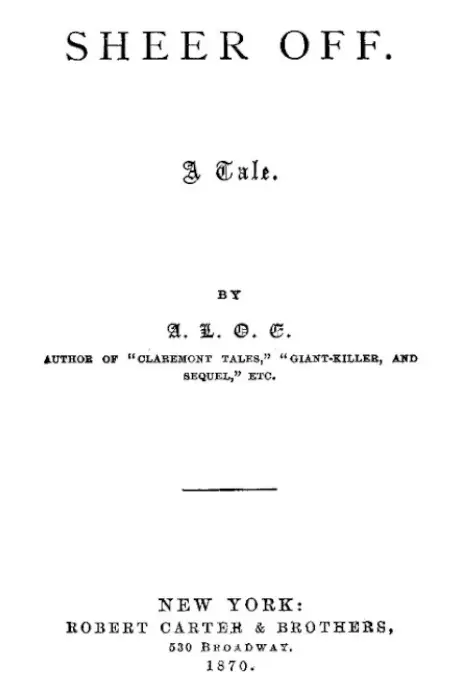
THE CLASSIC COLLECTION · 1870
"Sheer Off: A Tale" by A. L. O. E. is a novel likely written in the late 19th century. The story revolves around Ned Franks, a one-armed sailor turned schoolmaster, and his attempts to uplift his community in the village of Colme, particularly focusing on the plight of the damned almshouses and the struggles of his neighbor, John Sands, whose wife suffers from alcoholism. Through its exploration of themes like charity, community spirit, and personal responsibility, the novel invites readers to consider the moral dilemmas faced by its characters, setting the stage for deeper social commentary. At the start of the tale, readers are introduced to the contrasting worlds of Ned Franks and Nancy Sands, whose jealousy of Ned's newly appointed role as schoolmaster starkly contrasts the joyful occasion of his child’s christening. The opening scene captures a village gathering to celebrate, against which Nancy’s scorn highlights her bitterness. Franks himself is depicted as a kind-hearted individual, striving to maintain a positive environment for his students while contemplating his responsibilities towards the poor and the downtrodden of the village. Discussions about the state of the almshouses establish the book's central conflict: the need for community support and the challenge of overcoming personal obstacles. The arrival of Mr. Leyton, the young curate, adds another layer to the unfolding narrative, setting up future interactions that will further explore the themes of redemption and the human capacity for change.
Introduction adapted from the source catalogue; source summaries may be automatically generated.
Free to read · English · 73,333 words · No account needed
MAKE TIME FOR A GOOD BOOK
On by default. Untick to stop anonymous reading totals. Each page counts after 10 seconds in view. How this works.
Anonymous counting is on unless you have switched it off.
Norah had passed several pleasant months in London, in the service of Mrs. Lowndes, with the consciousness that she was faithfully performing her duty and giving satisfaction to her mistress, when an incident occurred, which showed her more clearly than ever the importance of having a character for truthfulness and honesty.
"Why, there's your bell and my bell a-ringing together, and rung so loud, too! What can missus want us both for at once?" exclaimed Martha, the housemaid, to Norah, who was helping her, as usual, to make the bed in the little girl's room. Martha's manner was flurried and frightened.
"We'd better go and answer the bells directly," said Norah. "I hope and trust that nothing's the matter with dear little missy!"
The two maids entered the dining-room together. Mr. Lowndes was seated in his large red arm-chair, with his feet on the fender, and his spectacles on his nose, apparently engaged in studying the Times. Mrs. Lowndes, a large, tall, and rather formidable-looking lady, dressed in a very stiff silk, sat, even more erect than usual, at the breakfast-table, on which she was resting her folded hands. She had a peculiarly deep-toned voice, and the voice sounded deeper, her manners seemed sterner than Norah had ever thought them before, as she addressed the young maid with the question, "Did you enter my room this morning?"
"Yes, ma'am, to put by your comb and brush."
"And when?"
"Just the minute after you had left it."
"Did you see a sovereign on the dressing-table?" asked the lady, with the air of a magistrate questioning a witness.
"No, indeed, ma'am, I did not," said Norah.
"Did you see one when you tidied my room?" Mrs. Lowndes turned her keen gray eyes upon Martha, to whom this last question was addressed.
"No, I never saw a sovereign, nor nothing like it, ma'am; I could take my oath that I did not. I did not so much as enter the room till Norah had been there, and gone out again."
Mrs. Lowndes looked very grave, and somewhat perplexed. "I certainly left a sovereign on that table when I came down to breakfast, and an hour afterwards it as certainly was gone. There are only two individuals who could have entered, and did enter, that room during my absence, and both deny having seen the money. I cannot doubt that one of them is uttering a falsehood, and that she who utters it is also the thief."
The idea of being suspected of such a crime as theft covered the face of Norah with crimson; she attempted to speak, but could not bring out a word.
Your reading position is saved on this browser. Take it to another device with a library code. Reading pages adapt to text, rather than matching a printed edition.
A. L. O. E.
A. L. O. E.
A. L. O. E.
A. L. O. E.
BEHIND THE BOOK
This eBook is for the use of anyone anywhere in the United States and most other parts of the world at no cost and with almost no restrictions whatsoever. You may copy it, give it away or re-use it under the terms of the Project Gutenberg License included with this eBook or online at www.gutenberg.org. If you are not located in the United States, you will have to check the laws of the country where you are located before using this eBook. Read the source licence.
The original source file, including credits and licence, is retained by this library. Request an original-format copy at no charge. Please include the book title and Project Gutenberg identifier #61804.
KEEP YOUR CURIOSITY GOING
Coulson Kernahan

Maurice Baring
Frances Wright
Cécile Tormay

Frederic Jesup Stimson

W. H. P. (William Henry Pope) Jarvis