THE CLASSIC COLLECTION✦An outlaw’s diary: the CommuneCLASSIC FREE BOOKS
An outlaw’s diary: the Commune
Cécile Tormay
THE CLASSIC COLLECTION · 1893
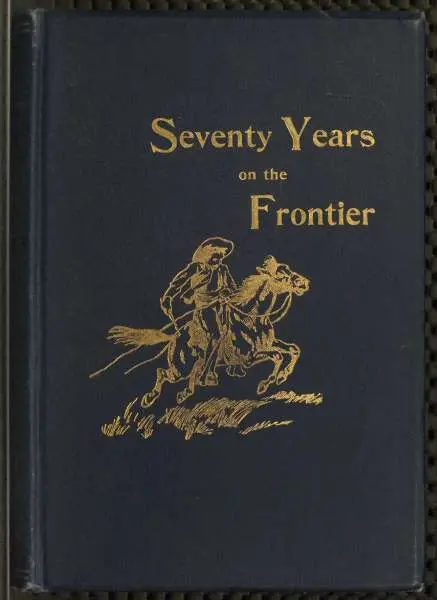
"Seventy Years on the Frontier" by Alexander Majors is a historical memoir written in the late 19th century. The narrative chronicles the author's extensive experiences and adventures on the American frontier, highlighting his contributions to overland freighting and the Pony Express. The book offers an insightful view into the life and challenges faced by pioneers and settlers during a transformative period in American history. The opening of "Seventy Years on the Frontier" introduces Alexander Majors, who reflects on his childhood and early experiences. He recounts his family's migration to Missouri, detailing their encounters with the wilderness and the hardships involved in settling in an untamed land. Through vivid anecdotes, Majors depicts the frontier's stark realities, including the dangers posed by Indigenous populations and the challenges of survival. He shares touching memories of his mother and the resilience instilled in him from a young age, setting the stage for a life characterized by adventure and the forging of a new path across the American landscape.
Introduction adapted from the source catalogue; source summaries may be automatically generated.
Free to read · English · 94,573 words · No account needed
MAKE TIME FOR A GOOD BOOK
On by default. Untick to stop anonymous reading totals. Each page counts after 10 seconds in view. How this works.
Anonymous counting is on unless you have switched it off.
They had but few vices, in fact might say almost none outside of their religious teachings, which allowed them to steal horses and fur skins, and sometimes take the lives of enemies or opposing tribes. Persons who were not thoroughly acquainted with Indian character and life might wonder why there were so many different tribes--or bands, as they were sometimes called--and if it could be there were so many nationalities among them. This is accounted for solely and truly upon the fact that when a tribe grew to a certain number it became a necessity in nature for them to divide, which would form two bands or tribes and at that point of time and condition it became necessary for the one leaving the main tribe to have a name to designate themselves from the family that they had of necessity parted from, for as soon as a tribe reached such a proportion in numbers that it was inconvenient for them to rendezvous at some given point easy of access, their necessities in such cases demanded a new deal or different arrangements; hence the different names by which tribes were called.
These tribes differed in their methods of living according to the conditions with which they were surrounded. Indians who lived along the Atlantic Coast and made their living from fishing, as well as from hunting, were very different from the Indians of the plains and Rocky Mountain regions, who live almost solely upon buffalo and other varieties of game that they were able to secure.
The Indians from the Atlantic and Mississippi valleys were more dangerous, as a rule, when they came into a combat with white soldiers, than were the Indians of the plains and Rockies. The Shawnee and Delaware Indian braves a hundred years ago, when my grandfather was an Indian fighter in Kentucky, were considered equal to any white soldiers and proved themselves in battle to be so. Their mode of warfare, however, was not on horseback, as was the mode of warfare with the Indians of the plains. They were "still" hunters, as they might be called, and when they met with white men in battle array, would get behind trees, if possible, as a protection, and remain and fight to the bitter end. When these tribes became overpowered, it was easy, compared with the Indians of the plains, to bring them under some of the conditions of civilization; therefore the Cherokees, Seminoles, Chickasaws, Choctaws, Shawnees, Delawares, Wyandottes, Kickapoos, Sacs, Foxes, the Creeks, and many others whose names I can not now recall, have become somewhat civilized, and many of them semi-civilized tribes, but the Indians of the plains and Rocky Mountain regions have been very slow to accept what we term civilization. They seem somewhat like the buffalo and other wild animals that we have never been able to domesticate. It looks to one like myself that has known them for so many years, that before they are civilized they will become almost exterminated; that is to say that civilized life does not agree with them, and they die from causes and conditions that such life compels them to exist under, and in my opinion the day will come when there will be few, if any, in the near future, left of the tribes that were known to belong to the territory west of the Mississippi River and extending to the Pacific Coast. There was often among the wildest tribes of America many good traits. If they found you hungry and alone and in distress, as a rule they would take care of you, giving you the very best they had, and never with a view of charging you for their kindness. If they had a grudge against the white race for some misdemeanor some white man may have committed, they might kill you in retaliation. For this reason white men always felt, when they were among them, that their safety depended largely upon how the tribe had been treated by some other white man, or party of white men. As far as I know, throughout the entire savage tribes retaliation is one of the laws by which they are governed. The women, as a rule, were very generous and kind-hearted, and I know of one case where a friend of mine, Judge Brown of Pettis County, Mo., had his life saved and his property restored to him through the instrumentality of an Indian woman. The Indians were at that time quite hostile toward the whites, and had held council and determined to kill him, as they had him a prisoner and at their mercy. This woman seemed to be one of great influence in the tribe, and when the braves held their council and decided to take his life and property, she rose to her feet and plead for the life of my friend. Of course he could not understand a word she said, but he saw in her face a benevolence and kindness that gave him heart, for he had about despaired of ever living another hour. From the way in which she looked, talked, and gestured, he felt certain that she was assuming his cause, and he in relating the circumstances to me and others said he never saw a greater heroine in the appearance and conduct of any woman in his life. Of course this he had to judge largely of from appearances, as the Indians judge of the white people that I before alluded to.
Your reading position is saved on this browser. Take it to another device with a library code. Reading pages adapt to text, rather than matching a printed edition.
BEHIND THE BOOK
This eBook is for the use of anyone anywhere in the United States and most other parts of the world at no cost and with almost no restrictions whatsoever. You may copy it, give it away or re-use it under the terms of the Project Gutenberg License included with this eBook or online at www.gutenberg.org. If you are not located in the United States, you will have to check the laws of the country where you are located before using this eBook. Read the source licence.
The original source file, including credits and licence, is retained by this library. Request an original-format copy at no charge. Please include the book title and Project Gutenberg identifier #42195.
KEEP YOUR CURIOSITY GOING
Cécile Tormay

Moritz Busch
John L. Ransom
Frances Wright
Cécile Tormay

Mabel Potter Daggett