THE CLASSIC COLLECTION✦An outlaw’s diary: the CommuneCLASSIC FREE BOOKS
An outlaw’s diary: the Commune
Cécile Tormay
THE CLASSIC COLLECTION · 1893
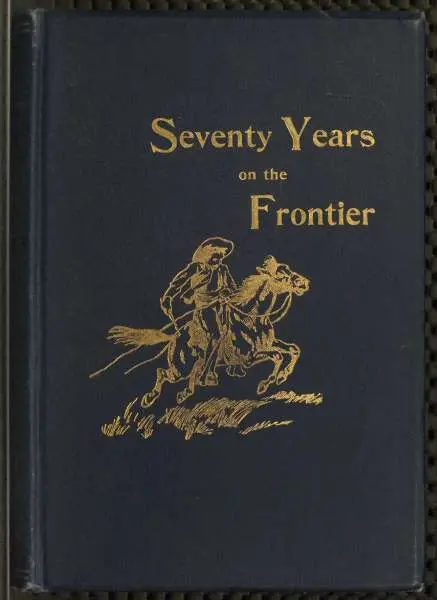
"Seventy Years on the Frontier" by Alexander Majors is a historical memoir written in the late 19th century. The narrative chronicles the author's extensive experiences and adventures on the American frontier, highlighting his contributions to overland freighting and the Pony Express. The book offers an insightful view into the life and challenges faced by pioneers and settlers during a transformative period in American history. The opening of "Seventy Years on the Frontier" introduces Alexander Majors, who reflects on his childhood and early experiences. He recounts his family's migration to Missouri, detailing their encounters with the wilderness and the hardships involved in settling in an untamed land. Through vivid anecdotes, Majors depicts the frontier's stark realities, including the dangers posed by Indigenous populations and the challenges of survival. He shares touching memories of his mother and the resilience instilled in him from a young age, setting the stage for a life characterized by adventure and the forging of a new path across the American landscape.
Introduction adapted from the source catalogue; source summaries may be automatically generated.
Free to read · English · 94,573 words · No account needed
MAKE TIME FOR A GOOD BOOK
On by default. Untick to stop anonymous reading totals. Each page counts after 10 seconds in view. How this works.
Anonymous counting is on unless you have switched it off.
There are thousands, if not millions, of people in the United States who, if asked how they accounted for the fact that there are so many millionaires in the United States, could not give us a satisfactory explanation of the phenomenon.
It is a fact that there are hundreds who have amassed fortunes ranging from $1,000,000 to $100,000,000 each, within the last thirty years, and but very few people have any idea how they have made such immense fortunes in so short a time.
Not only our own people have made these vast fortunes, but hundreds of foreigners have accumulated immense wealth in this country, and now hold it. To give an idea of the immensity of these fortunes, I will call the attention of the reader to some well-known facts. First, to the fact, as is shown by Poor's Railroad Manual, that there is now about $5,500,000,000 of railroad bonds and floating debt, and there is about $4,500,000,000 of railroad stock, making a total of about $10,000,000,000, and this vast wealth is in the hands of comparatively few people.
Then there are national bonds to the amount of about $600,000,000. In addition to these are the bonds that have been issued by the States, counties, cities, towns, and school districts, amounting in the aggregate to probably $3,000,000,000. Then there are, according to the last census, about 9,000,000 of mortgages upon the farms, homes, and property of the people. The aggregate of these 9,000,000 of mortgages is probably not less than $5,000,000,000, and all of this vast amount of bonds, stocks, and mortgages draw interest, requiring about $1,000,000,000 each year to pay interest.
All of this wealth is in the hands of but a small percentage of the people, and what is incomprehensible to the masses is the fact that a very large per cent of it is in the hands of foreign capitalists. Of the $10,000,000,000 of railroad bonds and stocks, it is a conservative estimate to say that one-half of it belongs to foreign, principally English, capitalists. The question is often asked, How did they acquire this property? What did they give us in exchange for it? Was it gold, silver, or merchandise? If neither of these, what did we get? To prove that they did not send us either gold, silver, or merchandise in payment for at least $5,000,000,000 of our railroad bonds, we have only to refer to the report of the Secretary of the United States Treasury for 1891, and we find that since the close of the war, in 1865, our exports of gold, silver, and merchandise have exceeded our imports in the sum of $872,000,000; so that it is very clear that we have been sending them an enormous amount of money and merchandise over and above the amount we have imported from them, and whatever may have been received from the railroad bonds is still to be accounted for. To understand how they have acquired this hold upon the resources of the country, imposing a burden on the people that is surely and certainly reducing them to the condition of paupers and serfs, we shall have to go back to the days of the war, and review the financial policy of the Government, and point out how the laws have been framed exclusively in the interest of capital.
Your reading position is saved on this browser. Take it to another device with a library code. Reading pages adapt to text, rather than matching a printed edition.
BEHIND THE BOOK
This eBook is for the use of anyone anywhere in the United States and most other parts of the world at no cost and with almost no restrictions whatsoever. You may copy it, give it away or re-use it under the terms of the Project Gutenberg License included with this eBook or online at www.gutenberg.org. If you are not located in the United States, you will have to check the laws of the country where you are located before using this eBook. Read the source licence.
The original source file, including credits and licence, is retained by this library. Request an original-format copy at no charge. Please include the book title and Project Gutenberg identifier #42195.
KEEP YOUR CURIOSITY GOING
Cécile Tormay

Moritz Busch
John L. Ransom
Frances Wright
Cécile Tormay

Mabel Potter Daggett