THE CLASSIC COLLECTION✦An outlaw’s diary: the CommuneCLASSIC FREE BOOKS
An outlaw’s diary: the Commune
Cécile Tormay
THE CLASSIC COLLECTION · 1893
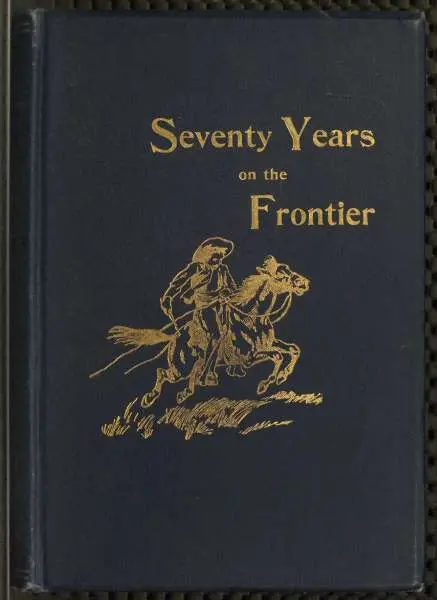
"Seventy Years on the Frontier" by Alexander Majors is a historical memoir written in the late 19th century. The narrative chronicles the author's extensive experiences and adventures on the American frontier, highlighting his contributions to overland freighting and the Pony Express. The book offers an insightful view into the life and challenges faced by pioneers and settlers during a transformative period in American history. The opening of "Seventy Years on the Frontier" introduces Alexander Majors, who reflects on his childhood and early experiences. He recounts his family's migration to Missouri, detailing their encounters with the wilderness and the hardships involved in settling in an untamed land. Through vivid anecdotes, Majors depicts the frontier's stark realities, including the dangers posed by Indigenous populations and the challenges of survival. He shares touching memories of his mother and the resilience instilled in him from a young age, setting the stage for a life characterized by adventure and the forging of a new path across the American landscape.
Introduction adapted from the source catalogue; source summaries may be automatically generated.
Free to read · English · 94,573 words · No account needed
MAKE TIME FOR A GOOD BOOK
On by default. Untick to stop anonymous reading totals. Each page counts after 10 seconds in view. How this works.
Anonymous counting is on unless you have switched it off.
My son Benjamin and I worked as contractors almost a year in 1868, upon the building of the Union Pacific Railroad, and we were present at the Promontory when the Union and Central Pacific roads met, and saw the gold and silver spikes driven into the California mahogany tie. It was regarded at that time as the greatest feat in railroad enterprise that had ever been accomplished in this or any other country, and it was a day that will be remembered during the lifetime of all that were present to witness this great iron link between the two oceans, Atlantic and Pacific. My calling as a freighter and overland stager having been deposed by the building of telegraph lines and the completion of a continental railway, I was compelled to look after a new industry, and as the silver mining at that time was just beginning to develop in Utah, I chose that as my next occupation, and my first experience in prospecting for silver mines was in Black Pine District north of Kelton some twenty-five miles, and I believe in the northwest corner of Utah. The district proved to be a failure, but leaving it, I met with Mr. R. C. Chambers, who, upon acquaintance, I found to be a very pleasant gentleman. I left the camp and went to Salt Lake City, and wrote Mr. Chambers that I thought mines in the mountains were a better show for prospectors than the Black Pine District, and in a few days he came to Salt Lake City, and we then engaged in prospecting in the American Fork and Cottonwood districts, which lay in the Wasatch Mountains, twenty-five or thirty miles southeast of Salt Lake City. We had some success, but were not able to find anything in the way of bonanzas. We were connected with each other more or less until 1872, when a gentleman came to me one day in July of that year and told me that he had a bond upon McHenry mine, in Park District, and that the mine was a remarkably rich one. He desired me to telegraph to Mr. George Hearst of San Francisco to come to Salt Lake City and go and see the mine. He said that he wanted me to send the message because he knew Mr. Hearst, with whom I had become acquainted through Mr. Chambers, would come for my telegram, when he would perhaps pay no attention to his. I sent the message, and received a reply forthwith that he would start at once for Salt Lake City. He arrived in due time, and we together went to the McHenry mine. Upon arrival we found it was not what was represented. We were thoroughly disappointed in our expectations. But while sitting, resting on a large boulder, a man by the name of Harmon Budden (who a day or two before had discovered and located the Ontario mine) approached us and spoke to Mr. Hearst. Mr. H. said he did not remember him, but Mr. Budden said he had previously met him in some mining camp in Nevada, and remarked that he had a prospect that he would like us to look at, only a short distance away. We went with him to the location. His shaft was then only about three feet deep, and when Mr. Hearst jumped down into the hole that he had dug, the surface of the ground was about as high as his waist, and he could jump in and out by putting his hands on the earth. I saw that he was very much interested in the appearance of the ore, which at that depth and at that time did not show more than a streak of eight or ten inches of mineral. I was at that time what they called a "tenderfoot," and had not been in the mining business long enough to be an expert, and to my inexperienced eye there was nothing unusual in the appearance of the ore, but Mr. Hearst did see something, and he determined then and there to purchase the Ontario prospect, and arranged when we returned to Salt Lake City with Mr. Chambers to keep a watch over its development, and purchase it when he saw an opportunity to do so. Mr. Budden and his associates asked $5,000 for the prospect when we were there, but Mr. Hearst thought it might be bought for less, as it was nothing but a prospect. But as the development of the mine progressed they raised their price for it $5,000 every time they were asked the terms, until at last it was up to $30,000, when Mr. Chambers purchased it for Mr. Hearst and his associates in San Francisco, Messrs. Tebis and Haggin. Mr. R. C. Chambers was made superintendent of the mine, and has remained its manager from that period until the present, he being one of the stockholders, as well as the superintendent. The mine has grown and developed until it is one of the great mines of the Rocky Mountain region, and under Mr. Chamber's supervision has been extremely successful and profitable to its owners. Its output, up to 1892, has been over $26,000,000, over $12,000,000 of which has been paid in dividends to the stockholders. This showed that Mr. Hearst was an expert, for he was really one of the best judges of minerals I ever met.
Your reading position is saved on this browser. Take it to another device with a library code. Reading pages adapt to text, rather than matching a printed edition.
BEHIND THE BOOK
This eBook is for the use of anyone anywhere in the United States and most other parts of the world at no cost and with almost no restrictions whatsoever. You may copy it, give it away or re-use it under the terms of the Project Gutenberg License included with this eBook or online at www.gutenberg.org. If you are not located in the United States, you will have to check the laws of the country where you are located before using this eBook. Read the source licence.
The original source file, including credits and licence, is retained by this library. Request an original-format copy at no charge. Please include the book title and Project Gutenberg identifier #42195.
KEEP YOUR CURIOSITY GOING
Cécile Tormay

Moritz Busch
John L. Ransom
Frances Wright
Cécile Tormay

Mabel Potter Daggett