THE CLASSIC COLLECTION✦An outlaw’s diary: the CommuneCLASSIC FREE BOOKS
An outlaw’s diary: the Commune
Cécile Tormay
THE CLASSIC COLLECTION · 1893
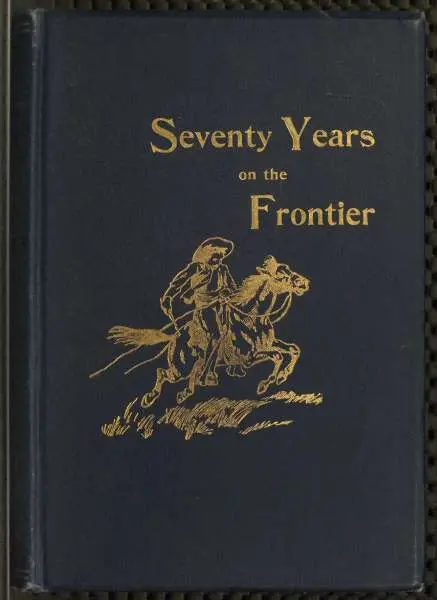
"Seventy Years on the Frontier" by Alexander Majors is a historical memoir written in the late 19th century. The narrative chronicles the author's extensive experiences and adventures on the American frontier, highlighting his contributions to overland freighting and the Pony Express. The book offers an insightful view into the life and challenges faced by pioneers and settlers during a transformative period in American history. The opening of "Seventy Years on the Frontier" introduces Alexander Majors, who reflects on his childhood and early experiences. He recounts his family's migration to Missouri, detailing their encounters with the wilderness and the hardships involved in settling in an untamed land. Through vivid anecdotes, Majors depicts the frontier's stark realities, including the dangers posed by Indigenous populations and the challenges of survival. He shares touching memories of his mother and the resilience instilled in him from a young age, setting the stage for a life characterized by adventure and the forging of a new path across the American landscape.
Introduction adapted from the source catalogue; source summaries may be automatically generated.
Free to read · English · 94,573 words · No account needed
MAKE TIME FOR A GOOD BOOK
On by default. Untick to stop anonymous reading totals. Each page counts after 10 seconds in view. How this works.
Anonymous counting is on unless you have switched it off.
Immediately after they tore down the printing office they sent to the store of Elder Partridge and Mr. Allen, who was also an elder in the church, and took them by force to the public square, stripped them to their waists, and poured on them a sufficient amount of tar to cover their bodies well, and then took feathers and rubbed them well into the tar, making the two elders look like a fright. One of their names being Partridge, many began to whistle like a cock partridge, in derision. Now, be it remembered that the people who were doing this were not what is termed "rabble" of a community, but many among them were respectable citizens and law-abiding in every other respect, but who actually thought they were doing God's service to destroy, if possible, and obliterate Mormonism. In all my experience I never saw a more law-abiding people than those who lived where this occurred. There is nothing, however, that they could have done that would have proved more effectual in building up and strengthening the faith of the people so treated as this and similar performances proved to do. For if there is anything under the sun that will strengthen people in their beliefs or faith, no matter whether it is error or truth, if they have adopted it as true, it is to abuse and punish them for their avowed belief in whatever they espouse as religion or politics.
A few months after the tearing down of the building, a dozen or two Mormons made their appearance one day on the county road west of the Big Blue and not far from the premises of Moses G. Wilson. Wilson's boy rode out to drive up the milk cows in the morning, and saw this group of Mormons and had some conversation with them, and they used some very violent language to the boy. He went back and told his father, and it happened that there were several of the neighbors in at the time, as he kept a little county store; and in those days men generally carried their guns with them, in case they should have a chance to shoot a deer or turkey as they went from one neighbor's to another. It so happened that several of them had their guns with them; those who did not picked up a club of some kind, and they all followed the boy, who showed them where they were. When they got in close proximity to where the Mormons were grouped, seeing the men approaching with guns, the Mormons opened fire upon them, and the Gentiles, as they were called by the Mormons, returned the fire. There was a lawyer on the Gentile side by the name of Brazeel, who was shot dead; another man by the name of Lindsay was shot in the jaw and was thought to be fatally wounded, but recovered. Wilson's boy was also shot in the body, but not fatally. There were only one or two Mormons killed. Of course, after this occurrence, it aroused an intense feeling of hate and revenge in the citizens, and the Mormons would not have been so bold had it not been for their elders claiming that under all circumstances and at all times they would be sustained by the Almighty's power, and that a few of them would be able to put their enemies to flight. The available Mormon men then formed themselves into an organization for fighting the battles of the Lord, and started to Independence, about ten miles away, to take possession of the town. On their way, and when they were within about a mile of Independence, they marched with all the faith and fervor imaginable for fanatics to possess, encouraging each other with the words, "God will be with us and deliver our enemies into our hands." At this point they met a gentleman whom I well knew, by the name of Rube Collins, a citizen of the place, who was leaving the town in a gallop to go home and get more help to defend the town from the Mormon invasion. He shouted out as he passed them, "You are a d--d set of fools to go there now; there are armed men enough there to exterminate you in a minute." They were acquainted with Collins, and supposed he had told them the truth; however, at that time they could have taken the town had they pressed on, but his words intimidated them somewhat, and they filed off from the big road and hid themselves in the brush until they could hold a council, and I presume pray for light to be guided by. During this time there were runners going in all directions, notifying the citizens that the Mormons were coming to the town to take it, and every citizen, as soon as he could run bullets and fill his powder horn with powder, gathered his gun and made for the town; and in a few hours men enough had gathered to exterminate them had they approached. In their council that they held they decided not to approach until they sent spies ahead to see whether Collins had told them the truth or not. They supposed he had, from the fact that they found the public square almost covered with men, and others arriving every minute. As quickly as the citizens had organized themselves into companies (my father, Benjamin Majors, being captain of one of them), they then sent a message by two or three citizens to the Mormons, where they were still secreted in the paw-paw brush, and told them that if they did not come and surrender immediately, the whole party that was waiting for them in the town would come out and exterminate them. This message sent terror to their hearts, with all their claims that God would go before them and fight their battles for them. After holding another council they decided the best thing they could do was to go and surrender themselves to their enemies, which they did. I never saw a more pale-faced, terror-stricken set of men banded together than these seventy-five Mormons, for it was all the officers could do to keep the citizens from shooting them down, even when they were surrendering. However, they succeeded in keeping the men quiet, and no one was hurt. They stacked all their arms around a big white-oak stump that was perhaps four feet in diameter, and at that time was standing in the public square. Afterward the guns were put in the jail house for safe keeping, and were eaten up with rust, and never to my knowledge delivered to them. They then stipulated that every man, woman, and child should leave the county within three weeks. This was a tremendous hardship upon the Mormons, as it was late in the fall, and there were no markets for their crops or anything else that they had. The quickest way to get out of the county was to cross the river into Clay, as the river was the line between the two counties. They had to leave their homes, their crops, and in fact every visible thing they had to live upon. Many of their houses were burned, their fences thrown down, and the neighbors' stock would go in and eat and destroy the crop.
Your reading position is saved on this browser. Take it to another device with a library code. Reading pages adapt to text, rather than matching a printed edition.
BEHIND THE BOOK
This eBook is for the use of anyone anywhere in the United States and most other parts of the world at no cost and with almost no restrictions whatsoever. You may copy it, give it away or re-use it under the terms of the Project Gutenberg License included with this eBook or online at www.gutenberg.org. If you are not located in the United States, you will have to check the laws of the country where you are located before using this eBook. Read the source licence.
The original source file, including credits and licence, is retained by this library. Request an original-format copy at no charge. Please include the book title and Project Gutenberg identifier #42195.
KEEP YOUR CURIOSITY GOING
Cécile Tormay

Moritz Busch
John L. Ransom
Frances Wright
Cécile Tormay

Mabel Potter Daggett