
Life of Edwin Forrest, the American Tragedian. Volume 2 (of 2)
William Rounseville Alger & Horatio, Jr. Alger
THE CLASSIC COLLECTION · 1899
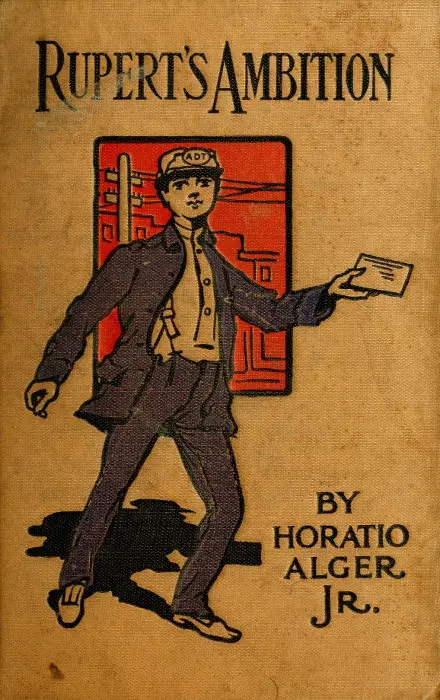
"Rupert's Ambition" by Horatio Alger, Jr. is a novel written in the late 19th century. The story follows a young boy named Rupert Rollins, who faces hardship after losing his job at a dry goods house during a time of economic downturn. Struggling to support his mother and invalid sister, Rupert's journey is one of resilience and determination as he navigates his way through various challenges in search of employment and stability. At the start of the narrative, Rupert experiences the shock of being discharged from his job, which is a primary source of income for his family. He is deeply concerned about their future, particularly as his sister's health adds to the family's challenges. Despite the grim prospect of unemployment, Rupert displays a commendable spirit of optimism and resourcefulness. The opening sections introduce themes of kindness, the effects of economic hardship, and the strength of familial bonds, setting a poignant tone for Rupert's pursuit of a better life.
Introduction adapted from the source catalogue; source summaries may be automatically generated.
Free to read · English · 57,140 words · No account needed
MAKE TIME FOR A GOOD BOOK
On by default. Untick to stop anonymous reading totals. Each page counts after 10 seconds in view. How this works.
Anonymous counting is on unless you have switched it off.
Rupert had engaged a room on Bleecker Street. It is not a fashionable locality, but the time was when A. T. Stewart and other men of social standing lived upon it.
Rupert's room, a small hall bedroom, cost him two dollars per week. It was rather large for a hall room, and was clean and well furnished, beyond the average of such rooms in that locality. The house was kept by a widow, a Mrs. Stetson, a good, hard-working woman, who deserved a better fate than the position of a lodging-house keeper.
Usually Rupert reached his room about eight o'clock in the evening. He left the hotel at seven, and stopped for supper on the way. Arrived at his room he generally spent an hour in reading or studying (he had undertaken to review his arithmetic, thinking that some time he might obtain a situation where a good knowledge of that science might be needed).
He had nearly reached the house where he lodged on the evening after the departure of Mr. Onthank from the Somerset Hotel, when his attention was drawn to a boy of ten with a bundle of the "Evening News" under his arm. He was shedding tears quietly. Rupert had a warm heart and was always kind to younger boys.
He was touched by the little fellow's evident distress and spoke to him.
"What is the matter, Johnny?" he asked.
"I can't sell my papers," answered the boy.
"How many have you got left?"
"Twelve copies."
"How many did you have in the first place?"
"Twenty."
"Then you have only sold eight?"
"Yes, sir."
"So that you are behindhand unless you sell more. Have you a father and
mother living?"
The boy answered in the affirmative.
"I shouldn't think they would let you go out selling papers so late."
"They are very poor," answered the boy, in a sorrowful tone.
"Doesn't your father work?"
"Yes, he works for Mr. Lorimer, on Third Avenue."
Rupert's attention was aroused. This Lorimer, as the reader has already been told, was his father's former partner, and, as Rupert believed, the cause of his failure.
"If your father has a position I should think he would be able to
support his family."
"Mr. Lorimer only pays him five dollars a week," explained the boy.
"Only five dollars a week!" repeated Rupert, in amazement. "Doesn't he pay more to his other salesmen?"
"Yes, but he knew father was poor, so he told him he must work for that
or leave the store."
Rupert was not altogether surprised to hear this, as he knew that Lorimer was a mean man who had no consideration for the poor.
Your reading position is saved on this browser. Take it to another device with a library code. Reading pages adapt to text, rather than matching a printed edition.
William Rounseville Alger & Horatio, Jr. Alger

William Rounseville Alger & Horatio, Jr. Alger

Horatio, Jr. Alger

Horatio, Jr. Alger
BEHIND THE BOOK
This eBook is for the use of anyone anywhere in the United States and most other parts of the world at no cost and with almost no restrictions whatsoever. You may copy it, give it away or re-use it under the terms of the Project Gutenberg License included with this eBook or online at www.gutenberg.org. If you are not located in the United States, you will have to check the laws of the country where you are located before using this eBook. Read the source licence.
The original source file, including credits and licence, is retained by this library. Request an original-format copy at no charge. Please include the book title and Project Gutenberg identifier #54621.
KEEP YOUR CURIOSITY GOING
Coulson Kernahan

Maurice Baring
Frances Wright
Cécile Tormay

Frederic Jesup Stimson

W. H. P. (William Henry Pope) Jarvis