
Life of Edwin Forrest, the American Tragedian. Volume 2 (of 2)
William Rounseville Alger & Horatio, Jr. Alger
THE CLASSIC COLLECTION · 1899
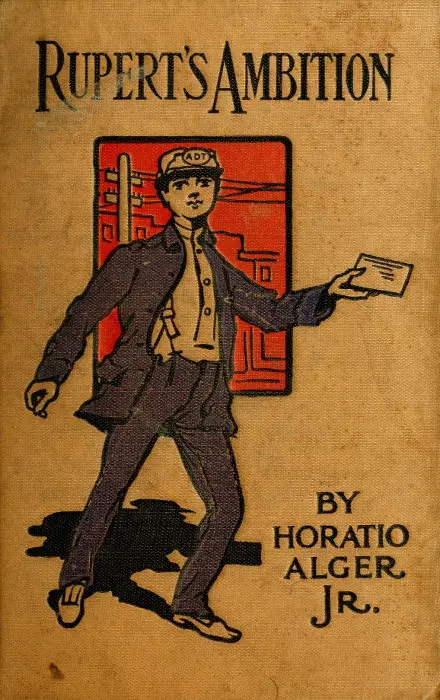
"Rupert's Ambition" by Horatio Alger, Jr. is a novel written in the late 19th century. The story follows a young boy named Rupert Rollins, who faces hardship after losing his job at a dry goods house during a time of economic downturn. Struggling to support his mother and invalid sister, Rupert's journey is one of resilience and determination as he navigates his way through various challenges in search of employment and stability. At the start of the narrative, Rupert experiences the shock of being discharged from his job, which is a primary source of income for his family. He is deeply concerned about their future, particularly as his sister's health adds to the family's challenges. Despite the grim prospect of unemployment, Rupert displays a commendable spirit of optimism and resourcefulness. The opening sections introduce themes of kindness, the effects of economic hardship, and the strength of familial bonds, setting a poignant tone for Rupert's pursuit of a better life.
Introduction adapted from the source catalogue; source summaries may be automatically generated.
Free to read · English · 57,140 words · No account needed
MAKE TIME FOR A GOOD BOOK
On by default. Untick to stop anonymous reading totals. Each page counts after 10 seconds in view. How this works.
Anonymous counting is on unless you have switched it off.
"Yes, Rupert," she answered, raising her head, "but for the moment I felt discouraged. Grace has been suffering more than usual to-day. Sickness and poverty, too, are hard to bear."
"That is true, mother," and Rupert's heart sank as he remembered that by the end of the week the poverty would become destitution.
"Grace has been unable to eat anything to-day. She thought she could eat an orange, but I absolutely didn't have money enough to buy one."
"She shall have an orange," said Rupert, in a low voice.
The sick girl heard, and her face brightened. It was an instinctive craving, such as a sick person sometimes has.
"I should enjoy an orange," she said, faintly. "I think I could sleep
after eating one."
"I will go right out and get one."
Rupert put on his hat and went down stairs.
"You may buy a loaf of bread, Rupert," said his mother, as he was starting, "that is, if you have money enough."
"Yes, mother."
There was an Italian fruit vender's stall at the next corner. As he stepped out on the sidewalk Rupert took out his slender purse and examined its contents. It held but thirty-five cents, and this must last till Saturday night, when he would receive his weekly wages.
Going to the stand, he examined the Italian's stock. He saw some large, attractive oranges marked "five cents." There were some smaller ones marked three cents, but Rupert judged that they were sour, and would not please his sister. Yet five cents was considerable for him to pay under the circumstances. It represented one-seventh of his scanty stock of money.
"Won't you let me have one of these oranges for four cents?" he asked.
Nicolo, the Italian, shook his head.
"No," he answered. "It is good-a orange. It is worth more than I ask."
Rupert sighed and hesitated.
"I suppose I shall have to pay it," he said, regretfully.
He drew out his purse and took out a nickel.
"I'll take an orange," he said.
"Is it for yourself?" asked a gentle voice.
Rupert turned, and saw a tiny woman, not over five feet in height, with
a pleasant, kindly face.
"No," he said, "it is for my sister."
"Is your sister sick?"
"Yes. She has taken a fancy to an orange, and I want her to have one, but--it is extravagant for one in my circumstances to pay a nickel for one."
"Would you mind," said the little woman, hesitatingly, "would you mind if I sent an orange to your sister?"
Rupert hesitated. He was proud, but not foolishly so, and he saw that the offer was meant in kindness.
Your reading position is saved on this browser. Take it to another device with a library code. Reading pages adapt to text, rather than matching a printed edition.
William Rounseville Alger & Horatio, Jr. Alger

William Rounseville Alger & Horatio, Jr. Alger

Horatio, Jr. Alger

Horatio, Jr. Alger
BEHIND THE BOOK
This eBook is for the use of anyone anywhere in the United States and most other parts of the world at no cost and with almost no restrictions whatsoever. You may copy it, give it away or re-use it under the terms of the Project Gutenberg License included with this eBook or online at www.gutenberg.org. If you are not located in the United States, you will have to check the laws of the country where you are located before using this eBook. Read the source licence.
The original source file, including credits and licence, is retained by this library. Request an original-format copy at no charge. Please include the book title and Project Gutenberg identifier #54621.
KEEP YOUR CURIOSITY GOING
Coulson Kernahan

Maurice Baring
Frances Wright
Cécile Tormay

Frederic Jesup Stimson

W. H. P. (William Henry Pope) Jarvis