THE CLASSIC COLLECTION✦An outlaw’s diary: the CommuneCLASSIC FREE BOOKS
An outlaw’s diary: the Commune
Cécile Tormay
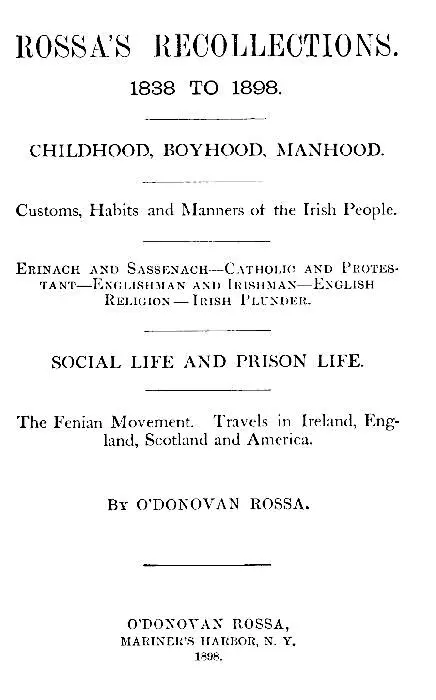
THE CLASSIC COLLECTION · 1898
"Rossa's Recollections, 1838 to 1898" by Jeremiah O'Donovan Rossa is a historical account written in the late 19th century. The memoir details the author’s life experiences, focusing on his childhood, family ties, and the social and political backdrop of Irish life during times of struggle and change, including the impact of English rule and the Fenian movement. The narrative offers strong insights into the customs, habits, and shared history of the Irish people through the lens of Rossa's personal journey. The opening of the memoir introduces the reader to Rossa’s early life in Ross Carbery, County Cork. He recalls poignant memories from childhood, including his baptism, and the scattering of his family due to emigration and political strife. As he reminisces about life with his grandparents and the warmth of familial bonds, he contrasts this with the emotional weight of separation and loss faced by many Irish families. Rossa provides vivid descriptions of his upbringing, the language and stories that shaped his identity, and the overarching influences of English oppression, setting the stage for the deeper political commentary that emerges in later chapters.
Introduction adapted from the source catalogue; source summaries may be automatically generated.
Free to read · English · 107,176 words · No account needed
MAKE TIME FOR A GOOD BOOK
On by default. Untick to stop anonymous reading totals. Each page counts after 10 seconds in view. How this works.
Anonymous counting is on unless you have switched it off.
“Swords to back his words
Were ready, did he need them.
But that treaty of ’82 was broken as perfidiously as was the treaty of Limerick, and every other treaty or compact that was ever made between the two peoples. As a prelude, Ireland was incited by the enemy to premature rebellion; and as Archbishop Hughes, of New York, said when delivering a lecture on Irish starvation in ’46--‘Martial law for the people--a bayonet or a gibbet for the patriot who loved Ireland--a bribe for the traitor who did not--led to that act called the Union, in which the charter of Irish nationality was destroyed--I trust not forever.’ Irishmen have since experienced the happiness of being an integral portion of the disunited kingdom; they have been relieved from the cares and troubles of native manufactories and internal bustle, and they are now such an important people as to be saddled with an ‘integral’ portion of a thousand million pounds, as a national debt. If we were able to pay this debt for England, Ireland may have some chance of becoming a separate portion of this kingdom; but whoever would seriously endeavor to make her so without any stipulation, may experience the blessings of the ‘Glorious British Constitution’ through the agency of the halter, the dungeon, the convict ship, the gibbet or the jail. When I speak of these instruments of our tyrants, thoughts of blood and fiendish deeds connected with ’98 and the succeeding years visit my memory. The two Thomas street murders, within a few years and a few yards of each other, forcibly and brilliantly reveal to us the charms of that constitution, and particularly that circumstance connected with the murder of Lord Edward, where the bloodhounds pursued his spirit to the other world, and after the Universal Judge in heaven had passed sentence on him either as a traitor or a martyr, they retried him, and by a packed jury robbed and plundered his widow and orphan children. Excuse me, Mr. Chairman and Irishmen, for trespassing so far upon the property of my successor, who is to speak of the men of ’98. I have digressed much from my subject, but it is more of the heart than of the mind. A few other remarks and I will have ceased from tiring you farther. You will understand that I am not one of those individuals who believe in the regeneration of my country through the agency of a viceroy or vice-reine, through the propagation of high-blood cattle and the cultivation for their support of mangel-wurzel and yellow-bullock; the latter would be very well in their proper time and place, but I would reverse the order of things, and the comforts of human creation would be with me a primary consideration to the comforts of the brute species, or as my friend and neighbor, Michael Burke, says, I would rather see ‘stamina’ in the man than in the animal (laughter). To effect this, the existing relations of Irishman and Englishman should undergo a change, and now should be the time for the Irish nation to agitate for this change, and strive to obtain it by every proper means, so as to prevent a recurrence of the national disasters of ’46 and ’47, when England allowed thousands of our people to starve, and blasphemously charged God Almighty with the crime, while the routine of her misgovernment compelled the cereal produce of the country to be exported. A curse upon foreign legislation. A domestic government, no matter how constituted, would never have allowed it; even this terrible evil might have been averted, had the leaders in ’48 profited by the past history of their country; they ought to have known that an enemy never paid any attention to moral force, when not backed by physical force, and had the Repealers followed the example of the ’82 men, and had they presented their petitions with pikes and swords instead of with magic wands and brass buttons, the issue would have been different with them, and instead of injuring the cause of their country, they would occupy as prominent and proud a place in her future history as Grattan and his compatriots. To obtain a name and a position for our country, and the restoration of our plundered rights, we will need such an organization as that of ’82--nay such a one as ’48, if you will. Had Irishmen, or any one class of Irishmen, been united, bided their time, and embraced their opportunity, the future would be ours--no matter though there may be many difficulties before men who seek to establish a name and position for their country amongst the nations of the earth. But let me say, that as Irishmen here to-night--we have no foe--no enemy amongst any class or creed of our countrymen; politically speaking, the man who looks upon us, and men of our political profession, as his enemy, is our enemy. He must be a man who would have his country forever under the yoke of the foreigner; or, he must be a man who has profited by the plunder, or who is supported by the plunderer. I now conclude, thanking you for the honor you have done me, and the kindness you have shown me, assuring you wherever I am cast by fortune, it shall ever be my pride to stand, as I stand here to-night, amongst men who are prepared to assist in any and every agitation or undertaking to obtain their rights, or an instalment of their rights, which may ultimately result in qualifying them to write the epitaph of Robert Emmet.”
Your reading position is saved on this browser. Take it to another device with a library code. Reading pages adapt to text, rather than matching a printed edition.
BEHIND THE BOOK
This eBook is for the use of anyone anywhere in the United States and most other parts of the world at no cost and with almost no restrictions whatsoever. You may copy it, give it away or re-use it under the terms of the Project Gutenberg License included with this eBook or online at www.gutenberg.org. If you are not located in the United States, you will have to check the laws of the country where you are located before using this eBook. Read the source licence.
The original source file, including credits and licence, is retained by this library. Request an original-format copy at no charge. Please include the book title and Project Gutenberg identifier #49978.
KEEP YOUR CURIOSITY GOING
Cécile Tormay

Moritz Busch
John L. Ransom
Frances Wright
Cécile Tormay

Mabel Potter Daggett