READ · DISCOVER · ENJOYClassic literature · Always free
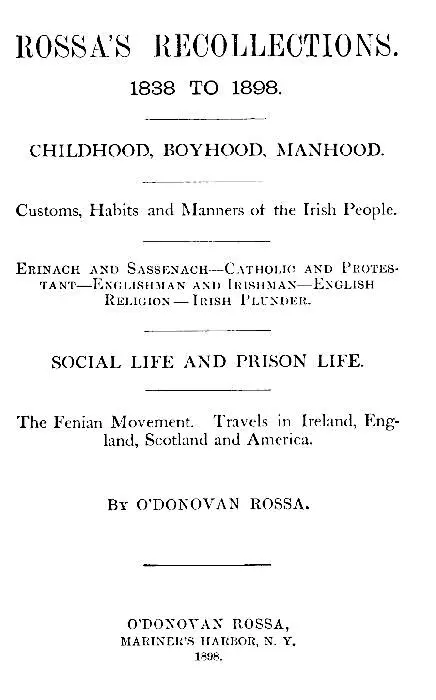
Rossa’s Recollections, 1838 to 1898 Childhood, boyhood, manhood; customs, habits and manners of the Irish people; Erinach and Sassenach; Catholic and protestant; Englishman and Irishman; English religion; Irish plunder; social life and prison life; the Fenian movement; Travels in Ireland, England, Scotland and America — digital edition cover

THE CLASSIC COLLECTION · 1898

Rossa’s Recollections, 1838 to 1898 Childhood, boyhood, manhood; customs, habits and manners of the Irish people; Erinach and Sassenach; Catholic and protestant; Englishman and Irishman; English religion; Irish plunder; social life and prison life; the Fenian movement; Travels in Ireland, England, Scotland and America

"Rossa's Recollections, 1838 to 1898" by Jeremiah O'Donovan Rossa is a historical account written in the late 19th century. The memoir details the author’s life experiences, focusing on his childhood, family ties, and the social and political backdrop of Irish life during times of struggle and change, including the impact of English rule and the Fenian movement. The narrative offers strong insights into the customs, habits, and shared history of the Irish people through the lens of Rossa's personal journey. The opening of the memoir introduces the reader to Rossa’s early life in Ross Carbery, County Cork. He recalls poignant memories from childhood, including his baptism, and the scattering of his family due to emigration and political strife. As he reminisces about life with his grandparents and the warmth of familial bonds, he contrasts this with the emotional weight of separation and loss faced by many Irish families. Rossa provides vivid descriptions of his upbringing, the language and stories that shaped his identity, and the overarching influences of English oppression, setting the stage for the deeper political commentary that emerges in later chapters.

Introduction adapted from the source catalogue; source summaries may be automatically generated.

Start reading ↓

Free to read · English · 107,176 words · No account needed

MAKE TIME FOR A GOOD BOOK

Rossa’s Recollections, 1838 to 1898 Childhood, boyhood, manhood; customs, habits and manners of the Irish people; Erinach and Sassenach; Catholic and protestant; Englishman and Irishman; English religion; Irish plunder; social life and prison life; the Fenian movement; Travels in Ireland, England, Scotland and America

On by default. Untick to stop anonymous reading totals. Each page counts after 10 seconds in view. How this works.

Anonymous counting is on unless you have switched it off.

Rossa’s Recollections, 1838 to 1898 Childhood, boyhood, manhood; customs, habits and manners of the Irish people; Erinach and Sassenach; Catholic and protestant; Englishman and Irishman; English religion; Irish plunder; social life and prison life; the Fenian movement; Travels in Ireland, England, Scotland and America

“Mr. Jeremiah O’Donovan (Rossa) in response to this toast spoke as follows: Mr. Chairman and gentlemen. At your call I reluctantly rise, for I am badly prepared and ill qualified to speak to the toast of Our Country; but should that country ever have a call on the services of her sons during my existence, I trust I will be found more willing to rise and better prepared to act than I am now to speak for it. Too much talk and too little action have been the characteristics of Irish patriotism during a large portion of the last half century; and as we are supposed to learn from experience, it is believed that less of the former and a corresponding increase of the latter will, in the future, serve our country’s cause best and our enemy’s cause least. I don’t know whether or not the committee who prepared our toasts took this view of the matter when they wrote down this land to be toasted as our country, when it is an established fact that we have no country. We are the most cosmopolitan race in the whole universe; but Irishmen should have a country; they have a right to the country of their birth. By the use and aid of one steel--the pen--our committee have taken possession of that right, and as their title one day may be disputed, I trust they will be able and willing to prove it by the aid of another steel--the sword (loud cheers). I have heard an anecdote, which I will repeat to you, concerning Dr. Croke of Mallow. When a young man, he was traveling through France, and in a village there he had his seat taken on a Diligence, but having forgotten something at the time, he went for it and on his return found his place occupied by another. In consideration of the loss of his seat he received some impertinence, which he resented; a dispute arose, the disputants appealed to the authorities, and their names were taken down to appear before a tribunal of justice next morning. He gave his name as Thomas Croke, of Ireland, but for reasons that you can plainly understand, he was called next morning as Thomas Croke, Englishman! Feeling the indignity to his country, he never answered till pointed out by one of the officials, and when he stated he was Thomas Croke, Irishman, and not Thomas Croke, Englishman, he was only sneeringly laughed at for presuming to think that he had a country. Thus was this Irishman reminded of the loss of his country; he had no country; we Irishmen are slaves and outcasts in the land of our birth. What a shame! What a disgrace! Yes; disgraceful alike to peer and peasant--Protestant, Catholic and Presbyterian. Thus may foreign nations believe this country is not ours, and I am sure you will not be surprised that England is particularly positive on this point. She has made all possible efforts to convince us of it. She has broken the heads of many Irishmen trying to hammer this opinion into them. For seven long and dreary centuries has she been trying to force it on us; and against her during all this time have the majority of Irishmen protested. Yet has she disregarded every protestation, every claim, and every petition, and instead of treating us as human beings or subjects, she has made every effort that pen, fire and sword could make to extirpate our race. She has stained almost every hearthstone in the land with the heart’s blood of a victim; and the other day, in savage exultation at the idea of her work being accomplished, she cried out, ‘The Irish are gone, and gone with a vengeance’ (groans). But the mercenary Thunderer lies. I read it in your countenances. The Irish are not gone; but part of them are gone, and in whatever clime their pulses beat to night, that ‘vengeance’ which banished them is inscribed on their hearts, impregnates their blood, and may yet operate against that oppressor who, by his exterminating and extirpating laws, deprived them of a means of living in the land of their fathers (hear, hear, and cheers). I don’t now particularly confine myself to the last ten or twelve years. If I go back centuries, the same language will apply to England. In the seventeenth century she issued the following instructions to Lord Ormond, and as the Eastern monarch said, I now say, ‘hear and tremble’:--‘That his lordship do endeavor, with his majesty’s forces, to wound, kill, slay or destroy, by all the ways and means he may, all the said rebels, their adherents and relievers; and burn, waste, spoil, consume, destroy and demolish all the places, towns and houses where the said rebels are, or have been relieved or harbored, and all the hay and corn there, and kill or destroy all the men inhabiting there capable of bearing arms.’ When I reflect on this and the other innumerable instruments made and provided for the destruction of the Irish, I begin to doubt my identity as of Milesian descent. Many of you possess similar doubts or feelings, for assuredly our ancestors were none of the favored class, and nothing but the miraculous intervention of Providence could have preserved our race from utter extinction. Again, hear what the following historians say:--Carte writes: ‘That the Lord Justices set their hearts on the extermination not only of the mere Irish, but also of the old English families who were Catholics.’ Dr. Leland says that:--‘The favorite object of the Irish Governors and the English Parliament was the utter extermination of all the Catholics of Ireland.’ Clarendon writes that:--‘They have sworn to extirpate the whole Irish nation;’ and the Rev. Dr. Warner says that:--‘It is evident that the Lord Justices hoped for an extirpation not of the mere Irish only, but of all the old English families who were Catholics.’ I give you these extracts without wishing to be sectarian. The old Irish Catholics were fighting for their nationality, and if the old Irish Protestants were to fight for the same to morrow, it is proved that the tyrant would treat them similarly if she had the power. When will Irishmen cease from doing the work of the enemy? When will they ponder on their present degraded condition? When will the sunshine of unity dispel the clouds of dissension and distrust that hover over their understanding, and make them blind to the interests of their common country? If it be advantageous for Irishmen to make their own laws, to govern their own country--if they are qualified to do so--why allow another people to think and act for them? Why not Irishmen prefer the interest of their own to that of another country? Can I attribute the motives to love or fear? Are we so pleased with the fostering care and protective kindness of our masters, that we do not care about changing our condition? Or can it be that we are so much afraid of the power of England, that cowardice alone prevents us from properly claiming and obtaining the rights of free men? The time is gone when England could create fear; under present circumstances she has still the power over Ireland in consequence of all her internal elements of discord, disunion and disorganization, but not over any united or enlightened people. Russia has proved this. America and Naples insult and defy her, and India grasps her by the throat and cries: ‘Robber, stand and deliver up your booty’ (prolonged cheers). In her humility, she is truly a most gullible creature. She now calls for our sympathy and aid. I don’t for a moment deny the Saxon interest is strong amongst us; yet who will wonder at it? And who will be surprised if Lord Mayors and Town Scoundrels, official invaders and castle traders; lunatic, militia, stipendiary, detective, expectants, and all other innumerable officers and satellites of vicious and vice-royalty should forward an address of commiseration and condolence, accompanied with a few lacs for the comfort and relief of their task masters (cries of ‘they want it’). The poor struggling tenant-at-will will pay for all; he can starve his family a few pounds more, and he can fatten the master’s pigs proportionately, and then when he can’t do any more, he will get Indian tenant right, what he richly deserves when he fails to take the proper steps to right himself. If every farmer in the country had a proper supply of agricultural implements, one of which is a pitchfork, and if all combined then and petitioned Parliament, stating they were determined to improve their holdings and positions, and praying to the House to consider their situation, it is my firm conviction they would not be long without tenant right, and the remnant of our race would not be forced into exile. England has never given us anything through a love for us or a love of justice. She has ever spurned our petitions when they were not backed by the sword or a firm determination, and whenever Irishmen demanded an instalment of their rights by the pen alone, they were only mocked and laughed at, and sometimes favored with additional fetters. Wellington and Peel granted emancipation through fear; they admitted it was not safe to refuse it longer; and Grattan would never have repealed the Sixth of George I., passed in 1720, to confirm ‘and better secure the dependence of Ireland,’ only that the English government knew that

Your reading position is saved on this browser. Take it to another device with a library code. Reading pages adapt to text, rather than matching a printed edition.

BEHIND THE WORDS

About Jeremiah O'Donovan Rossa

Jeremiah O'Donovan Rossa (1831–1915). Explore Rossa’s Recollections, 1838 to 1898 Childhood, boyhood, manhood; customs, habits and manners of the Irish people; Erinach and Sassenach; Catholic and protestant; Englishman and Irishman; English religion; Irish plunder; social life and prison life; the Fenian movement; Travels in Ireland, England, Scotland and America in this collection. These books span biography & memoir, history.

Explore this author’s books →

THE READERS’ VERDICT

How did this story stay with you?

Not rated yet
Your rating for Rossa’s Recollections, 1838 to 1898 Childhood, boyhood, manhood; customs, habits and manners of the Irish people; Erinach and Sassenach; Catholic and protestant; Englishman and Irishman; English religion; Irish plunder; social life and prison life; the Fenian movement; Travels in Ireland, England, Scotland and America

Be the first to share your verdict.

One rating per browser, which you can change or remove. A necessary browser identifier remembers your vote. How ratings work

A GOOD STORY DESERVES COMPANY

Pass this book along.

A great read is even better when it’s shared.

SEND A LITTLE INSPIRATION

Share this book

BEHIND THE BOOK

Edition & source details.

Title
Rossa’s Recollections, 1838 to 1898 Childhood, boyhood, manhood; customs, habits and manners of the Irish people; Erinach and Sassenach; Catholic and protestant; Englishman and Irishman; English religion; Irish plunder; social life and prison life; the Fenian movement; Travels in Ireland, England, Scotland and America
Author
Jeremiah O'Donovan Rossa
First publication (Open Library catalogue match)
1898
Digital edition publisher
Project Gutenberg
Gutenberg release date
2015-09-15
Language
English
Source edition imprint
Not stated in source catalogue
Source identifier
Project Gutenberg #49978
Contributors
No additional named contributors in source metadata

Public-domain source & licence

This eBook is for the use of anyone anywhere in the United States and most other parts of the world at no cost and with almost no restrictions whatsoever. You may copy it, give it away or re-use it under the terms of the Project Gutenberg License included with this eBook or online at www.gutenberg.org. If you are not located in the United States, you will have to check the laws of the country where you are located before using this eBook. Read the source licence.

Full source licence and obtaining an original copy

The original source file, including credits and licence, is retained by this library. Request an original-format copy at no charge. Please include the book title and Project Gutenberg identifier #49978.

the full Project Gutenberg License must appear
prominently whenever any copy of a Project Gutenberg work (any work
on which the phrase “Project Gutenberg” appears, or with which the
phrase “Project Gutenberg” is associated) is accessed, displayed,
performed, viewed, copied or distributed:

This eBook is for the use of anyone anywhere in the United States and most
other parts of the world at no cost and with almost no restrictions
whatsoever. You may copy it, give it away or re-use it under the terms
of the Project Gutenberg™ License included with this eBook or online
at www.gutenberg.org. If you
are not located in the United States, you will have to check the laws
of the country where you are located before using this eBook.

1.E.2. If an individual Project Gutenberg electronic work is
derived from texts not protected by U.S. copyright law (does not
contain a notice indicating that it is posted with permission of the
copyright holder), the work can be copied and distributed to anyone in
the United States without paying any fees or charges. If you are
redistributing or providing access to a work with the phrase “Project
Gutenberg” associated with or appearing on the work, you must comply
either with the requirements of paragraphs 1.E.1 through 1.E.7 or
obtain permission for the use of the work and the Project Gutenberg
trademark as set forth in paragraphs 1.E.8 or 1.E.9.

1.E.3. If an individual Project Gutenberg electronic work is posted
with the permission of the copyright holder, your use and distribution
must comply with both paragraphs 1.E.1 through 1.E.7 and any
additional terms imposed by the copyright holder. Additional terms
will be linked to the Project Gutenberg License for all works
posted with the permission of the copyright holder found at the
beginning of this work.

1.E.4. Do not unlink or detach or remove the full Project Gutenberg
License terms from this work, or any files containing a part of this
work or any other work associated with Project Gutenberg.

1.E.5. Do not copy, display, perform, distribute or redistribute this
electronic work, or any part of this electronic work, without
prominently displaying the sentence set forth in paragraph 1.E.1 with
active links or immediate access to the full terms of the Project
Gutenberg License.

1.E.6. You may convert to and distribute this work in any binary,
compressed, marked up, nonproprietary or proprietary form, including
any word processing or hypertext form. However, if you provide access
to or distribute copies of a Project Gutenberg work in a format
other than “Plain Vanilla ASCII” or other format used in the official
version posted on the official Project Gutenberg website
(www.gutenberg.org), you must, at no additional cost, fee or expense
to the user, provide a copy, a means of exporting a copy, or a means
of obtaining a copy upon request, of the work in its original “Plain
Vanilla ASCII” or other form. Any alternate format must include the
full Project Gutenberg License as specified in paragraph 1.E.1.

1.E.7. Do not charge a fee for access to, viewing, displaying,
performing, copying or distributing any Project Gutenberg works
unless you comply with paragraph 1.E.8 or 1.E.9.

1.E.8. You may charge a reasonable fee for copies of or providing
access to or distributing Project Gutenberg electronic works
provided that:

• You pay a royalty fee of 20% of the gross profits you derive from
the use of Project Gutenberg works calculated using the method
you already use to calculate your applicable taxes. The fee is owed
to the owner of the Project Gutenberg trademark, but he has
agreed to donate royalties under this paragraph to the Project
Gutenberg Literary Archive Foundation. Royalty payments must be paid
within 60 days following each date on which you prepare (or are
legally required to prepare) your periodic tax returns. Royalty
payments should be clearly marked as such and sent to the Project
Gutenberg Literary Archive Foundation at the address specified in
Section 4, “Information about donations to the Project Gutenberg
Literary Archive Foundation.”

• You provide a full refund of any money paid by a user who notifies
you in writing (or by e-mail) within 30 days of receipt that s/he
does not agree to the terms of the full Project Gutenberg™
License. You must require such a user to return or destroy all
copies of the works possessed in a physical medium and discontinue
all use of and all access to other copies of Project Gutenberg™
works.

• You provide, in accordance with paragraph 1.F.3, a full refund of
any money paid for a work or a replacement copy, if a defect in the
electronic work is discovered and reported to you within 90 days of
receipt of the work.

• You comply with all other terms of this agreement for free
distribution of Project Gutenberg™ works.


1.E.9. If you wish to charge a fee or distribute a Project
Gutenberg™ electronic work or group of works on different terms than
are set forth in this agreement, you must obtain permission in writing
from the Project Gutenberg Literary Archive Foundation, the manager of
the Project Gutenberg™ trademark. Contact the Foundation as set
forth in Section 3 below.

1.F.

1.F.1. Project Gutenberg volunteers and employees expend considerable
effort to identify, do copyright research on, transcribe and proofread
works not protected by U.S. copyright law in creating the Project
Gutenberg™ collection. Despite these efforts, Project Gutenberg™
electronic works, and the medium on which they may be stored, may
contain “Defects,” such as, but not limited to, incomplete, inaccurate
or corrupt data, transcription errors, a copyright or other
intellectual property infringement, a defective or damaged disk or
other medium, a computer virus, or computer codes that damage or
cannot be read by your equipment.

1.F.2. LIMITED WARRANTY, DISCLAIMER OF DAMAGES - Except for the “Right
of Replacement or Refund” described in paragraph 1.F.3, the Project
Gutenberg Literary Archive Foundation, the owner of the Project
Gutenberg™ trademark, and any other party distributing a Project
Gutenberg™ electronic work under this agreement, disclaim all
liability to you for damages, costs and expenses, including legal
fees. YOU AGREE THAT YOU HAVE NO REMEDIES FOR NEGLIGENCE, STRICT
LIABILITY, BREACH OF WARRANTY OR BREACH OF CONTRACT EXCEPT THOSE
PROVIDED IN PARAGRAPH 1.F.3. YOU AGREE THAT THE FOUNDATION, THE
TRADEMARK OWNER, AND ANY DISTRIBUTOR UNDER THIS AGREEMENT WILL NOT BE
LIABLE TO YOU FOR ACTUAL, DIRECT, INDIRECT, CONSEQUENTIAL, PUNITIVE OR
INCIDENTAL DAMAGES EVEN IF YOU GIVE NOTICE OF THE POSSIBILITY OF SUCH
DAMAGE.

1.F.3. LIMITED RIGHT OF REPLACEMENT OR REFUND - If you discover a
defect in this electronic work within 90 days of receiving it, you can
receive a refund of the money (if any) you paid for it by sending a
written explanation to the person you received the work from. If you
received the work on a physical medium, you must return the medium
with your written explanation. The person or entity that provided you
with the defective work may elect to provide a replacement copy in
lieu of a refund. If you received the work electronically, the person
or entity providing it to you may choose to give you a second
opportunity to receive the work electronically in lieu of a refund. If
the second copy is also defective, you may demand a refund in writing
without further opportunities to fix the problem.

1.F.4. Except for the limited right of replacement or refund set forth
in paragraph 1.F.3, this work is provided to you ‘AS-IS’, WITH NO
OTHER WARRANTIES OF ANY KIND, EXPRESS OR IMPLIED, INCLUDING BUT NOT
LIMITED TO WARRANTIES OF MERCHANTABILITY OR FITNESS FOR ANY PURPOSE.

1.F.5. Some states do not allow disclaimers of certain implied
warranties or the exclusion or limitation of certain types of
damages. If any disclaimer or limitation set forth in this agreement
violates the law of the state applicable to this agreement, the
agreement shall be interpreted to make the maximum disclaimer or
limitation permitted by the applicable state law. The invalidity or
unenforceability of any provision of this agreement shall not void the
remaining provisions.

1.F.6. INDEMNITY - You agree to indemnify and hold the Foundation, the
trademark owner, any agent or employee of the Foundation, anyone
providing copies of Project Gutenberg™ electronic works in
accordance with this agreement, and any volunteers associated with the
production, promotion and distribution of Project Gutenberg™
electronic works, harmless from all liability, costs and expenses,
including legal fees, that arise directly or indirectly from any of
the following which you do or cause to occur: (a) distribution of this
or any Project Gutenberg work, (b) alteration, modification, or
additions or deletions to any Project Gutenberg work, and (c) any
Defect you cause.

Section 2. Information about the Mission of Project Gutenberg

Project Gutenberg is synonymous with the free distribution of
electronic works in formats readable by the widest variety of
computers including obsolete, old, middle-aged and new computers. It
exists because of the efforts of hundreds of volunteers and donations
from people in all walks of life.

Volunteers and financial support to provide volunteers with the
assistance they need are critical to reaching Project Gutenberg’s
goals and ensuring that the Project Gutenberg collection will
remain freely available for generations to come. In 2001, the Project
Gutenberg Literary Archive Foundation was created to provide a secure
and permanent future for Project Gutenberg and future
generations. To learn more about the Project Gutenberg Literary
Archive Foundation and how your efforts and donations can help, see
Sections 3 and 4 and the Foundation information page at www.gutenberg.org.

Section 3. Information about the Project Gutenberg Literary Archive Foundation

The Project Gutenberg Literary Archive Foundation is a non-profit
501(c)(3) educational corporation organized under the laws of the
state of Mississippi and granted tax exempt status by the Internal
Revenue Service. The Foundation’s EIN or federal tax identification
number is 64-6221541. Contributions to the Project Gutenberg Literary
Archive Foundation are tax deductible to the full extent permitted by
U.S. federal laws and your state’s laws.

The Foundation’s business office is located at 41 Watchung Plaza #516,
Montclair NJ 07042, USA, +1 (862) 621-9288. Email contact links and up
to date contact information can be found at the Foundation’s website
and official page at www.gutenberg.org/contact

Section 4. Information about Donations to the Project Gutenberg
Literary Archive Foundation

Project Gutenberg™ depends upon and cannot survive without widespread
public support and donations to carry out its mission of
increasing the number of public domain and licensed works that can be
freely distributed in machine-readable form accessible by the widest
array of equipment including outdated equipment. Many small donations
($1 to $5,000) are particularly important to maintaining tax exempt
status with the IRS.

The Foundation is committed to complying with the laws regulating
charities and charitable donations in all 50 states of the United
States. Compliance requirements are not uniform and it takes a
considerable effort, much paperwork and many fees to meet and keep up
with these requirements. We do not solicit donations in locations
where we have not received written confirmation of compliance. To SEND
DONATIONS or determine the status of compliance for any particular state
visit www.gutenberg.org/donate.

While we cannot and do not solicit contributions from states where we
have not met the solicitation requirements, we know of no prohibition
against accepting unsolicited donations from donors in such states who
approach us with offers to donate.

International donations are gratefully accepted, but we cannot make
any statements concerning tax treatment of donations received from
outside the United States. U.S. laws alone swamp our small staff.

Please check the Project Gutenberg web pages for current donation
methods and addresses. Donations are accepted in a number of other
ways including checks, online payments and credit card donations. To
donate, please visit: www.gutenberg.org/donate.

Section 5. General Information About Project Gutenberg electronic works

Professor Michael S. Hart was the originator of the Project
Gutenberg concept of a library of electronic works that could be
freely shared with anyone. For forty years, he produced and
distributed Project Gutenberg eBooks with only a loose network of
volunteer support.

Project Gutenberg eBooks are often created from several printed
editions, all of which are confirmed as not protected by copyright in
the U.S. unless a copyright notice is included. Thus, we do not
necessarily keep eBooks in compliance with any particular paper
edition.

Most people start at our website which has the main PG search
facility: www.gutenberg.org.

This website includes information about Project Gutenberg,
including how to make donations to the Project Gutenberg Literary
Archive Foundation, how to help produce our new eBooks, and how to
subscribe to our email newsletter to hear about new eBooks.


KEEP YOUR CURIOSITY GOING

Your next chapter awaits.

Your privacy choices

Reading is always free. You can change these settings at any time.

Book banners link to our books on simonward.net. They do not use advertising cookies or tracking.

Privacy & cookie policy · Reading data and privacy controls