THE CLASSIC COLLECTION✦An outlaw’s diary: the CommuneCLASSIC FREE BOOKS
An outlaw’s diary: the Commune
Cécile Tormay
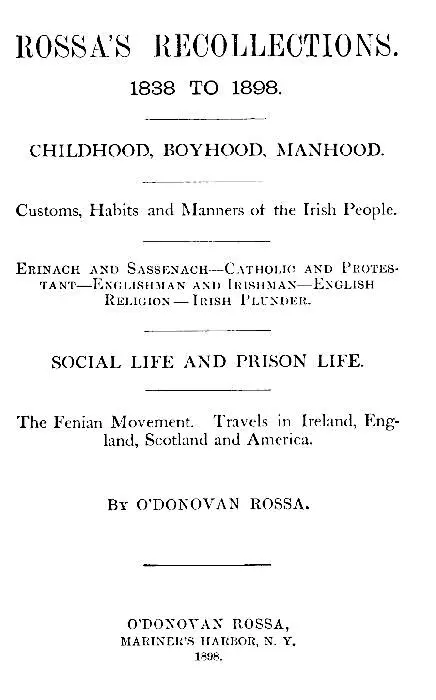
THE CLASSIC COLLECTION · 1898
"Rossa's Recollections, 1838 to 1898" by Jeremiah O'Donovan Rossa is a historical account written in the late 19th century. The memoir details the author’s life experiences, focusing on his childhood, family ties, and the social and political backdrop of Irish life during times of struggle and change, including the impact of English rule and the Fenian movement. The narrative offers strong insights into the customs, habits, and shared history of the Irish people through the lens of Rossa's personal journey. The opening of the memoir introduces the reader to Rossa’s early life in Ross Carbery, County Cork. He recalls poignant memories from childhood, including his baptism, and the scattering of his family due to emigration and political strife. As he reminisces about life with his grandparents and the warmth of familial bonds, he contrasts this with the emotional weight of separation and loss faced by many Irish families. Rossa provides vivid descriptions of his upbringing, the language and stories that shaped his identity, and the overarching influences of English oppression, setting the stage for the deeper political commentary that emerges in later chapters.
Introduction adapted from the source catalogue; source summaries may be automatically generated.
Free to read · English · 107,176 words · No account needed
MAKE TIME FOR A GOOD BOOK
On by default. Untick to stop anonymous reading totals. Each page counts after 10 seconds in view. How this works.
Anonymous counting is on unless you have switched it off.
On the evening of December the 5th, 1858, there was an entertainment at my house in Skibbereen in compliment to Dan McCartie, the brewer, who was leaving town, to accept the position of brewer in some Brewery in the County Galway. The company did not separate till about two o’clock. I went to bed, and was soon aroused from sleep by a thundering knocking at the hall door. When it was opened a dozen policemen rushed in and took charge of me and of every one in the house. Then every room was ransacked for papers, and for everything contraband of war--contraband of peace or war, I may say. I stood in the drawing-room under arrest. The sergeant-in-command was smashing the drawers of the chiffonier in search of documents. My wife rushed toward him, crying out not to break the drawers, as she would get him the keys. He rudely shoved her away. One of the policemen near me was making a rush at him, but I caught him and pushed him back. He was a Kerryman named Moynahan; he is not living now, so I do him no harm by mentioning his name. Tom O’Shea was a guest at the entertainment, he lived at the Curragh, some distance from the town. As there was an “eerie” place at the Steam-mill Cross, on his way home, where the “good people” used to show themselves, I told him it was better for him to sleep in one of the rooms than to risk getting a “puck” by traveling that road at the dead hour of the night. He was occupying one of the bedrooms when the police ransacked the house. They made a prisoner of him, and he was taken with us to Cork Jail, though he never was a member of the Phœnix Society. He was simply a friend of mine and a friend of Dan McCartie, and was at the entertainment as such. ’Tis one of those misfortunes that come upon good people on account of keeping bad company. Some twenty men were arrested in Skibbereen that night. We were lodged in the police barracks till clear day in the morning. Then, with two policemen in charge of every one of us--every one of us handcuffed to a policeman--we were taken through the towns of Rosscarbery and Clonakilty, to Bandon, where we arrived about seven o’clock in the evening. We were put into the jail of Bandon that night, and put into cells that were flooded with water. We met here Jerrie Cullinane, Pat Cullinane, Denis O’Sullivan, and William O’Shea, who had been arrested in Bantry that morning. Next morning we were taken by train to the county jail in the city of Cork. We were two weeks in this jail, without any trial or any charge of any kind being made against us. Then, two stipendiary magistrates came into the jail, and opened court in a room in the jail, and charged us with treason of some kind to something belonging to England. We had McCarthy Downing for our attorney. Sullivan-goula was there to swear that we belonged to the Phœnix society; that he saw us in the rooms of the society, and that he saw me drilling three hundred men out near the New bridge one night. He never saw such a drilling; there never was such a drilling took place; he never saw a drilling of any kind amongst us anywhere. ’Tis true, that he saw many of us at the rooms of the Phœnix Society, for he was lodging in the house where those rooms were. We, having word from Kenmare, that he was a suspicious character, and maybe sent among us as an English spy, went in some numbers to the rooms that night, out of curiosity, to see him. We told Morty Downing to bring him in to the room, that we may have some talk with him. In his sworn information against us, he swore against every man that was in the room that night--swore that they were all among the three hundred men that I was drilling out at the New bridge that same night. He didn’t leave a single one of the company escape, that would be able to contradict his perjury. Fitzmaurice, the stipendiary magistrate, knew well that he was swearing falsely. In fact, it was Fitzmaurice that made the swearing for him; and made the plot for him. Davis, the stipendiary magistrate, knew well he was swearing falsely; Davis belonged to Roscommon, and seemed to have more of a conscience than Fitzmaurice, for he used to occasionally address Goula, when McCarthy Downing was cross examining him, and say “Oh, you unfortunate man! Remember you are testifying on your oath before your God;” but ’twas all to no use; Goula went along with his perjuries. Sir Matthew Barrington, the Crown Prosecutor, was down from Dublin to assist Goula in this star-chamber prosecution. To provide some kind of testimony that would make a corroboration of Goula’s testimony, he put on the witness table one of the Skibbereen policemen, who swore that he saw Denis Downing marching through North street, Skibbereen “with a military step.” In the cross-examination of this policeman, our attorney asked him, “Who was walking with Denis Downing?” The policeman said, “No one was walking with him, but he was stepping out like a soldier.” And so he was a soldier--by nature and instinct--as many an Irishman is; he is the Captain Denis Downing who lost a leg at the battle of Gettysburg in America, and who had charge of the military company that were present at the execution of Mrs. Suratt in Washington, America. He was released from Cork Jail that day of the examination there; but his brother Patrick--who afterward came to be in command of the Forty second (Tammany) Regiment in the American war--was detained in jail till an appeal was made to the Queen’s Bench for his release on bail. About half the number arrested in Bantry and Skibbereen were so released at this first examination in Cork Jail. The other half were kept in prison, and would not be released on bail. Then, an application for “release on bail” was made to the Court of Queen’s Bench in Dublin, and all were released, except Billy O’Shea, Morty Moynahan, and myself.
Your reading position is saved on this browser. Take it to another device with a library code. Reading pages adapt to text, rather than matching a printed edition.
BEHIND THE BOOK
This eBook is for the use of anyone anywhere in the United States and most other parts of the world at no cost and with almost no restrictions whatsoever. You may copy it, give it away or re-use it under the terms of the Project Gutenberg License included with this eBook or online at www.gutenberg.org. If you are not located in the United States, you will have to check the laws of the country where you are located before using this eBook. Read the source licence.
The original source file, including credits and licence, is retained by this library. Request an original-format copy at no charge. Please include the book title and Project Gutenberg identifier #49978.
KEEP YOUR CURIOSITY GOING
Cécile Tormay

Moritz Busch
John L. Ransom
Frances Wright
Cécile Tormay

Mabel Potter Daggett