
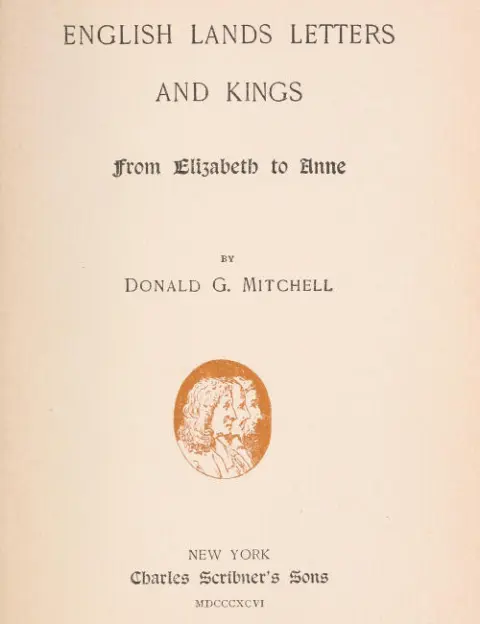
English Lands, Letters and Kings, vol. 1: From Celt to Tudor
Donald Grant Mitchell

THE CLASSIC COLLECTION · 1906
"Reveries of a Bachelor; or, A Book of the Heart" by Donald Grant Mitchell is a collection of reflective essays written in the mid-19th century. The book explores the thoughts and feelings of a bachelor contemplating life, love, and marriage, capturing the introspective and often whimsical nature of bachelorhood. Through its various reveries, it delves into the contrasts between solitude, companionship, and the bittersweet reality of desire, particularly through the lens of the unnamed bachelor reflecting on his experiences and musings. The opening of the book introduces us to the bachelor at his quaint farmhouse, where he finds solace by a roaring fire. Through rich and expressive language, he leads us into a deep reverie sparked by the comforting glow of the flames, which prompts him to contemplate marriage and its implications. He grapples with doubt and fear regarding the commitment of marriage, exploring the potential joys and sorrows that accompany such a life-altering decision. Moving through a series of thoughts, he wrestles with the balance of independence versus the desire for love, drawing readers into his intimate and often humorous introspections. As his thoughts shift from uncertainty to cheerfulness, and finally to the shadows of desolation, the bachelor reveals the complexities and paradoxes of the human experience, setting the tone for the rest of this reflective journey.
Introduction adapted from the source catalogue; source summaries may be automatically generated.
Free to read · English · 62,706 words · No account needed
MAKE TIME FOR A GOOD BOOK
On by default. Untick to stop anonymous reading totals. Each page counts after 10 seconds in view. How this works.
Anonymous counting is on unless you have switched it off.
AFTER all, thought I, ashes follow blaze inevitably as death follows life. Misery treads on the heels of joy; anguish rides swift after pleasure.
“Come to me again, Carlo,” said I to my dog; and I patted him fondly once more, but now only by the light of the dying embers.
It is very little pleasure one takes in fondling brute favorites; but it is a pleasure that when it passes, leaves no void. It is only a little alleviating redundance in your solitary heart-life which, if lost, another can be supplied.
But if your heart, not solitary—not quieting its humors with mere love of chase, or dog—not repressing, year after year, its earnest yearnings after something better and more spiritual—has fairly linked itself by bonds strong as life, to another heart—is the casting off easy then?
Is it then only a little heart-redundancy cut off, which the next bright
sunset will fill up?
And my fancy, as it had painted doubt under the smoke, and cheer under warmth of the blaze, so now it began under the faint light of the smoldering embers, to picture heart-desolation.
What kind, congratulatory letters, hosts of them, coming from old and half-forgotten friends, now that your happiness is a year, or two years old!
“Beautiful.”
—Ay, to be sure, beautiful!
“Rich.”
—Pho, the dawdler! how little he knows of heart-treasure, who speaks of wealth to a man who loves his wife as a wife only should be loved!
“Young.”
—Young indeed; guileless as infancy; charming as the morning.
Ah, these letters bear a sting: they bring to mind, with new and newer freshness, if it be possible, the value of that which you tremble lest you lose.
How anxiously you watch that step—if it lose not its buoyancy. How you study the color on that cheek, if it grow not fainter. How you tremble at the luster in those eyes, if it be not the luster of death. How you totter under the weight of that muslin sleeve—a phantom weight! How you fear to do it, and yet press forward, to note if that breathing be quickened, as you ascend the home-heights, to look off on the sunset lighting the plain.
Is your sleep, quiet sleep, after that she has whispered to you her fears, and in the same breath—soft as a sigh, sharp as an arrow—bid you bear it bravely?
Perhaps—the embers were now glowing fresher, a little kindling, before the ashes—she triumphs over disease.
But Poverty, the world’s almoner, has come to you with ready, spare
hand.
Your reading position is saved on this browser. Take it to another device with a library code. Reading pages adapt to text, rather than matching a printed edition.
Donald Grant Mitchell

Donald Grant Mitchell
Donald Grant Mitchell
Donald Grant Mitchell
BEHIND THE BOOK
This eBook is for the use of anyone anywhere in the United States and most other parts of the world at no cost and with almost no restrictions whatsoever. You may copy it, give it away or re-use it under the terms of the Project Gutenberg License included with this eBook or online at www.gutenberg.org. If you are not located in the United States, you will have to check the laws of the country where you are located before using this eBook. Read the source licence.
The original source file, including credits and licence, is retained by this library. Request an original-format copy at no charge. Please include the book title and Project Gutenberg identifier #62823.
KEEP YOUR CURIOSITY GOING

David Patterson (Spirit) Hatch

David Patterson (Spirit) Hatch

David Patterson (Spirit) Hatch

Ralph Waldo Emerson

Maurice Baring

Oscar Wilde & James McNeill Whistler