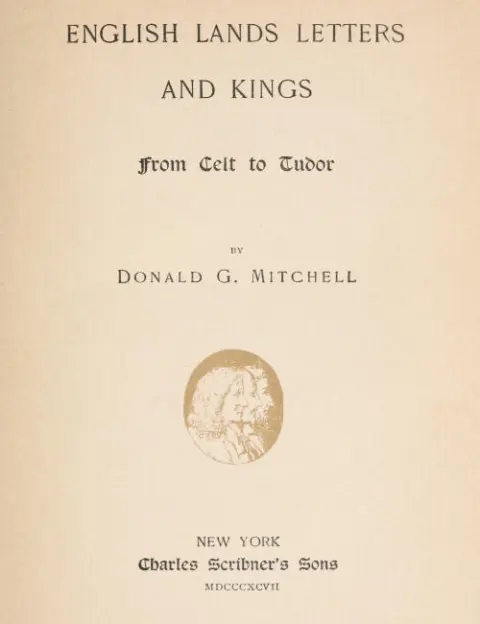
English Lands, Letters and Kings, vol. 1: From Celt to Tudor
Donald Grant Mitchell

THE CLASSIC COLLECTION · 1906
"Reveries of a Bachelor; or, A Book of the Heart" by Donald Grant Mitchell is a collection of reflective essays written in the mid-19th century. The book explores the thoughts and feelings of a bachelor contemplating life, love, and marriage, capturing the introspective and often whimsical nature of bachelorhood. Through its various reveries, it delves into the contrasts between solitude, companionship, and the bittersweet reality of desire, particularly through the lens of the unnamed bachelor reflecting on his experiences and musings. The opening of the book introduces us to the bachelor at his quaint farmhouse, where he finds solace by a roaring fire. Through rich and expressive language, he leads us into a deep reverie sparked by the comforting glow of the flames, which prompts him to contemplate marriage and its implications. He grapples with doubt and fear regarding the commitment of marriage, exploring the potential joys and sorrows that accompany such a life-altering decision. Moving through a series of thoughts, he wrestles with the balance of independence versus the desire for love, drawing readers into his intimate and often humorous introspections. As his thoughts shift from uncertainty to cheerfulness, and finally to the shadows of desolation, the bachelor reveals the complexities and paradoxes of the human experience, setting the tone for the rest of this reflective journey.
Introduction adapted from the source catalogue; source summaries may be automatically generated.
Free to read · English · 62,706 words · No account needed
MAKE TIME FOR A GOOD BOOK
On by default. Untick to stop anonymous reading totals. Each page counts after 10 seconds in view. How this works.
Anonymous counting is on unless you have switched it off.
Alone, with your dog living on bones, and you on hope—kindling each morning, dying slowly each night—this could be borne. Philosophy would bring home its stores to the lone man. Money is not in his hand, but knowledge is in his brain! and from that brain he draws out faster, as he draws slower from his pocket. He remembers; and on remembrance he can live for days and weeks. The garret, if a garret covers him, is rich in fancies. The rain, if it pelts, pelts only him used to rain-peltings. And his dog crouches not in dread, but in companionship. His crust he divides with him, and laughs. He crowns himself with glorious memories of Cervantes, though he begs; if he nights it under the stars, he dreams heaven-sent dreams of the prisoned and homeless Galileo.
He hums old sonnets, and snatches of poor Jonson’s plays. He chants Dryden’s odes, and dwells on Otway’s rhyme. He reasons with Bolingbroke or Diogenes as the humor takes him, and laughs at the world, for the world, thank Heaven, has left him alone!
Keep your money, old misers, and your palaces, old princes—the world is
mine!
I care not, fortune, what you me deny. You cannot rob me of free nature’s grace, You cannot shut the windows of the sky; You cannot bar my constant feet to trace The woods and lawns, by living streams, at eve, Let health, my nerves and finer fibers brace, And I, their toys, to the great children, leave. Of fancy, reason, virtue, nought can we bereave!
But—if not alone?
If she is clinging to you for support, for consolation, for home, for life—she, reared in luxury, perhaps, is faint for bread?
Then the iron enters the soul; then the nights darken under any skylight. Then the days grow long, even in the solstice of winter.
She may not complain; what then?
Will your heart grow strong, if the strength of her love can dam up the fountains of tears, and the tied tongue not tell of bereavement? Will it solace you to find her parting the poor treasure of food you have stolen for her, with begging, foodless children?
But this ill, strong hands and Heaven’s help will put down. Wealth again; flowers again; patrimonial acres again; brightness again. But your little Bessie, your favorite child, is pining.
Would to God! you say in agony, that wealth could bring fullness again into that blanched cheek, or round those little thin lips once more; but it can not. Thinner and thinner they grow; plaintive and more plaintive her sweet voice.
Your reading position is saved on this browser. Take it to another device with a library code. Reading pages adapt to text, rather than matching a printed edition.
Donald Grant Mitchell
Donald Grant Mitchell
Donald Grant Mitchell
Donald Grant Mitchell
BEHIND THE BOOK
This eBook is for the use of anyone anywhere in the United States and most other parts of the world at no cost and with almost no restrictions whatsoever. You may copy it, give it away or re-use it under the terms of the Project Gutenberg License included with this eBook or online at www.gutenberg.org. If you are not located in the United States, you will have to check the laws of the country where you are located before using this eBook. Read the source licence.
The original source file, including credits and licence, is retained by this library. Request an original-format copy at no charge. Please include the book title and Project Gutenberg identifier #62823.
KEEP YOUR CURIOSITY GOING

David Patterson (Spirit) Hatch

David Patterson (Spirit) Hatch

David Patterson (Spirit) Hatch

Ralph Waldo Emerson

Maurice Baring

Oscar Wilde & James McNeill Whistler