THE CLASSIC COLLECTION✦An outlaw’s diary: the CommuneCLASSIC FREE BOOKS
An outlaw’s diary: the Commune
Cécile Tormay
THE CLASSIC COLLECTION · 1842
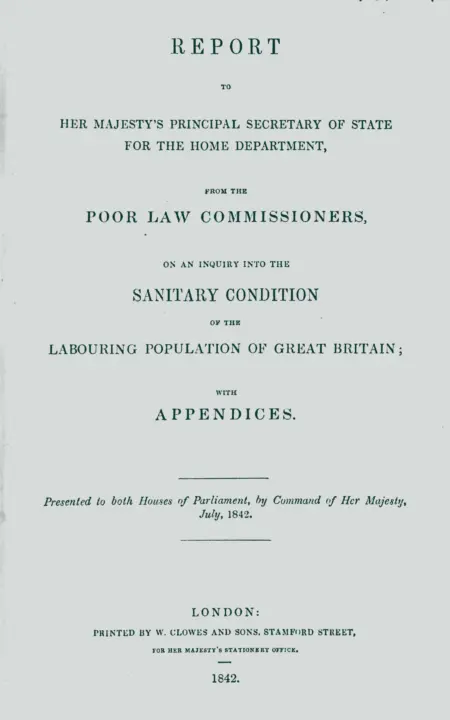
"Report to Her Majesty's Principal Secretary of State For the Home Department" by Edwin Chadwick is a scientific publication written in the early 19th century. This report addresses the sanitary conditions of the laboring population in Great Britain, focusing on the causes of disease and the potential improvements that could be made in their living conditions. It highlights the relationship between poverty, living conditions, and public health, aiming to provide evidence to support legislative reforms for the benefit of the working classes. At the start of the report, Edwin Chadwick outlines the context of a series of inquiries undertaken by the Poor Law Commissioners at the behest of Lord John Russell in 1839. These inquiries were prompted by the alarming prevalence of diseases among the laboring classes, particularly in urban areas. The text details the systematic approach taken to gather data from various unions, medical professionals, and local authorities regarding the living conditions and health impacts on the laboring population. The tone is formal, presenting preliminary statistics and testimonies about the dismal state of housing, hygiene, and public health, setting the stage for a thorough examination of the societal factors contributing to health disparities in Britain.
Introduction adapted from the source catalogue; source summaries may be automatically generated.
Free to read · English · 254,670 words · No account needed
MAKE TIME FOR A GOOD BOOK
On by default. Untick to stop anonymous reading totals. Each page counts after 10 seconds in view. How this works.
Anonymous counting is on unless you have switched it off.
Deterioration of the strength of the population by disease without diminishing its numbers 185
Increase of food or production concurrently with the increase of population 188
V. PECUNIARY BURDENS CREATED BY THE NEGLECT OF SANITARY MEASURES:— 188
Cost of remedies for sickness and of mortality which is preventible 188
Average ages of death of the heads of families of widows and orphans chargeable to the Manchester, Whitechapel, Bethnal Green, Strand, Oakham and Uppingham, Alston with Garrigill, and Bath unions 190
Table of the number of widows and dependent orphans chargeable in eight unions 191
Table of the chief cause of death producing widowhood and orphanage in eight unions 192
Detailed instances of the causes of widowhood and orphanage in Alston with Garrigill 193
Examples of the sanitary effects of superior care in the residences and the places of work of labourers—in the Reeth union, North York, 196; in Gwennap, Illogan, and Camborne, Cornwall, 198; in Great Bradford and Horton, West York 199
Comparison of a young population under favourable and a mature population under unfavourable circumstances 200
Effects of noxious physical agencies on the moral and intellectual condition of the working classes 202
Jurisprudential measures for the prevention of deaths from accidents 203
Cost of disease as compared with cost of prevention, instances of in Glasgow and Dundee 206
VI. EVIDENCE OF THE EFFECTS OF PREVENTIVE MEASURES IN RAISING THE STANDARD OF HEALTH AND THE CHANCES OF LIFE:— 211
Former health of gaols as compared with the present state 211
Effects of sanitary measures of prevention on the health of prisoners 214
Comparison of the experience of sickness amongst different classes of people 216
Amount of sickness experienced by the labouring classes 217
Defects of Insurance tables 218
Effects of sanitary measures in the prevention of disease in the army and navy 219
Cost to tenants and owners of the public measures for drainage, cleansing, and the supplies of water, as compared with the cost of sickness:— 222
Cost of measures of prevention as compared with the cost of sickness and mortality 222
Means of payment for improved accommodation 227
Impolicy of exemptions of tenements from proper charges 229
Injurious effects of exemptions of labourers’ tenements 230
Inability of workmen to improve their own condition 231
Necessity of extrinsic aid for the improvement of the condition of the working classes 232
Employers’ influence on the health of workpeople, by means of improved habitations:— 233
Advantages to labourers of holding tenements in connexion with their employments 233
Instance of a superior moral and sanitary condition enjoyed by workers in a cotton factory 236
Elevation of a manufacturing population by improvements in the condition of their dwellings 238
Most advantageous construction of manufactories for the health of the workpeople 240
The employers’ influence on the health of workpeople:— 245
By modes of payment which do not lead to temptations to intemperance 245
Your reading position is saved on this browser. Take it to another device with a library code. Reading pages adapt to text, rather than matching a printed edition.
BEHIND THE BOOK
This eBook is for the use of anyone anywhere in the United States and most other parts of the world at no cost and with almost no restrictions whatsoever. You may copy it, give it away or re-use it under the terms of the Project Gutenberg License included with this eBook or online at www.gutenberg.org. If you are not located in the United States, you will have to check the laws of the country where you are located before using this eBook. Read the source licence.
The original source file, including credits and licence, is retained by this library. Request an original-format copy at no charge. Please include the book title and Project Gutenberg identifier #65090.
KEEP YOUR CURIOSITY GOING
Cécile Tormay

Moritz Busch
John L. Ransom
Frances Wright
Cécile Tormay

Mabel Potter Daggett