THE CLASSIC COLLECTION✦An outlaw’s diary: the CommuneCLASSIC FREE BOOKS
An outlaw’s diary: the Commune
Cécile Tormay
THE CLASSIC COLLECTION · 1842
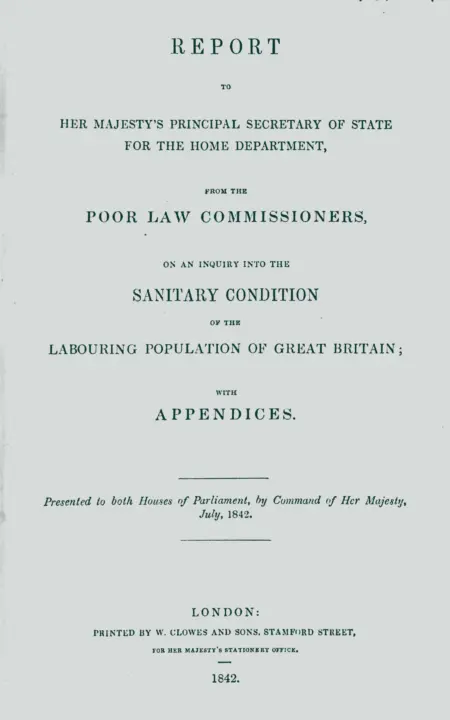
"Report to Her Majesty's Principal Secretary of State For the Home Department" by Edwin Chadwick is a scientific publication written in the early 19th century. This report addresses the sanitary conditions of the laboring population in Great Britain, focusing on the causes of disease and the potential improvements that could be made in their living conditions. It highlights the relationship between poverty, living conditions, and public health, aiming to provide evidence to support legislative reforms for the benefit of the working classes. At the start of the report, Edwin Chadwick outlines the context of a series of inquiries undertaken by the Poor Law Commissioners at the behest of Lord John Russell in 1839. These inquiries were prompted by the alarming prevalence of diseases among the laboring classes, particularly in urban areas. The text details the systematic approach taken to gather data from various unions, medical professionals, and local authorities regarding the living conditions and health impacts on the laboring population. The tone is formal, presenting preliminary statistics and testimonies about the dismal state of housing, hygiene, and public health, setting the stage for a thorough examination of the societal factors contributing to health disparities in Britain.
Introduction adapted from the source catalogue; source summaries may be automatically generated.
Free to read · English · 254,670 words · No account needed
MAKE TIME FOR A GOOD BOOK
On by default. Untick to stop anonymous reading totals. Each page counts after 10 seconds in view. How this works.
Anonymous counting is on unless you have switched it off.
By the promotion of personal cleanliness 253
By the ventilation of the places of work and the prevention of noxious fumes, dust, &c. 256
By promoting respectability in dress 261
Employers’ or owners’ influence in the improvement of habitations and sanitary arrangements for the protection of the labouring classes in the rural districts 261
Instances of, in the Bedford Union, 262; Stafford Union, 263, in Norfolk and Suffolk, 264; at Harlaxton, Lincolnshire, 266; at the Earl of Rosebery’s estate, Scotland, 266; at Closeburn, Dumfries, 266; Turton and Bollington, Lancashire, 267; Birmingham 267
Instances of the influence of the materials used in building upon the health of the inmates in Cheshire, Lancashire, Buckingham and Berkshire 267
Instances of efficient improvements in the detail of labourers’ dwellings in Scotland 270
Improvements proposed for the construction of the dwellings of the lower classes in towns 272
Effects of public walks and gardens on the health and morals of the lower classes of the population 275
VII. RECOGNISED PRINCIPLES OF LEGISLATION AND STATE OF THE EXISTING LAW FOR THE PROTECTION OF THE PUBLIC HEALTH:— 279
Necessity of legislative interference for the protection of the health of the population 279
Spread of old evils in unprotected new districts by inefficient legislation 280
Dangers of increased charges for inefficient sanitary measures shifting without improving the population 282
Expulsion of labourers from old tenements without providing appropriate new ones, not invariably beneficial 286
Advantages in the regulation of the sites of dwellings 287
General state of the law for the protection of the public health:— 288
Medical police in Germany 288
Existing laws for the protection of the public health in England 289
Early state of the law for the protection of the public health 291
State of the special authorities for reclaiming the execution of the laws for the protection of the public health:— 296
General desuetude of the laws for the protection of the public health 296
State of the administration of the laws for the protection of the public health, by court leets and local trusts 299
State of the local executive authorities for the erection and maintenance of drains and other works for the protection of the public health:— 302
State of the obstructions to land drainage and works of private profit redounding to the public health 302
Injuries to private property as well as to the public health, occasioned by defective administration 305
Continuance of the causes of disease in the face of representations of their effects on the population 307
Areas of jurisdiction for drainage inconsistent with efficient operations 309
Prevalent misconceptions as to the objects and state of management of existing sewerage 311
Objections made to the existing local administration of the sewers’ rate 315
Securities requisite to obviate opposition to new expenditure for sewerage 316
Necessity of the subordinate drainage of private tenements being comprehended as part of one system 319
Your reading position is saved on this browser. Take it to another device with a library code. Reading pages adapt to text, rather than matching a printed edition.
BEHIND THE BOOK
This eBook is for the use of anyone anywhere in the United States and most other parts of the world at no cost and with almost no restrictions whatsoever. You may copy it, give it away or re-use it under the terms of the Project Gutenberg License included with this eBook or online at www.gutenberg.org. If you are not located in the United States, you will have to check the laws of the country where you are located before using this eBook. Read the source licence.
The original source file, including credits and licence, is retained by this library. Request an original-format copy at no charge. Please include the book title and Project Gutenberg identifier #65090.
KEEP YOUR CURIOSITY GOING
Cécile Tormay

Moritz Busch
John L. Ransom
Frances Wright
Cécile Tormay

Mabel Potter Daggett