THE CLASSIC COLLECTION✦An outlaw’s diary: the CommuneCLASSIC FREE BOOKS
An outlaw’s diary: the Commune
Cécile Tormay
THE CLASSIC COLLECTION · 1842
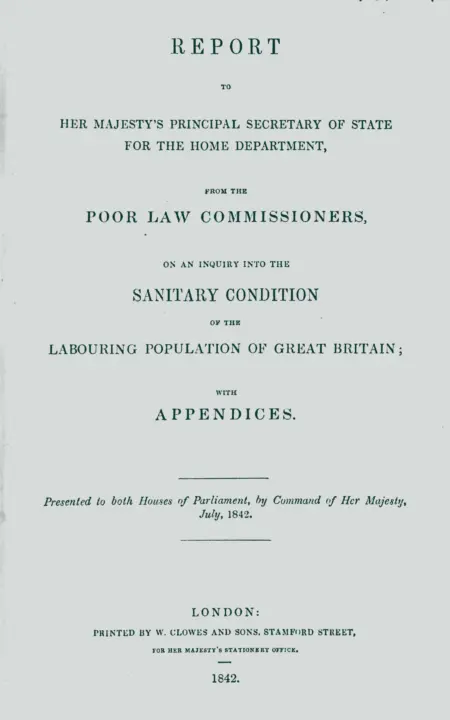
"Report to Her Majesty's Principal Secretary of State For the Home Department" by Edwin Chadwick is a scientific publication written in the early 19th century. This report addresses the sanitary conditions of the laboring population in Great Britain, focusing on the causes of disease and the potential improvements that could be made in their living conditions. It highlights the relationship between poverty, living conditions, and public health, aiming to provide evidence to support legislative reforms for the benefit of the working classes. At the start of the report, Edwin Chadwick outlines the context of a series of inquiries undertaken by the Poor Law Commissioners at the behest of Lord John Russell in 1839. These inquiries were prompted by the alarming prevalence of diseases among the laboring classes, particularly in urban areas. The text details the systematic approach taken to gather data from various unions, medical professionals, and local authorities regarding the living conditions and health impacts on the laboring population. The tone is formal, presenting preliminary statistics and testimonies about the dismal state of housing, hygiene, and public health, setting the stage for a thorough examination of the societal factors contributing to health disparities in Britain.
Introduction adapted from the source catalogue; source summaries may be automatically generated.
Free to read · English · 254,670 words · No account needed
MAKE TIME FOR A GOOD BOOK
On by default. Untick to stop anonymous reading totals. Each page counts after 10 seconds in view. How this works.
Anonymous counting is on unless you have switched it off.
Great apparent increase in the proportionate number of houses according to the last census attributable to a different mode of making the return 120
Instances of great overcrowding in cottages in—
Greenock, 121; Tranent, 121; Sleaford union 122
The want of separate apartments and overcrowding of private dwellings. 122
Effects of the overcrowding of private dwellings on the morals of the population, instances of, in—
The Ampthill union, 122; the Leighton Buzzard union, 123; the Bicester union, 123; the Romsey union, 123; among the border peasantry, 124; in Manchester, Liverpool, Ashton-under-Lyne, and Hull, 124; in Leeds, 126; in Nottingham, 126; in Clitheroe 126
Instances of the injurious influences of bad tenements upon the personal condition and moral habits of the inmates 128
Effects of noxious agencies in preventing frugality and promoting intemperance 129
In preventing the influence of education 132
Force of habits of intemperance in the use of spirituous liquors against all habits of decency, or frugality, or morality 133
Misconceptions as to casualties occurring among the indigent or profligate 134
Intemperance the cause of fever 136
Domestic mismanagement a predisposing cause of disease. 137
Mismanagement of earnings obstructive to the domestic
improvement of the sanitary condition of the labouring
classes.
Instances of in—
Derby, 137; Birmingham, 138; Manchester, 139; Preston union, 140; Ayr, 141; Tranent, 141; Dundee 142
Attacks of fever most frequent on workmen in full employment and ordinary health 145, 147
Irrelevancy of controversy on the generation of fever, in respect to practical means of prevention 148
Concurrence of medical opinions as to the most efficient means of preventing fever 150
IV. COMPARATIVE CHANCES OF LIFE IN DIFFERENT CLASSES OF THE COMMUNITY. 153
Instances of the comparative chances of life amongst the gentry, tradesmen, and working men—
In Truro, 154; in Derby, 155; in Manchester, 157; in Rutland, 157; in the Bolton union, 158; in Bethnal Green, 159; in Leeds Borough, 159; in Liverpool, 159; in the Whitechapel union, 160; in the Strand union, 160; in the Kensington union, 161; in Wiltshire, 161; in the Kendal union 161
Tabular views of the ages at which deaths have occurred in different classes of society 162
Comparative mortality of differently circumstanced districts of the metropolis 164
Comparative prevalence of fever in different districts of Leith 167
High mortality not essential to towns 167
Comparative mortality in three classes of the community at Bath 168
Corroborative experience from Paris as to the influence of local circumstances on mortality 170
Improvements in the health of large towns chiefly confined to improved districts 171
Instance of progressive improvement in the social condition of the population concurrently with its increase in numbers 175
Prevalence of disease no evidence of the pressure of population on food 177
Variations of the proportion of deaths and births in different districts of the same town 178
Proportion of births to the population greatest where there is the greatest mortality 179
Proof that pestilence or excessive mortality does not diminish population 182
Numbers merely not the test of strength or prosperity of a community 185
Your reading position is saved on this browser. Take it to another device with a library code. Reading pages adapt to text, rather than matching a printed edition.
BEHIND THE BOOK
This eBook is for the use of anyone anywhere in the United States and most other parts of the world at no cost and with almost no restrictions whatsoever. You may copy it, give it away or re-use it under the terms of the Project Gutenberg License included with this eBook or online at www.gutenberg.org. If you are not located in the United States, you will have to check the laws of the country where you are located before using this eBook. Read the source licence.
The original source file, including credits and licence, is retained by this library. Request an original-format copy at no charge. Please include the book title and Project Gutenberg identifier #65090.
KEEP YOUR CURIOSITY GOING
Cécile Tormay

Moritz Busch
John L. Ransom
Frances Wright
Cécile Tormay

Mabel Potter Daggett