
Last letters from the living dead man
David Patterson (Spirit) Hatch
THE CLASSIC COLLECTION · 1759
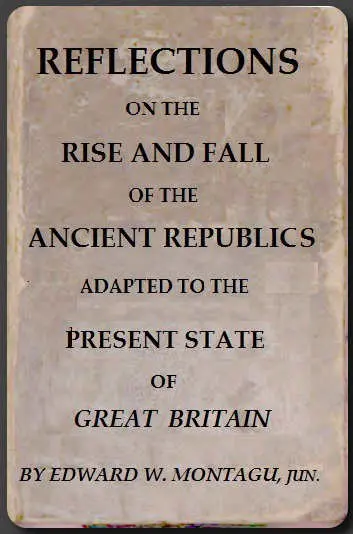
"Reflections on the Rise and Fall of the Ancient Republicks" by Edward W. Montagu is a historical account written in the early 19th century. The work examines the ancient republics such as Sparta, Athens, and Rome, drawing lessons that relate to the political climate of Great Britain at the time. Montagu aims to explore the factors that contributed to the rise and decline of these states, suggesting that contemporary issues in Britain resonate with those of the past. The opening portion of the book sets the stage for Montagu's exploration by introducing the historical context of various republics, particularly focusing on the governance of Sparta under Lycurgus. It discusses how Lycurgus addressed the deep-rooted issues of civil strife and inequality in Spartan society, ultimately leading to his significant reforms that promoted equality and a strong sense of civic duty among citizens. Montagu emphasizes the importance of unity and public virtue to maintain a free state, warning against the disunity that plagued ancient republics as a precursor to their downfall. The narrative establishes a foundation for Montagu's reflections, highlighting the dangers of neglecting the lessons of history in the face of contemporary political turmoil.
Introduction adapted from the source catalogue; source summaries may be automatically generated.
Free to read · English · 84,030 words · No account needed
MAKE TIME FOR A GOOD BOOK
On by default. Untick to stop anonymous reading totals. Each page counts after 10 seconds in view. How this works.
Anonymous counting is on unless you have switched it off.
The learned, I know, are not a little divided in their opinions about Epicurus. But a disquisition into what were, or were not the real tenets of that philosopher, would be wholly foreign to my purpose. By the doctrine of the Epicureans, I mean that system which Lucretius has dressed up in his poem with all the beauties of poetry, and all the elegance of diction. This, like the rest of the atheistick systems, which are attributed to most of the Grecian philosophers, is pregnant with the wildest absurdities that ever entered into the human imagination. Epicurus, if Lucretius has given us his genuine tenets, ascribes the formation of the universe to the fortuitous concourse of senseless atoms of matter.[314] His master, Democritus, from whom he borrowed his system, asserts the same. But Epicurus has exceeded him in absurdity. For Democritus, if we may credit Plutarch, endowed his atoms with a certain living-intelligence, which Epicurus scorns to make use of. He boldly deduces life, intelligence, and free-will itself, from the direct, oblique, and other various motions of his inanimate atoms. He admits a sort of insignificant beings, whom he terms gods; but as he would not allow them to have any hand in the formation of his universe, so neither will he suffer them to have the least share in the conduct of it. He has showed them plainly, that he could do without them, and, as he has made them so egregiously insignificant as to be able to do neither good nor harm, he has packed them off at a distance, to live an indolent, lazy life, and to divert themselves just as they think proper. Thus he has got rid of the troublesome doctrine of a divine superintending Providence. Sometimes he forgets himself, and seems to deny their very existence. For he tells us in one place, that the whole universe contains nothing but matter and empty space, or what arises from the casual concurrence of these two principles:[315] consequently that no third nature, different from these two, can possibly be proved to exist either by the cognizance of our senses, or by the utmost efforts of our reasoning faculty. He teaches, that the soul is composed of the finest, and most subtile atoms, consequently discerptible and mortal. That the identity of man consists in the union of these finer corpuscles with the grosser ones, which compose the body. That, at their disunion by death, the soul evaporates, and is dissipated in the upper regions, from whence it first distilled, and the same man exists no more.[316] Nay he is so amazingly absurd as to assert, that if the soul,[317] after its separation, should still retain its consciousness, and, after a length of time, by some lucky jumble of his atoms, should happen to animate another body, this new compound would be quite a different man: consequently, that this new man would be no more interested in the actions of the former, than the former would be responsible for the behaviour of the latter, or for that of any future man, who might happen hereafter to be produced by another casual assemblage of the atoms of the same soul, united to those of another body. This doctrine is plainly stolen from the Pythagorean system of the transmigration of souls; but mutilated, and miserably perverted to the purposes of atheism. The absurdities in this wild philosophy are so self-evident, that to attempt a refutation of them, would be an affront to common sense. Yet, from this source, these philosophers draw their pretended consolations against the fear of death. That at death the identity of the man absolutely ceases, and we totally lose our existence.[318] Yet, from these excellent comforters, our modern scepticks have revived their senseless tenet of annihilation to serve the cause of libertinism. The grand desideratum, in libertinism, is, to be able to give an unbounded loose to the sensual passions, to their very utmost extent, without any impertinent hints from a certain disagreeable monitor, called conscience, and the dread of an after-reckoning. Now as both these terrors are removed by this system of annihilation, it is no wonder that libertines, who abound in a corrupt licentious age, should fly eagerly to so comfortable a doctrine, which at once silences those enemies to their pleasures. This is the creed introduced by the sect of Epicurus amongst the Romans, which easily accounts for that sudden, and universal revolution in their manners. For manners can never be so effectually, and so speedily depraved, as by a total extinction of all religious principle; and all religious principle must be necessarily subverted wherever this doctrine of annihilation is received.[319] I allow that Lucretius gives us some excellent maxims from Epicurus, and inveighs in many places against the vices of his countrymen. But the cheat is too gross and palpable, and only proves, that he has gilt over the pill of atheism to make it go down more smoothly.[320] For how can a superstructure stand when the foundation is taken away; and of what service is the best system of morality when the sanction of future rewards and punishments, the great motive which should enforce the practice, is removed by the denial of a Providence, and the doctrine of annihilation? Cicero informs us, that all the fine things, which Epicurus asserts of the existence of his gods, and their excellent nature, are mere grimace, and only thrown out to screen him from censure.[321] For he could not be ignorant, that the laws of his country punished every man with the utmost severity, who struck at that fundamental principle of all religion, the existence of a Deity. Cicero therefore, who had thoroughly examined his tenets, affirms him, by his own principles, to have been a downright atheist.[322] For in reality, a man who should assert the existence of such idle gods, as are neither capable of doing good or hurt, must, if he expects to be believed, be a greater fool than the man, “who says in his heart there is no God at all.” Yet this strange system, though fraught with such absurdities and contradictions as could scarce be palmed upon the genius of a Hottentot, has been implicitly swallowed by too many of those gentlemen, who affect to call themselves the esprits forts of the present age. These are the atheistical tenets of Epicurus, preserved by Lucretius in his beautiful poem, which, like poison, conveyed in sweets, please and murder at the same time.
Your reading position is saved on this browser. Take it to another device with a library code. Reading pages adapt to text, rather than matching a printed edition.
BEHIND THE BOOK
This eBook is for the use of anyone anywhere in the United States and most other parts of the world at no cost and with almost no restrictions whatsoever. You may copy it, give it away or re-use it under the terms of the Project Gutenberg License included with this eBook or online at www.gutenberg.org. If you are not located in the United States, you will have to check the laws of the country where you are located before using this eBook. Read the source licence.
The original source file, including credits and licence, is retained by this library. Request an original-format copy at no charge. Please include the book title and Project Gutenberg identifier #45592.
KEEP YOUR CURIOSITY GOING
David Patterson (Spirit) Hatch
Cécile Tormay

Moritz Busch
Coulson Kernahan
John L. Ransom

Ralph Waldo Emerson