
Last letters from the living dead man
David Patterson (Spirit) Hatch
THE CLASSIC COLLECTION · 1759
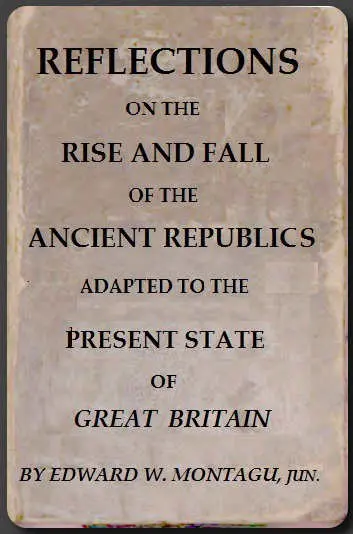
"Reflections on the Rise and Fall of the Ancient Republicks" by Edward W. Montagu is a historical account written in the early 19th century. The work examines the ancient republics such as Sparta, Athens, and Rome, drawing lessons that relate to the political climate of Great Britain at the time. Montagu aims to explore the factors that contributed to the rise and decline of these states, suggesting that contemporary issues in Britain resonate with those of the past. The opening portion of the book sets the stage for Montagu's exploration by introducing the historical context of various republics, particularly focusing on the governance of Sparta under Lycurgus. It discusses how Lycurgus addressed the deep-rooted issues of civil strife and inequality in Spartan society, ultimately leading to his significant reforms that promoted equality and a strong sense of civic duty among citizens. Montagu emphasizes the importance of unity and public virtue to maintain a free state, warning against the disunity that plagued ancient republics as a precursor to their downfall. The narrative establishes a foundation for Montagu's reflections, highlighting the dangers of neglecting the lessons of history in the face of contemporary political turmoil.
Introduction adapted from the source catalogue; source summaries may be automatically generated.
Free to read · English · 84,030 words · No account needed
MAKE TIME FOR A GOOD BOOK
On by default. Untick to stop anonymous reading totals. Each page counts after 10 seconds in view. How this works.
Anonymous counting is on unless you have switched it off.
The Romans founded their system of policy, at the very origin of their state, upon that best and wisest principle, “the fear of the gods, a firm belief of a divine superintending providence, and a future state of rewards and punishments:” their children were trained up in this belief from tender infancy, which took root and grew up with them by the influence of an excellent education, where they had the benefit of example as well as precept.[305] Hence we read of no heathen nation in the world, where both the publick and private duties of religion were so strictly adhered to, and so scrupulously observed as amongst the Romans. They imputed their good or bad success to their observance of these duties, and they received publick prosperities or publick calamities, as blessings conferred, or punishments inflicted by their gods. Their historians hardly ever give us an account of any defeat received by that people,[306] which they do not ascribe to the omission, or contempt of some religious ceremony by their generals. For though the ceremonies there mentioned, justly appear to us instances of the most absurd, and most extravagant superstition, yet as they were esteemed essential acts of religion by the Romans, they must consequently carry all the force of religious principle. We neither exceeded, says Cicero,[307] speaking of his countrymen, the Spaniards in number, nor did we excel the Gauls in strength of body, nor the Carthaginians in craft, nor the Greeks in arts or sciences. But we have indisputably surpassed all the nations in the universe in piety and attachment to religion,[308] and in the only point, which can be called true wisdom, a thorough conviction, that all things here below are directed, and governed by divine providence. To this principle alone Cicero wisely attributes the grandeur and good fortune of his country. For what man is there, says he, who is convinced of the existence of the gods, but must be convinced at the same time, that our mighty empire owes its origin,[309] its increase, and its preservation, to the protecting care of their divine providence. A plain proof that these continued to be the real sentiments of the wiser Romans, even in the corrupt times of Cicero. From this principle proceeded that respect for, and submission to their laws, and that temperance, moderation, and contempt for wealth, which are the best defence against the encroachments of injustice and oppression. Hence too arose that inextinguishable love for their country, which, next to the gods, they looked upon as the chief object of veneration. This they carried to such a height of enthusiasm,[310] as to make every human tie of social love, natural affection, and self-preservation give way to this duty to their dearer country. Because they not only loved their country as their common mother, but revered it as a place which was dear to their gods; which they had destined to give laws to the rest of the universe,[311] and consequently favoured with their peculiar care and protection. Hence proceeded that obstinate and undaunted courage, that insuperable contempt of danger, and death itself in defence of their country, which complete the idea of the Roman character as it is drawn by historians in the virtuous ages of the republick. As long as the manners of the Romans were regulated by this first great principle of religion, they were free and invincible. But the atheistical doctrine of Epicurus,[312] which insinuated itself at Rome, under the respectable name of philosophy, after their acquaintance with the Greeks, undermined and destroyed this ruling principle. I allow that luxury, by corrupting manners, had weakened this principle, and prepared the Romans for the reception of atheism, which is the never-failing attendant of luxury. But as long as this principle remained, it controlled manners, and checked the progress of luxury in proportion to its influence. But when the introduction of atheism had destroyed this principle, the great bar to corruption was removed, and the passions at once let loose to run their full career without check, or control. The introduction therefore of the atheistical tenets attributed to Epicurus,[313] was the real cause of that rapid depravity of the Roman manners, which has never been satisfactorily accounted for, either by Sallust, or any other historians.
Your reading position is saved on this browser. Take it to another device with a library code. Reading pages adapt to text, rather than matching a printed edition.
BEHIND THE BOOK
This eBook is for the use of anyone anywhere in the United States and most other parts of the world at no cost and with almost no restrictions whatsoever. You may copy it, give it away or re-use it under the terms of the Project Gutenberg License included with this eBook or online at www.gutenberg.org. If you are not located in the United States, you will have to check the laws of the country where you are located before using this eBook. Read the source licence.
The original source file, including credits and licence, is retained by this library. Request an original-format copy at no charge. Please include the book title and Project Gutenberg identifier #45592.
KEEP YOUR CURIOSITY GOING
David Patterson (Spirit) Hatch
Cécile Tormay

Moritz Busch
Coulson Kernahan
John L. Ransom

Ralph Waldo Emerson