
Last letters from the living dead man
David Patterson (Spirit) Hatch
THE CLASSIC COLLECTION · 1759
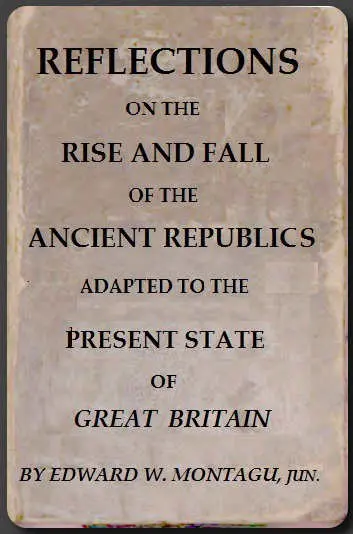
"Reflections on the Rise and Fall of the Ancient Republicks" by Edward W. Montagu is a historical account written in the early 19th century. The work examines the ancient republics such as Sparta, Athens, and Rome, drawing lessons that relate to the political climate of Great Britain at the time. Montagu aims to explore the factors that contributed to the rise and decline of these states, suggesting that contemporary issues in Britain resonate with those of the past. The opening portion of the book sets the stage for Montagu's exploration by introducing the historical context of various republics, particularly focusing on the governance of Sparta under Lycurgus. It discusses how Lycurgus addressed the deep-rooted issues of civil strife and inequality in Spartan society, ultimately leading to his significant reforms that promoted equality and a strong sense of civic duty among citizens. Montagu emphasizes the importance of unity and public virtue to maintain a free state, warning against the disunity that plagued ancient republics as a precursor to their downfall. The narrative establishes a foundation for Montagu's reflections, highlighting the dangers of neglecting the lessons of history in the face of contemporary political turmoil.
Introduction adapted from the source catalogue; source summaries may be automatically generated.
Free to read · English · 84,030 words · No account needed
MAKE TIME FOR A GOOD BOOK
On by default. Untick to stop anonymous reading totals. Each page counts after 10 seconds in view. How this works.
Anonymous counting is on unless you have switched it off.
The Greeks were early infected with this execrable doctrine, and shew the effect it had upon their manners by their violation of publick faith, and contempt for the most sacred ties of religion. Trust, says Polybius, but a single talent to a Greek, who has been used to finger the publick money, and though you have the security of ten counterparts, drawn up by as many publick notaries, backed by as many seals, and the testimony of twice as many witnesses, yet, with all these precautions, you cannot possibly prevent him from proving a rogue.[323] Whilst the Romans, who, by their various offices, are intrusted with large sums of publick money, pay so conscientious a regard to the religion of their office-oath, that they were never known to violate their faith, though restrained only by that single tie. How greatly they deviated from this rectitude of manners, after these infidel tenets had taken root amongst them, we may learn from Cicero, in his orations and epistles. Sallust too will inform us, how extremely common the crime of perjury was grown, in that severe reproach, which Lucius Philippus, a patrician, makes to Lepidus, the consul, before the whole senate. That he neither stood in awe of men or gods, whom he had so frequently injured, and defied by his villanies and perjuries.[324]
Polybius gives it as his real opinion, that nothing shows the superior excellence of the civil government of the Romans, to that of other people, so much as those religious sentiments with respect to their gods, which they constantly inculcated and supported.[325] He affirms too his real sentiments to be, that the chief support and preservation of the Roman republick arose from that awful fear of the gods, which was so much ridiculed, and exploded by the Grecians. I have taken the liberty to render τοῖς ἄλλοις ἀνθρώποις, the Grecians, who are evidently pointed at in this passage.[326] For so just and accurate a writer as Polybius could not be ignorant, that the Grecians were the only people in the world at that time, who had been debauched into atheism by the pernicious tenets of Epicurus. Polybius firmly believed the existence of a Deity, and the interposition of a divine superintending Providence, though he was an enemy to superstition. Yet when he observed the good effects produced amongst the Romans by their religion,[327] though carried even to the highest possible degree of superstition, and the remarkable influence it had upon their manners in private life, as well as upon their publick counsels, he concludes it to be[328] the result of a wise, and consummate policy in the ancient legislators. He therefore very justly censures those as wrong-headed, and wretchedly bungling politicians, who at that time endeavoured to eradicate the fear of an after-reckoning, and the terrors of an hell, out of the minds of a people. Yet how few years ago did we see this miserably mistaken policy prevail in our own country, during the whole administration of some late power-engrossing ministers. Compelled at all events to secure a majority in parliament to support themselves against the efforts of opposition, they found the greatest obstacle to their schemes arise from those principles of religion, which yet remained amongst the people. For though a great number of the electors were not at all averse to the bribe, yet their consciences were too tender to digest perjury. To remove this troublesome test at elections, which is one of the bulwarks of our constitution, would be impracticable. To weaken or destroy those principles, upon which the oath was founded, and from which it derived its force and obligation, would equally answer the purpose, and destroy all publick virtue at the same time. The bloody and deep felt effects of that hypocrisy, which prevailed in the time of Cromwell, had driven great numbers of the sufferers into the contrary extreme. When therefore so great a part of the nation was already prejudiced against whatever carried the appearance of a stricter piety, it is no wonder that shallow superficial reasoners, who have not logick enough to distinguish between the use and abuse of a thing, should readily embrace those atheistical tenets, which were imported, and took root in the voluptuous, and thoughtless reign of Charles the second. But that solid learning, which revived after the restoration, easily baffled the efforts of open and avowed atheism, which from that time has taken shelter under the less obnoxious name of deism. For the principles of modern deism, when stript of that disguise which has been artfully thrown over them, to deceive those who hate the fatigue of thinking, and are ever ready to admit any conclusion in argument, which is agreeable to their passions, without examining the premises, are in reality the same with those of Epicurus, as transmitted to us by Lucretius. The influence therefore, which they had upon the manners of the Greeks and Romans, will readily account for those effects which we experience from them in our own country, where they so fatally prevail. To patronise and propagate their principles, was the best expedient which the narrow selfish policy of those ministers could suggest. For their greatest extent of genius never reached higher, than a fertility in temporary shifts and expedients, to stave off the evil day of national account, which they so much dreaded. They were sensible that the wealth and luxury, which are the general effects of an extensive trade in a state of profound peace, had already greatly hurt the morals of the people, and smoothed the way for their grand system of corruption. Far from checking this licentious spirit of luxury and dissipation, they left it to its full and natural effects upon the manners, whilst, in order to corrupt the principles of the people, they retained, at the publick expense, a venal set of the most shameless miscreants that ever abused the liberty of the press, or insulted the religion of their country. To the administration of such ministers, which may justly be termed the grand æra of corruption, we owe that fatal system of bribery, which has so greatly affected the morals of the electors in almost every borough in the kingdom. To that too we may justly attribute the present contempt, and disregard of the sacred obligation of an oath, which is the strongest bond of society, and the best security and support of civil government.
Your reading position is saved on this browser. Take it to another device with a library code. Reading pages adapt to text, rather than matching a printed edition.
BEHIND THE BOOK
This eBook is for the use of anyone anywhere in the United States and most other parts of the world at no cost and with almost no restrictions whatsoever. You may copy it, give it away or re-use it under the terms of the Project Gutenberg License included with this eBook or online at www.gutenberg.org. If you are not located in the United States, you will have to check the laws of the country where you are located before using this eBook. Read the source licence.
The original source file, including credits and licence, is retained by this library. Request an original-format copy at no charge. Please include the book title and Project Gutenberg identifier #45592.
KEEP YOUR CURIOSITY GOING
David Patterson (Spirit) Hatch
Cécile Tormay

Moritz Busch
Coulson Kernahan
John L. Ransom

Ralph Waldo Emerson