Confessions of the Czarina
Catherine, Princess Radziwill
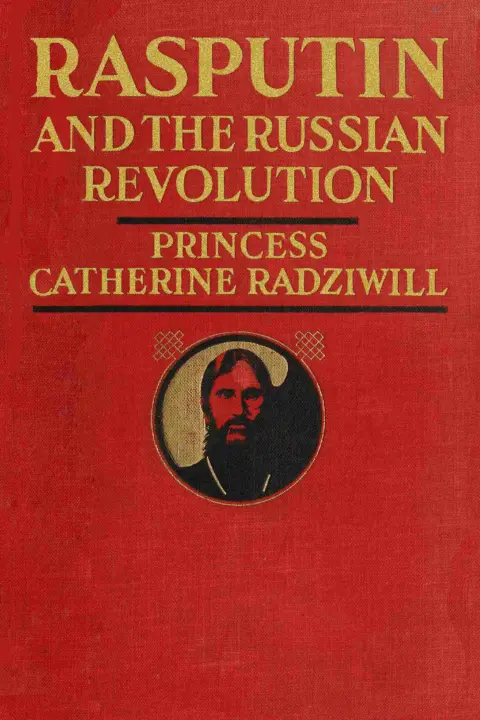
THE CLASSIC COLLECTION · 1917
"Rasputin and the Russian Revolution" by Princess Catherine Radziwill is a historical account written in the early 20th century. This work delves into the life and influence of Gregory Rasputin, a controversial figure at the Russian court, examining his role in the events leading up to the Russian Revolution. The narrative aims to demystify Rasputin and provide insights into the political and personal dynamics that contributed to the fall of the Romanoff dynasty, particularly highlighting the Empress Alexandra's connections to him. The opening of the book sets the stage for a detailed exploration of Rasputin's life, his rise to power, and the misconceptions surrounding his influence within the Russian Empire. The author introduces the context of Rasputin's emergence during a time of social and political upheaval, detailing how he captively drew in various members of society—from nobility to the impoverished—under the guise of a mystic and healer. Princess Radziwill emphasizes the many exaggerated tales and public perceptions of Rasputin, contrasting them with the more mundane reality of his ambitious pursuits and the manipulative dynamics involving the Empress and other court figures. This groundwork hints at a complex relationship between personal power, political intrigue, and the eventual revolution that would shake Russia to its core.
Introduction adapted from the source catalogue; source summaries may be automatically generated.
Free to read · English · 83,465 words · No account needed
MAKE TIME FOR A GOOD BOOK
On by default. Untick to stop anonymous reading totals. Each page counts after 10 seconds in view. How this works.
Anonymous counting is on unless you have switched it off.
Another misfortune connected with the government that replaced that of Nicholas II. was that it failed to recognise the terrible German propaganda that was carried on with renewed energy in Russia after the Revolution. It would not believe in its danger, and it could not bring itself to employ violence to put an end to the Socialist or, rather, anarchist agitation fomented by German intrigues and kept up by German money, which alone has rendered possible the triumph of Bolschevikism and the seizure of supreme power by people such as Lenine, Trotzky, Kameneff, and other personalities of the same kind, and the same doubtful or, rather, not doubtful reputation.
And yet it would have been relatively easy to put an end to the career of these men, had one only applied oneself to do so in time and bravely faced the criticisms of the people who were in their pay, or in their employ. The whole story of the Lenine-Trotzky intrigue has not yet been told, at least not here in America; and it may not be without interest to disclose some of its details. When Milyukoff and Prince Lvoff proceeded to form a government after the overthrow of the Monarchy, they offered the portfolio of Justice to a Moscow lawyer called Karensky (nothing to do with Alexander Kerensky) who enjoyed the reputation of being one of the most eloquent, and, at the same time, honest members of the Moscow Bar. They called him to Petrograd, where they held several consultations with him. Karensky declared himself ready to accept the position offered him, but only on one condition: that he would be given an absolutely free hand to proceed with the greatest energy and vigour against all the German spies and agents with which the Capital was infested, and that he would also be allowed the same free hand in his dealings with the anarchists who were beginning to make themselves heard. Neither Prince Lvoff nor Milyukoff would agree to give him these powers he demanded. They feared that if they did so they would be reproached for doing exactly the same as the government that had crumbled down a few days before; and they also objected to allowing a member of the cabinet to dispose at his will and fancy of such grave questions as those involved in repression exercised against any political party, no matter of what shade or opinion. Karensky thereupon refused the position offered to him, but accepted the post of State Prosecutor under Alexander Kerensky at first, and, afterwards, when the latter had been transferred to the war office, under Mr. Pereviazeff. This allowed him to watch the growing German agitation, connected with anarchist conspiracies, which was beginning to feel its way previous to its explosion. He had heard about Lenine and Trotzky, and was from the first convinced that they were both in the employ of the Kaiser either directly or indirectly, and he set himself to obtain proof that such was the case. He had wondered at the easiness with which Lenine had been able to obtain a passport from the German government authorising him to cross the dominions of William II. on his way from Switzerland to Russia. He, therefore, had the correspondence of both Lenine and Trotzky watched, and very soon his attention was attracted by the fact that they were both sending and receiving constantly telegrams to and from Sweden and Finland, all of which were deeply concerned with the health of a certain “Kola” who seemed to be always getting ill, and then better, in a sort of regular way which appeared more than strange. This was the first remark which led to the result that at last, it was established, to the absolute satisfaction of Karensky and of others, that Trotzky, Lenine, Kameneff, a certain Zinovieff, a lawyer called Kozlovsky, a lady going by the name of Madame Soumentay, and the wife of Lenine, had received not less than nineteen millions of rubles from the German government. This money had been sent through so many different channels that it was next to impossible to discover its origin. It had passed through eight banks, and, I do not now remember, through how many private hands. But the people whose names I have just mentioned had received it, partly in Russian banknotes, and partly in banknotes printed in Berlin, which were supposed to be Russian, of a new type with which the German government was beginning to meet its obligations so as not to make them too heavy for its own Exchequer.
Your reading position is saved on this browser. Take it to another device with a library code. Reading pages adapt to text, rather than matching a printed edition.
Catherine, Princess Radziwill
BEHIND THE BOOK
This eBook is for the use of anyone anywhere in the United States and most other parts of the world at no cost and with almost no restrictions whatsoever. You may copy it, give it away or re-use it under the terms of the Project Gutenberg License included with this eBook or online at www.gutenberg.org. If you are not located in the United States, you will have to check the laws of the country where you are located before using this eBook. Read the source licence.
The original source file, including credits and licence, is retained by this library. Request an original-format copy at no charge. Please include the book title and Project Gutenberg identifier #66358.
KEEP YOUR CURIOSITY GOING
Cécile Tormay

Moritz Busch
John L. Ransom
Frances Wright
Cécile Tormay

Mabel Potter Daggett