Confessions of the Czarina
Catherine, Princess Radziwill
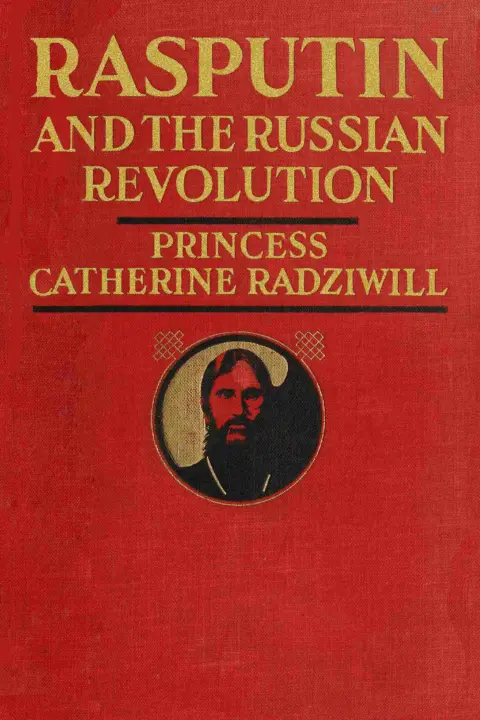
THE CLASSIC COLLECTION · 1917
"Rasputin and the Russian Revolution" by Princess Catherine Radziwill is a historical account written in the early 20th century. This work delves into the life and influence of Gregory Rasputin, a controversial figure at the Russian court, examining his role in the events leading up to the Russian Revolution. The narrative aims to demystify Rasputin and provide insights into the political and personal dynamics that contributed to the fall of the Romanoff dynasty, particularly highlighting the Empress Alexandra's connections to him. The opening of the book sets the stage for a detailed exploration of Rasputin's life, his rise to power, and the misconceptions surrounding his influence within the Russian Empire. The author introduces the context of Rasputin's emergence during a time of social and political upheaval, detailing how he captively drew in various members of society—from nobility to the impoverished—under the guise of a mystic and healer. Princess Radziwill emphasizes the many exaggerated tales and public perceptions of Rasputin, contrasting them with the more mundane reality of his ambitious pursuits and the manipulative dynamics involving the Empress and other court figures. This groundwork hints at a complex relationship between personal power, political intrigue, and the eventual revolution that would shake Russia to its core.
Introduction adapted from the source catalogue; source summaries may be automatically generated.
Free to read · English · 83,465 words · No account needed
MAKE TIME FOR A GOOD BOOK
On by default. Untick to stop anonymous reading totals. Each page counts after 10 seconds in view. How this works.
Anonymous counting is on unless you have switched it off.
In one of her letters addressed to her daughter Marie Antoinette, the Empress Marie Therese wrote: “I am glad to hear that you have decided to re-establish the old etiquette and representation of Versailles. However tiresome it may be, its inconveniences are still far less than those which arise out of its absence. A Court must learn to know well its sovereigns.” These words of a woman who knew better than any other queen had ever known how to uphold the prestige of her crown, ought to have been remembered by the Czar Nicholas II., because it is an undoubted fact that the custom which was established during his reign to keep the Emperor and his family isolated from the nation over which he ruled, had a good deal to do with the change that established itself gradually in the ideas of the people, as well as in the minds of the aristocracy, in regard to the reigning house. One forgot that there existed in Russia an Emperor, and one only remembered the manifold abuses which were the consequence of the detestable government to which the nation was subjected. All the personal ties that might have bound the monarch with those who could in an emergency have defended him against danger, had been snapped asunder by that monarch himself. St. Petersburg, which formerly (I have now in mind only the upper classes) had converged towards the sun represented by the Imperial Palace and its inhabitants, learned how to do without it, and it was no longer considered to be an honour to have relations, no matter of what nature, with any member of the House of Romanoff. The Imperial Family, in imitation of the conduct pursued by its Chief, seemed as if it wished to efface itself and to lead the existence of common mortals, which it did not succeed in doing, because it had been brought up too far from the world in general, represented by that portion of humanity which suffers and which works in silence, to be able to enter into its interests, and to make them its own. On the other hand that same family gave the first signal of rebellion against the system represented by the masters of the Palace of Tsarskoie Selo, whom it applied itself to discredit with an energy which was the more tenacious that it would have liked to be in their place. The Grand Duchess Vladimir, especially, together with her two sons, who had never cared for the Head of their dynasty, were the first ones to greet in their house all the discontented people who abounded in the Russian capital, and to deplore in their presence the scandal occasioned by the strange conduct of the Empress. The Revolution which was to come later on was prepared silently in the palaces of the very persons who ought to have fought against it, as well as in the homes of those old servants of the monarchy, who would have wished to save it from the disaster, which they saw but too well, was fast overtaking it, but who had to own themselves powerless to do so, and had to acknowledge with sorrow and with shame that it was discrediting itself a little more with each day that was passing. The nation, on its side, was preparing itself for the impending struggle. The systematic manner in which the labour party in Russia organised itself in view of the approaching Revolution, has never been sufficiently known or appreciated abroad. It has constituted for those who have followed the slow evolution which was the consequence of the premature revolutionary movement that had failed in 1905, one of the most interesting political problems of the twentieth century. I have lived in Russia during the years which have immediately preceded the war, and I have been in personal relations with some of the leaders of this party. I can therefore write about it from the point of view of a witness eager to watch the slow transformation, which out of a party essentially violent in its view and aspirations had produced a political faction, sufficiently ripened and saddened by the unsuccesses of its first fight not to seek elsewhere than in a too rapid solution the end of the difficulties under which it had been condemned to develop itself. It was quite sufficient to have witnessed the manifestations that used to take place each first of May, to come to the conclusion that the workman who was walking the streets, singing and carrying revolutionary flags, in 1906, was quite a different man from the one who indulged in manifestations of the like kind in 1913 and 1914. The general strike which preceded the war by a few weeks upon which the Germans founded so many useless hopes was, notwithstanding its revolutionary character, rather an expression of opinion on the part of a powerful and perfectly well organised party than a rebellion against authority. The workman had at last realised that he had got the future for him, provided he did not allow his natural impatience to carry him too far, and that he could resist the temptation to proceed too quickly with the plans which he had formed. He had also realised another thing, and that was that neither the liberals nor the octobrists, nor the party called that of the cadets, nor even the revolutionary socialists, were strong enough to constitute a government, and that all the plans they were continually talking about, would only end in speeches more or less empty and devoid of practical common sense. The workman applied himself to avoid mistakes, which perhaps he had noticed before he had quite grasped their importance. He understood on the other hand perfectly well the fact that the immense industrial movement, which had developed itself during the years that had followed immediately upon the war with Japan, was bound to increase still further in importance, and that the future belonged to those who would be able to profit by it, to guide it, and to direct it in the sense of a great and general reform of the different abuses which had corrupted all the higher classes of the nation. The number of factories which suddenly arose everywhere, the speculation that followed upon the rise in the value of all kinds of industrial securities, and the knowledge that the workman very quickly acquired as to the different means thanks to which the fortunes of so many people come, no one knew from whence, had been edified, gave him a strength which became the more formidable that he was compelled to remain silent in presence of so many spectacles that revolted his sense of integrity. In regard to this particular point, the impossibility to hold public meetings proved a blessing in disguise for the development of the activity of the labour party, because it allowed it to proceed in secret to a propaganda that became the more dangerous for the security of the government in that there existed no one able to point out to those among whom it flourished its perilous, and even to a certain extent, its disastrous sides. Under the very eyes of the police, the mass of the workmen employed in the different factories scattered all over Petrograd, prepared itself for the mission which it felt but too well was bound sooner or later to devolve upon it; so that whenever it allowed its voice to be heard, it was always with prudence, and even with a certain amount of cautious wisdom that prevented the general public and the authorities noticing how strong and powerful it was getting, and what a wonderful instrument it would prove later on, in the hands of those who in the meanwhile were leading it in secret, until the day when, thanks to their help, it would be able in its turn to lead others.
Your reading position is saved on this browser. Take it to another device with a library code. Reading pages adapt to text, rather than matching a printed edition.
Catherine, Princess Radziwill
BEHIND THE BOOK
This eBook is for the use of anyone anywhere in the United States and most other parts of the world at no cost and with almost no restrictions whatsoever. You may copy it, give it away or re-use it under the terms of the Project Gutenberg License included with this eBook or online at www.gutenberg.org. If you are not located in the United States, you will have to check the laws of the country where you are located before using this eBook. Read the source licence.
The original source file, including credits and licence, is retained by this library. Request an original-format copy at no charge. Please include the book title and Project Gutenberg identifier #66358.
KEEP YOUR CURIOSITY GOING
Cécile Tormay

Moritz Busch
John L. Ransom
Frances Wright
Cécile Tormay

Mabel Potter Daggett