
Confessions of the Czarina
Catherine, Princess Radziwill
THE CLASSIC COLLECTION · 1917
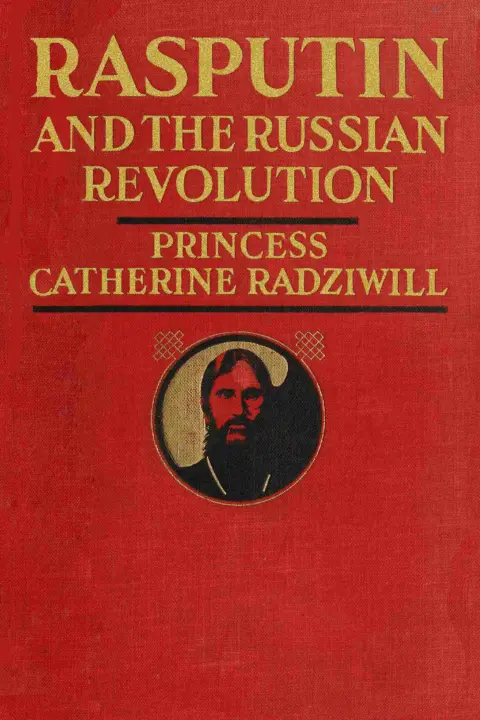
"Rasputin and the Russian Revolution" by Princess Catherine Radziwill is a historical account written in the early 20th century. This work delves into the life and influence of Gregory Rasputin, a controversial figure at the Russian court, examining his role in the events leading up to the Russian Revolution. The narrative aims to demystify Rasputin and provide insights into the political and personal dynamics that contributed to the fall of the Romanoff dynasty, particularly highlighting the Empress Alexandra's connections to him. The opening of the book sets the stage for a detailed exploration of Rasputin's life, his rise to power, and the misconceptions surrounding his influence within the Russian Empire. The author introduces the context of Rasputin's emergence during a time of social and political upheaval, detailing how he captively drew in various members of society—from nobility to the impoverished—under the guise of a mystic and healer. Princess Radziwill emphasizes the many exaggerated tales and public perceptions of Rasputin, contrasting them with the more mundane reality of his ambitious pursuits and the manipulative dynamics involving the Empress and other court figures. This groundwork hints at a complex relationship between personal power, political intrigue, and the eventual revolution that would shake Russia to its core.
Introduction adapted from the source catalogue; source summaries may be automatically generated.
Free to read · English · 83,465 words · No account needed
MAKE TIME FOR A GOOD BOOK
On by default. Untick to stop anonymous reading totals. Each page counts after 10 seconds in view. How this works.
Anonymous counting is on unless you have switched it off.
This discredited Monarch, and his hated and despised Empress, by whom were they surrounded during those eventful days which preceded their fall? Who were the people whom they trusted, and on whom they relied? Whom do we see advising them? Only a handful of flatterers, of sycophants, always ready to turn against him and to betray them at the first opportunity, together with Ministers devoid of any political sense, and without any knowledge or comprehension of the position into which the country had been allowed to drift; without any courage or energy, incapable of imposing themselves or their opinions upon the masses, and of convincing them of the soundness of their views; incapable even of subduing these masses by the use of sheer force. Apart from these flatterers and these weak advisers, whom could Nicholas II. and his Consort trust and believe in? Whom had they got beside them? A discontented army, that was too thoroughly weary of seeing itself neglected and passed over like a negligible quantity, whilst it was fighting for dear life on the frontiers, and who had lost all wish to go on with what appeared to it to have become a hopeless struggle; a few functionaries who cared for nothing but their own advantage or advancement; a handful of adventurers in quest of places, influence and riches, especially of the latter; a police always ready to listen to every kind of low denunciation; that had abused its power, that had destroyed, thanks to its criminal activity, every sense of personal security in the nation, and that prosecuted only those who did not pay it sufficiently to leave them alone. Blackmailers, spies, and valets; this was all that was left to the Czar of All the Russias, to watch over him. They were the only people on whom he could rely, and even they would only remain faithful to him as long as the supreme power would remain, at least nominally, in his hands. His family, as we have seen, detested the Empress, and was ready and prepared to side against him on the first notice of his downfall, which it effectively did. What was left in Petrograd of aristocracy had withdrawn itself from him, lamenting over evils which it knew itself powerless to allay, and had come to the sad conclusion that the further it kept from Tsarskoie Selo the better it would be for everybody. The Emperor stood alone, forsaken by all those who under different circumstances would have considered themselves but too honoured to die for him, let alone defend him against his foes. Alexandra Feodorovna had created a desert around her husband, and, thanks to her, there was hardly a Russian left in the world who did not for some reason or other curse the Sovereign whom Providence had destined to become in all human probability the last of the Romanoff’s crowned in Moscow. Nicholas II. imagined that he could rely on the devotion and the loyalty of his army. He forgot that this army was no longer the one that had acclaimed him with such enthusiasm at the beginning of the war. Most of the officers who had been in command of it at the time had fallen on some battle field or other; the soldiers too had disappeared, and the young recruits who had taken their place had been reared in different ideas, and were ignorant of the old discipline which had inspired the former regiments whose original contingents had been slain. The army had become a national one from the Imperialist it had been before; it was composed of the same elements of discontented minds who before they had been called to the colours had freely discussed the conditions under which the war was being fought, and who had noticed better than it would have been possible for them to do at the front, the mistakes of those in command, the remorseless dilapidation of the Public Exchequer which was going on everywhere, together with all the faults and the carelessness that had brought about all the disasters which had fallen upon the nation. This army could no longer nurse, in regard to the Czar, the veneration and almost religious respect which had animated it in earlier days. It had perceived at last that he was not at the height of the duties and responsibilities which had devolved upon him, and as a natural consequence of the fall of the scales from its eyes it had sided against him, together with the Duma, from which it was hoping and expecting the salvation which its masters of the present hour were unable to procure for it.
Your reading position is saved on this browser. Take it to another device with a library code. Reading pages adapt to text, rather than matching a printed edition.
Catherine, Princess Radziwill
BEHIND THE BOOK
This eBook is for the use of anyone anywhere in the United States and most other parts of the world at no cost and with almost no restrictions whatsoever. You may copy it, give it away or re-use it under the terms of the Project Gutenberg License included with this eBook or online at www.gutenberg.org. If you are not located in the United States, you will have to check the laws of the country where you are located before using this eBook. Read the source licence.
The original source file, including credits and licence, is retained by this library. Request an original-format copy at no charge. Please include the book title and Project Gutenberg identifier #66358.
KEEP YOUR CURIOSITY GOING
Cécile Tormay

Moritz Busch
John L. Ransom
Frances Wright
Cécile Tormay

Mabel Potter Daggett