Confessions of the Czarina
Catherine, Princess Radziwill
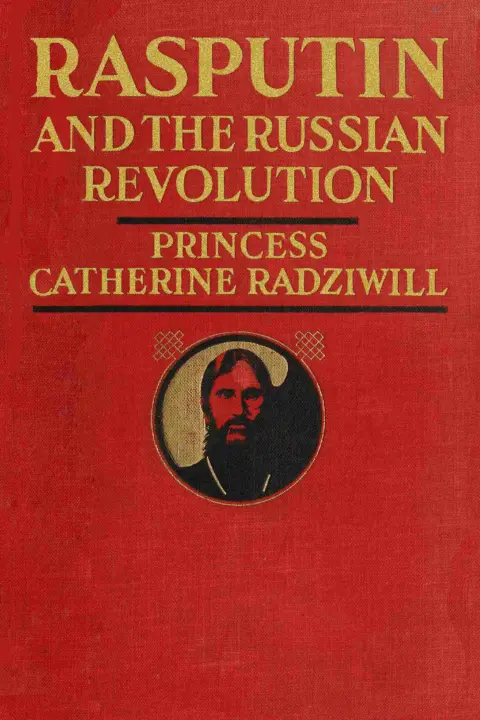
THE CLASSIC COLLECTION · 1917
"Rasputin and the Russian Revolution" by Princess Catherine Radziwill is a historical account written in the early 20th century. This work delves into the life and influence of Gregory Rasputin, a controversial figure at the Russian court, examining his role in the events leading up to the Russian Revolution. The narrative aims to demystify Rasputin and provide insights into the political and personal dynamics that contributed to the fall of the Romanoff dynasty, particularly highlighting the Empress Alexandra's connections to him. The opening of the book sets the stage for a detailed exploration of Rasputin's life, his rise to power, and the misconceptions surrounding his influence within the Russian Empire. The author introduces the context of Rasputin's emergence during a time of social and political upheaval, detailing how he captively drew in various members of society—from nobility to the impoverished—under the guise of a mystic and healer. Princess Radziwill emphasizes the many exaggerated tales and public perceptions of Rasputin, contrasting them with the more mundane reality of his ambitious pursuits and the manipulative dynamics involving the Empress and other court figures. This groundwork hints at a complex relationship between personal power, political intrigue, and the eventual revolution that would shake Russia to its core.
Introduction adapted from the source catalogue; source summaries may be automatically generated.
Free to read · English · 83,465 words · No account needed
MAKE TIME FOR A GOOD BOOK
On by default. Untick to stop anonymous reading totals. Each page counts after 10 seconds in view. How this works.
Anonymous counting is on unless you have switched it off.
The delegates looked at each other, and Schoulguine remarked that they were not prepared for this complication, and that he begged permission to consult with his colleague. But after a short conversation they gave up the point, as Goutschkoff remarked that he did not think they had the right to mix themselves up in a matter where paternal feelings and affection came into question, and that besides a regency had also much to say against it, and was likely to lead to complications. The Emperor seemed satisfied that the delegates had conceded the point, and then he asked them whether they could undertake to guarantee that his abdication would pacify the country and not lead to any disturbances. They declared that they could do so. Upon this he got up and passed into another compartment of his railway carriage. In about half an hour he returned, holding in his hand a folded paper, which he handed over to Goutschkoff, saying as he did so: “Here is my abdication, will you read it?” After which he shook hands with the delegates and retired as if nothing unusual had happened, perhaps not realising that with one stroke of his pen he had changed not only his own life, but the course of Russian history, and, in a certain sense, destroyed the work of his glorious ancestor, Peter the Great.
It is difficult here not to make some remark on the part played by General Roussky in this tragedy which without his interference would probably have taken a different course. It is impossible not to come to the conclusion that the unfortunate Czar whom he induced to abdicate, might have found better and more faithful servants than the people who forsook him in the hour of his peril. Very probably Roussky believed that he was acting in the interests of his country, which in a sense he was also doing, because something had to be attempted in order to stop the nefarious work of Alexandra Feodorovna, and it is certain that her husband would never willingly have consented to be parted from her. Killing a woman would have been disgracing oneself, together with the Revolution which had been accomplished under such exceptional circumstances; but still one would have preferred that the man who was instrumental in the destruction of the Romanoff dynasty should not have been one who wore on his epaulettes the initials of the Sovereign he was helping to dethrone. One would have liked him to feel some pity for the master whose hand he had kissed a few days before he presented to him the pen with which he ordered him to sign his own degradation. In spite of the impassibility preserved by Nicholas II. during the last hours of his reign, it is likely that the tragedy which took place at Pskov must have been one of the most poignant that has ever assailed a Sovereign, who, after having reigned for twenty-two years, found himself, in the course of a few hours, reduced to utter powerlessness and compelled to give up of his own accord the crown which his father had bequeathed to him, and which he had hoped to leave in his turn to the son, whom fate and perhaps a mistaken feeling of affection had made him despoil. He was not a bad man after all, although he had done many a bad action; he was a tender father, and the thought of his child must have added to the moral agony of his soul. By what means he was induced to put his name at the bottom of the document which snatched away from him the sceptre which he had dropped on his coronation day in Moscow, remains still a mystery. Whether violence was used, or whether he was persuaded by the eloquence of Roussky alone to give up the inheritance of his race, is a thing which the future alone will reveal to us. It is probable that he found himself compelled to come to his decision in some way or other, and perhaps the threat to reveal the treason against his allies in which he had participated, and which had been the work of the Empress, was the most powerful argument which was used to oblige him to sign his abdication. It was after all better to fall as a weak man than to be covered with shame in the eyes of the world. He was perhaps told to choose between degradation and dishonour, and he cannot be blamed if he refused to resign himself to the latter.
Your reading position is saved on this browser. Take it to another device with a library code. Reading pages adapt to text, rather than matching a printed edition.
Catherine, Princess Radziwill
BEHIND THE BOOK
This eBook is for the use of anyone anywhere in the United States and most other parts of the world at no cost and with almost no restrictions whatsoever. You may copy it, give it away or re-use it under the terms of the Project Gutenberg License included with this eBook or online at www.gutenberg.org. If you are not located in the United States, you will have to check the laws of the country where you are located before using this eBook. Read the source licence.
The original source file, including credits and licence, is retained by this library. Request an original-format copy at no charge. Please include the book title and Project Gutenberg identifier #66358.
KEEP YOUR CURIOSITY GOING
Cécile Tormay

Moritz Busch
John L. Ransom
Frances Wright
Cécile Tormay

Mabel Potter Daggett