Confessions of the Czarina
Catherine, Princess Radziwill
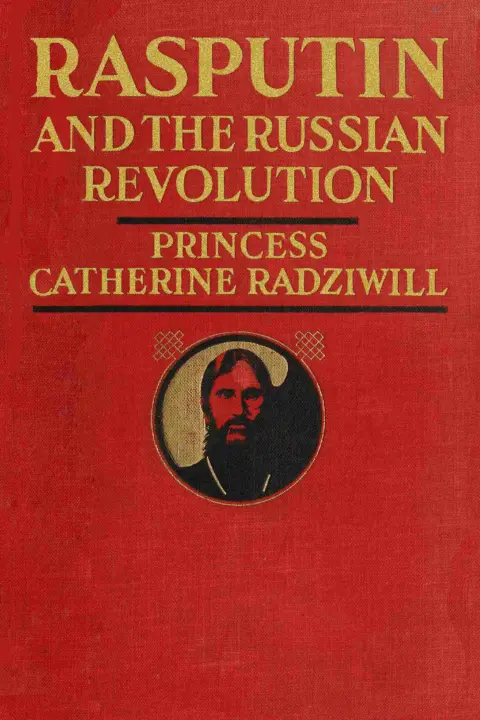
THE CLASSIC COLLECTION · 1917
"Rasputin and the Russian Revolution" by Princess Catherine Radziwill is a historical account written in the early 20th century. This work delves into the life and influence of Gregory Rasputin, a controversial figure at the Russian court, examining his role in the events leading up to the Russian Revolution. The narrative aims to demystify Rasputin and provide insights into the political and personal dynamics that contributed to the fall of the Romanoff dynasty, particularly highlighting the Empress Alexandra's connections to him. The opening of the book sets the stage for a detailed exploration of Rasputin's life, his rise to power, and the misconceptions surrounding his influence within the Russian Empire. The author introduces the context of Rasputin's emergence during a time of social and political upheaval, detailing how he captively drew in various members of society—from nobility to the impoverished—under the guise of a mystic and healer. Princess Radziwill emphasizes the many exaggerated tales and public perceptions of Rasputin, contrasting them with the more mundane reality of his ambitious pursuits and the manipulative dynamics involving the Empress and other court figures. This groundwork hints at a complex relationship between personal power, political intrigue, and the eventual revolution that would shake Russia to its core.
Introduction adapted from the source catalogue; source summaries may be automatically generated.
Free to read · English · 83,465 words · No account needed
MAKE TIME FOR A GOOD BOOK
On by default. Untick to stop anonymous reading totals. Each page counts after 10 seconds in view. How this works.
Anonymous counting is on unless you have switched it off.
The complete indifference of the Czar as to what was going on around him and under his own roof, combined with his weakness of character and his unreasonable love for his wife, did not add to the feelings of respect that his subjects ought to have entertained for him. In a very short time extraordinary rumours began to circulate concerning all that was supposed to take place at Tsarskoie Selo, rumours which, disseminated as they were among the population of Petrograd, contributed in no small degree to the promptitude with which it rallied itself to the cause of the Revolution that put an end to the reign of Nicholas II. It was related amongst other things that the Commander-in-Chief of the Army, the Grand Duke Nicholas, had one day told his Imperial nephew that if he did not lock up Alexandra Feodorovna in a convent, he would come himself at the head of his troops, to carry her away, and confine her within the walls of the monastery of Novodievitvchy. True or not, the story was repeated everywhere, and it procured for the Grand Duke a considerable number of friends and sympathisers.
Soon after this it was related that the Empress was in connivance with the numerous people who had made it their business to plunder the national exchequer, and that she looked with indulgence upon the malversations from which profited the partisans and the accomplices, for one could hardly call them by another name, of Rasputin. She began to be hated even more ferociously than had been the case before, and at last the police had to let Nicholas II. know that his Consort would do better not to show herself too often in public, because an attempt against her life might easily come to be made, under the influence of all the stories which one heard right and left concerning her private conduct and her affection for a being who was accused by the whole nation of being fatal to Russia’s prosperity at home and good renown abroad. The Czar listened to all this, as he was to listen later on to the remonstrances of his own family, but he did not act on all that he had been told. He continued to see Rasputin, partly because, according to the tales of those who were in the secret of what really went on in that strange Imperial household, the frank way of speaking of this uncouth peasant amused him and pleased him, being something so totally different from the language which he was accustomed to hear. But contrary to what was generally believed, he did not discuss with him matters of State, any more than did the Empress. It is to be hoped that this last assertion is correct, and that Rasputin in regard to Nicholas II. only played the part sustained by Chicot at the court of Henri III. of France, that of the King’s Jester, capable occasionally of telling some truths to his master. But during the last months which preceded the removal of this sinister figure from the horizon of Tsarskoie Selo, no one in Russia would believe in such a version, seeing that this Jester could dispose according to his pleasure of all the high places in the State, that he had created ministers, functionaries of paramount importance, church dignitaries, and that whoever addressed himself to him generally got what he wanted, whilst it was his friends who were controlling the government of the vast empire of the Czars. One did not realise that this had become possible only because all persons endowed with the slightest independence of character, had gradually become estranged from their Sovereign, and had come to the decision to abandon him to his fate, disgusted as they were by his weakness in regard to his wife, and being moreover unwilling to accept the responsibility of duties which they were not allowed to fulfil according to the dictates of their conscience. One after another the Ministers, who at the beginning of the reign of Nicholas II. had helped him to rule Russia, had been dismissed by him, or retired of their own accord, and their places had been taken by simple subaltern functionaries, preoccupied only with that one single thought of remaining as long as possible in possession of the places which they had been called upon by a caprice of destiny to occupy, and for which they knew at heart that they were not fit. Everybody who had a sense of decency left, had fled from Tsarskoie Selo, not caring to enter into conflict with the mysterious and subterranean powers, which, to repeat the words used by Professor Paul Miliukoff in his famous speech in the Duma a few days before the Revolution, alone decided the most important questions in the State. The whole country was disgusted at the conduct of those who ruled it, and this disgust was soon to change into an absolute contempt. The unpopularity of the Empress had extended itself to the person of the Czar himself, whom one was beginning to render responsible for the different things going on under his roof and to accuse of seeing, without any emotion, the Imperial prestige and honour sullied, and this autocracy for which he cared so much dishonoured. This unfortunate Emperor did not find anywhere a support. His mother had been estranged from him; his whole family had turned against him, after numerous and useless attempts to open his eyes as to the dangers which surrounded him and the position in which he stood before his subjects. His brother had been systematically kept away from him by the Empress, who did not care to have in her vicinity a man in whom she saw an eventual pretender to the throne of her son. His sisters tried to remove themselves as far from him as possible. He was longing for disinterested affections, and there is therefore nothing wonderful or surprising that he sought them from the wife whom fate had associated with his existence, whom in spite of everything he continued to love tenderly, and whose nefarious influence was to lead him to his destruction.
Your reading position is saved on this browser. Take it to another device with a library code. Reading pages adapt to text, rather than matching a printed edition.
Catherine, Princess Radziwill
BEHIND THE BOOK
This eBook is for the use of anyone anywhere in the United States and most other parts of the world at no cost and with almost no restrictions whatsoever. You may copy it, give it away or re-use it under the terms of the Project Gutenberg License included with this eBook or online at www.gutenberg.org. If you are not located in the United States, you will have to check the laws of the country where you are located before using this eBook. Read the source licence.
The original source file, including credits and licence, is retained by this library. Request an original-format copy at no charge. Please include the book title and Project Gutenberg identifier #66358.
KEEP YOUR CURIOSITY GOING
Cécile Tormay

Moritz Busch
John L. Ransom
Frances Wright
Cécile Tormay

Mabel Potter Daggett