Confessions of the Czarina
Catherine, Princess Radziwill
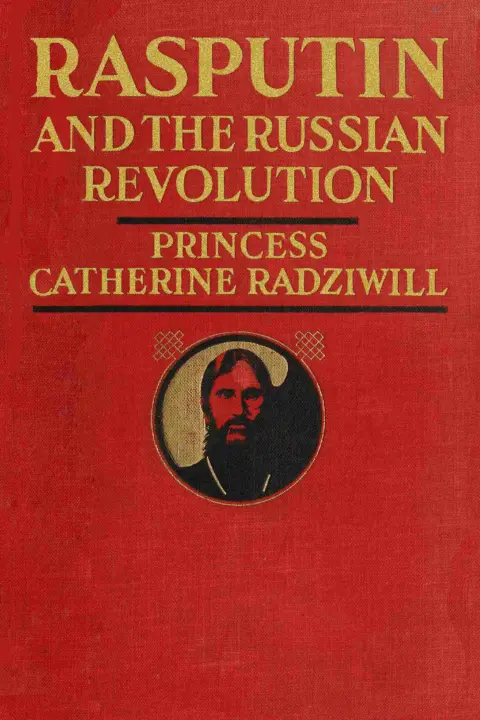
THE CLASSIC COLLECTION · 1917
"Rasputin and the Russian Revolution" by Princess Catherine Radziwill is a historical account written in the early 20th century. This work delves into the life and influence of Gregory Rasputin, a controversial figure at the Russian court, examining his role in the events leading up to the Russian Revolution. The narrative aims to demystify Rasputin and provide insights into the political and personal dynamics that contributed to the fall of the Romanoff dynasty, particularly highlighting the Empress Alexandra's connections to him. The opening of the book sets the stage for a detailed exploration of Rasputin's life, his rise to power, and the misconceptions surrounding his influence within the Russian Empire. The author introduces the context of Rasputin's emergence during a time of social and political upheaval, detailing how he captively drew in various members of society—from nobility to the impoverished—under the guise of a mystic and healer. Princess Radziwill emphasizes the many exaggerated tales and public perceptions of Rasputin, contrasting them with the more mundane reality of his ambitious pursuits and the manipulative dynamics involving the Empress and other court figures. This groundwork hints at a complex relationship between personal power, political intrigue, and the eventual revolution that would shake Russia to its core.
Introduction adapted from the source catalogue; source summaries may be automatically generated.
Free to read · English · 83,465 words · No account needed
MAKE TIME FOR A GOOD BOOK
On by default. Untick to stop anonymous reading totals. Each page counts after 10 seconds in view. How this works.
Anonymous counting is on unless you have switched it off.
She mixed openly in public affairs, and began to play a leading part in the conduct of the State. Her husband never dared to refuse her anything, and the Empress attempted to lead the destinies of Russia in the sense which she had the most at heart, that is in one corresponding to the interests of her own native country. She had remained entirely German in her tastes and opinions, and her English education had had absolutely no influence on her character. Thanks to an active correspondence which she kept up with her brother, the Grand Duke of Hesse, she was able to acquaint the Emperor William II. with a good many things that he would never have learned without her. This is the more curious, if one takes into account the fact that during the first years which had followed upon her marriage, and especially after the different journeys which she had made in France, Alexandra Feodorovna had expressed great sympathy and admiration for everything that was French, perhaps on account of the great enthusiasm with which she had been received by the French population. But later on, thanks to the influence of the unscrupulous people into whose hands she fell, her ideas became transformed, and she boldly tried to fight against the French leanings of her husband, and to lead him towards an alliance with Germany, in which she thought that she saw the advantage, and even the safety of her throne, and of the son she loved above everything else in the world.
All these facts could not long remain unknown, and soon the public began to discuss them, together with the story of the different intrigues of which the Palace of Tsarskoie Selo became the centre. Thanks to the friends whom she had chosen for herself, the ante-chamber of the Empress was transformed into a kind of annex to the Stock Exchange, where all sorts of people, honest or dishonest, used to meet, in order to obtain through her intercession more or less extravagant, if not dangerous, favours. Thanks to Madame Wyroubieva, there were introduced into the intimacy of the Czarina certain members of the orthodox clergy recommendable only by their love for money and for lucrative employments, or rich dioceses and monasteries. The Empress together with her sister, the Grand Duchess Elisabeth, who after the murder of her husband had become a nun and the superior of a cloister which she had founded in Moscow, and to whom one might have applied with success the remark of Marie Antoinette in regard to her aunt Madame Louise of France, “she is the most intriguing little Carmelite in the whole of the kingdom,” tried to mix themselves up in every important matter in the State, and to lead it according to their own lights and aims, making use of the Emperor as of an instrument of their own private ambitions and desires. They were both fierce reactionaries, who from the first day that Nicholas II. had promulgated the Constitution of the 17th of October, had tried to persuade him to recall it. It was thanks to the initiative of the Empress that the first Duma was dissolved, and that the government began to exercise considerable pressure over the elections in order to prevent the candidates whom it believed it could not trust from being chosen by their constituents. One Minister after another of those whom the Czar appointed in rapid succession, resigned their functions, until at last it was an acknowledged fact in Russia that no honest trial of constitutional government could or would be attempted so long as Alexandra Feodorovna would be there to counteract its existence. When the Revolution broke out in the year 1905, and especially at the time of the disturbances which took place in Moscow, it was the Empress who excited her husband to adopt rigorous measures in order to crush it, measures which led to nothing, and which only made Nicholas II. a little more unpopular than he already was among his subjects. It was related, whether true or not I cannot say, that when the famous Semenovsky Regiment was sent to Moscow to reduce into submission the insurrection which had broken out there, Alexandra Feodorovna had desired to say good-bye to the officers before their departure, and that the only recommendation which she had made to them had been not to show any mercy to the insurgents. She had read without understanding it in the very least, the history of the French Revolution in 1789, and one had often heard her say that to show any weakness or compassion in times of danger was equivalent to signing one’s own death warrant. Her friends were nearly all of them men and women with a bad reputation, and amidst the circle of her own immediate family she had only contrived to make herself enemies. Thanks to her influence, and to her petty personal spite, the young Grand Duke Cyril, the son of the Grand Duke Vladimir, was deprived of his titles and dignities and exiled from Russia for having dared to marry his first cousin, the divorced wife of the Empress’s brother, the Grand Duke of Hesse, the Princess Victoria Melita of Edinburgh. This punishment, however, was promptly cancelled, thanks to the numerous protests which followed upon it from all quarters, but the two people concerned never forgave the Empress her attitude in regard to their union, and we saw an echo of this hostility the other day when the Grand Duke Cyril on the outbreak of the Revolution tried to play the part of Philippe Egalité in the Romanoff family, and went with his regiment to put himself at the disposal of the new government appointed by the Duma.
Your reading position is saved on this browser. Take it to another device with a library code. Reading pages adapt to text, rather than matching a printed edition.
Catherine, Princess Radziwill
BEHIND THE BOOK
This eBook is for the use of anyone anywhere in the United States and most other parts of the world at no cost and with almost no restrictions whatsoever. You may copy it, give it away or re-use it under the terms of the Project Gutenberg License included with this eBook or online at www.gutenberg.org. If you are not located in the United States, you will have to check the laws of the country where you are located before using this eBook. Read the source licence.
The original source file, including credits and licence, is retained by this library. Request an original-format copy at no charge. Please include the book title and Project Gutenberg identifier #66358.
KEEP YOUR CURIOSITY GOING
Cécile Tormay

Moritz Busch
John L. Ransom
Frances Wright
Cécile Tormay

Mabel Potter Daggett