Confessions of the Czarina
Catherine, Princess Radziwill
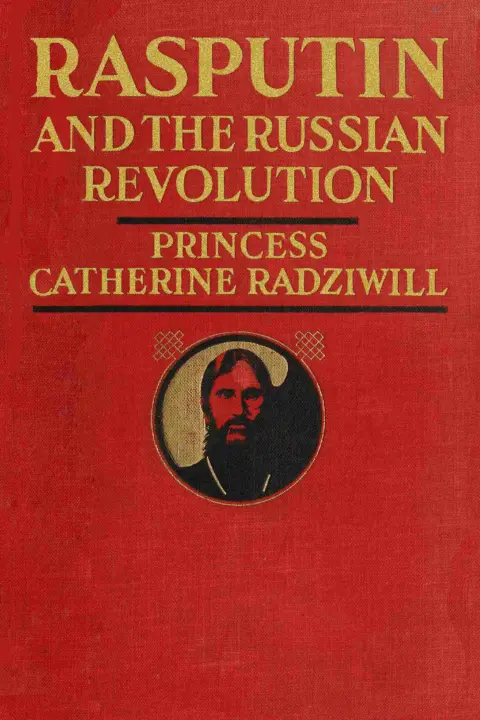
THE CLASSIC COLLECTION · 1917
"Rasputin and the Russian Revolution" by Princess Catherine Radziwill is a historical account written in the early 20th century. This work delves into the life and influence of Gregory Rasputin, a controversial figure at the Russian court, examining his role in the events leading up to the Russian Revolution. The narrative aims to demystify Rasputin and provide insights into the political and personal dynamics that contributed to the fall of the Romanoff dynasty, particularly highlighting the Empress Alexandra's connections to him. The opening of the book sets the stage for a detailed exploration of Rasputin's life, his rise to power, and the misconceptions surrounding his influence within the Russian Empire. The author introduces the context of Rasputin's emergence during a time of social and political upheaval, detailing how he captively drew in various members of society—from nobility to the impoverished—under the guise of a mystic and healer. Princess Radziwill emphasizes the many exaggerated tales and public perceptions of Rasputin, contrasting them with the more mundane reality of his ambitious pursuits and the manipulative dynamics involving the Empress and other court figures. This groundwork hints at a complex relationship between personal power, political intrigue, and the eventual revolution that would shake Russia to its core.
Introduction adapted from the source catalogue; source summaries may be automatically generated.
Free to read · English · 83,465 words · No account needed
MAKE TIME FOR A GOOD BOOK
On by default. Untick to stop anonymous reading totals. Each page counts after 10 seconds in view. How this works.
Anonymous counting is on unless you have switched it off.
This answer became known at once, and it traced between the Monarch and his subjects one of these white lines which in a tennis ground marks the antagonistic camps, and out of two players makes two enemies ... and this line went on getting wider and wider as time went on. It still existed when Nicholas II. abdicated, but it had then become an abyss.
In general there is nothing sadder in the world than a misunderstanding between two people both possessed of good intentions towards each other. It is something worse than a discussion, worse than a quarrel, and even worse than hatred, because it is the only thing which sound reasoning cannot conquer, and which is bound to go on aggravating itself from day to day. How much worse therefore is a thing of the kind when it has established itself between a nation and those who rule it. The great, the supreme misfortune of Nicholas II. consisted in the fact that he never could understand his people or their wants, whilst Russia on the other hand was, through circumstances independent of its will, brought to distrust the real feelings harboured by the Czar in regard to its welfare, and to indulge in comparisons which certainly were not to his advantage, between him and the Sovereign to whom he had succeeded, who had possessed the full confidence of his subjects.
This fatality which has dogged all the footsteps of the Emperor who abdicated a year ago, from the very first moment that he had ascended his Throne, can be partly attributed to the defective education which he had received, together with the deplorable weakness of his character; and partly to the state of absolute subjection in which he had been kept first by his father, during the whole time of the latter’s life, and later on by his wife, together with the complete ignorance in which he remained in regard to the wants, the aspirations, needs and character of his people. He was a despot by temperament, perhaps because he had never seen anything else but despotism around him, and perhaps because he had got a mistaken idea in regard to the duties which devolved upon him. He had always been told that he ought to uphold intact the principle of autocracy, thanks to which his predecessors had maintained themselves upon the throne. He had seen Alexander III. adopt him with these principles with success, and he had forgotten, or rather he had never known, that in order to be a successful autocrat, one must neither prove oneself a tyrant, nor an oppressor of people’s consciences and opinions. His first steps as a Sovereign had hurt all the feelings of loyalty of his subjects. Among the many addresses of congratulation that had been presented to him on the occasion of his marriage and of his accession to the Throne, there had been one from the Zemstvo or local assembly of the government of Tver, a town which was known to be very liberal in its opinions, in which was expressed the hope that the Monarch would try to govern his people with the help and with the co-operation of these same Zemstvos or local assemblies, the aim of which was the improvement of the local conditions of existence of the population of the different governments or provinces of the Russian Empire. There was absolutely nothing that was revolutionary in this address. Unfortunately there happened to be in the vicinity of the young Empress a person whose influence had always been perniciously exercised, whenever it had manifested itself: the Princess Galitzyne, her Mistress of the Robes. Out of a feeling of personal dislike, or rather hatred, against one of the signatories of this document, which, on account of the consequences that followed upon its composition, became historical, Princess Galitzyne explained to the Sovereign at the head of whose household she stood, that this appeal in favour of a liberal system of government ought to be discouraged, if not crushed, at once. Alexandra Feodorovna was then beginning to acquire the absolute power over her consort’s mind, which she was never to lose in the future, and she spoke to him of the matter suggested by the Princess, on the very day that different deputations, coming from all parts of Russia to express their good wishes to the young Imperial couple, were about to be received by them in the Winter Palace.
Your reading position is saved on this browser. Take it to another device with a library code. Reading pages adapt to text, rather than matching a printed edition.
Catherine, Princess Radziwill
BEHIND THE BOOK
This eBook is for the use of anyone anywhere in the United States and most other parts of the world at no cost and with almost no restrictions whatsoever. You may copy it, give it away or re-use it under the terms of the Project Gutenberg License included with this eBook or online at www.gutenberg.org. If you are not located in the United States, you will have to check the laws of the country where you are located before using this eBook. Read the source licence.
The original source file, including credits and licence, is retained by this library. Request an original-format copy at no charge. Please include the book title and Project Gutenberg identifier #66358.
KEEP YOUR CURIOSITY GOING
Cécile Tormay

Moritz Busch
John L. Ransom
Frances Wright
Cécile Tormay

Mabel Potter Daggett