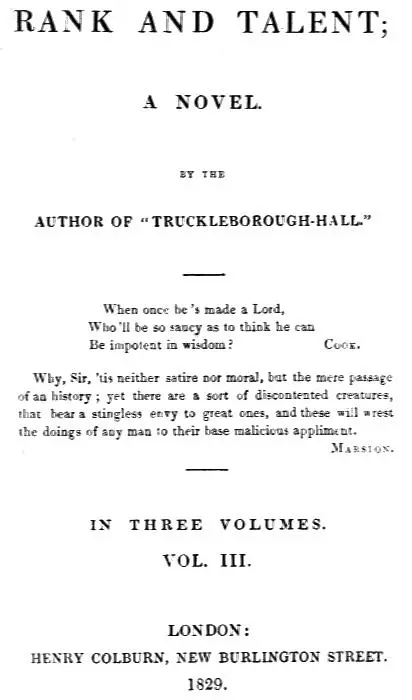
Rank and Talent; A Novel, Vol. 3 (of 3)
William Pitt Scargill
THE CLASSIC COLLECTION · 1829
"Rank and Talent; A Novel, Vol. 2" by William Pitt Scargill is a fictional narrative written in the early 19th century. The novel delves into the societal intricacies of London, exploring themes of class, ambition, and social standing through the character Philip Martindale and his interactions with various figures in high society. The narrative also introduces familial dynamics and romantic elements, particularly regarding the relationships of Martindale and the implications of his ambitious aspirations. The opening of the novel describes the bustling return of society to London after the country season, setting the stage for social rivalries and aspirations. We are introduced to Mr. Martindale, who is preparing to take his daughter Clara to a party hosted by Sir Gilbert Sampson. The dynamic reveals Martindale's cynical perspective on high society and his reluctance to engage with those he considers beneath him, while his cousin Philip faces pressures related to his rank and financial dependencies. Philip's qualms about his status and romantic entanglements foreshadow his struggles to navigate the expectations of aristocracy while exploring the social landscape influenced by wealth and privilege. The exploration of these intertwined relationships creates a rich backdrop for the continuing journey of ambition and class distinction.
Introduction adapted from the source catalogue; source summaries may be automatically generated.
Free to read · English · 56,943 words · No account needed
MAKE TIME FOR A GOOD BOOK
On by default. Untick to stop anonymous reading totals. Each page counts after 10 seconds in view. How this works.
Anonymous counting is on unless you have switched it off.
In saying so much, and in using such a tone of anger in her expressions, Miss Henderson forgot herself. She was too deeply mortified by her jealousy to be under the government of prudence; and when she had said so much, she wished it more than half unsaid, but it was too late. Markham, ignorant as he was of the world and its ways, was not so ignorant and so unobserving as not to understand and apprehend the complexion of Miss Henderson's mind. And without knowing, or even caring what might be the exact state of the case, he very plainly saw that the temper and disposition of Miss Henderson were not such as met his ideas of propriety or moral beauty. That part of the information which most affected and concerned him, was the intelligence that Mr. Tippetson was engaged to Clara. He had no reason to doubt that fact, but was surprised to find that Clara could attach herself to such a character. Yet judging from the tenor of Miss Henderson's philippic, he thought that Mr. Tippetson might not be quite so great a blockhead as she had represented him.
Markham took the earliest opportunity of paying his respects to Mr. Martindale, notwithstanding all that Miss Henderson had said and insinuated concerning the cruel usage she had experienced from that family. It was well that when Markham called, only Mr. Martindale was visible. The young lady, whom Miss Henderson was pleased to call a hypocrite, was not within. When the old gentleman saw Markham he greeted him with the utmost cordiality, and was, as he said, most heartily glad to see him.
"And pray, young man, how long have you been in England?"
Markham informed him of the circumstances which occasioned his return, and Mr. Martindale expressed his regret that there was such occasion of returning. "But," added he, "I don't see that you look ill now; it is a mere fancy that young men get into their heads about this and that place not agreeing with them. When I was a young man there was no such nonsense; young fellows went out to the East or West Indies, and made fortunes, and came home in high good health to enjoy themselves. It is a sad pity that you have let such a golden opportunity slip through your fingers; but if you really were ill, you could not help it. But don't be in a hurry, sit down. Little Clara and her mother will be home soon. You know you and Clara used to talk a good deal about poetry. I am sure she will be glad to see you. There is a young fellow, who is following us wherever we go, who is paying mighty close attention to Clara. I don't know whether they will make a match of it. Signora Rivolta does not like the young man. Perhaps you know him, his name is Tippetson; he has a very pretty fortune of his own. But I think it would be better if he had taken a profession. I don't like young men to be quite idle. My poor cousin Philip did himself no good by leaving his profession, and setting himself up as a man of rank. He is a man of higher rank now. I suppose you have heard that he has been created Earl of Trimmerstone. Foolish thing; but I believe it was partly my fault. Of course, you also know that he is married. Ah! to think that after all his fine talk about people of family and descent, to think, I say, that he should now go at last and marry the daughter of a soap-boiler. Though I don't see any harm in boiling soap. Soap must be had, and a soap-boiler is as useful a man as any other member of society, perhaps quite as useful as a lord; but I must not speak slightingly of lords. Philip's father died very suddenly at last. He was breaking very much, I think, when you were in England. You never knew him. He was a much steadier man than his son. I am very much afraid Philip is not going on well. I have heard sad stories about him of his gambling, and laying such unreasonably large bets upon the merest trifles in the world. You must be introduced to him again now he has a new title, and you must see his lady. You remember her; a pretty woman, but rather coarse in her manners. All very well for a rich man's wife, but not at all fit for a countess. People of rank don't admire her much; and she is so very intimate with vulgar people, that poor Philip says he is afraid to go into a snuff-shop for fear the man behind the counter should inquire after the Countess of Trimmerstone. It is a foolish thing to marry for money. Never do that, Markham."
Your reading position is saved on this browser. Take it to another device with a library code. Reading pages adapt to text, rather than matching a printed edition.
William Pitt Scargill
William Pitt Scargill
BEHIND THE BOOK
This eBook is for the use of anyone anywhere in the United States and most other parts of the world at no cost and with almost no restrictions whatsoever. You may copy it, give it away or re-use it under the terms of the Project Gutenberg License included with this eBook or online at www.gutenberg.org. If you are not located in the United States, you will have to check the laws of the country where you are located before using this eBook. Read the source licence.
The original source file, including credits and licence, is retained by this library. Request an original-format copy at no charge. Please include the book title and Project Gutenberg identifier #44996.
KEEP YOUR CURIOSITY GOING
Coulson Kernahan

Maurice Baring
Frances Wright
Cécile Tormay

Frederic Jesup Stimson

W. H. P. (William Henry Pope) Jarvis