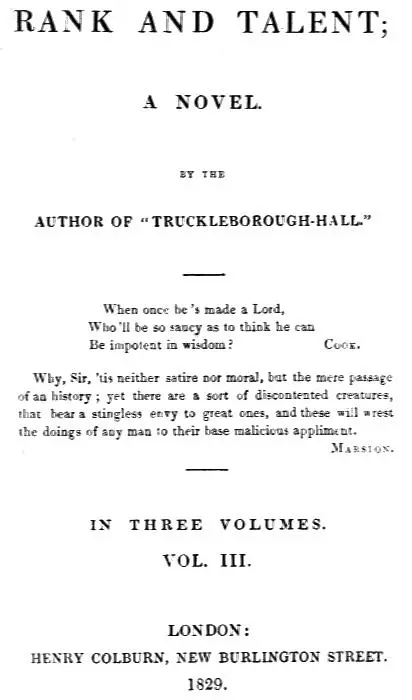
Rank and Talent; A Novel, Vol. 3 (of 3)
William Pitt Scargill
THE CLASSIC COLLECTION · 1829
"Rank and Talent; A Novel, Vol. 2" by William Pitt Scargill is a fictional narrative written in the early 19th century. The novel delves into the societal intricacies of London, exploring themes of class, ambition, and social standing through the character Philip Martindale and his interactions with various figures in high society. The narrative also introduces familial dynamics and romantic elements, particularly regarding the relationships of Martindale and the implications of his ambitious aspirations. The opening of the novel describes the bustling return of society to London after the country season, setting the stage for social rivalries and aspirations. We are introduced to Mr. Martindale, who is preparing to take his daughter Clara to a party hosted by Sir Gilbert Sampson. The dynamic reveals Martindale's cynical perspective on high society and his reluctance to engage with those he considers beneath him, while his cousin Philip faces pressures related to his rank and financial dependencies. Philip's qualms about his status and romantic entanglements foreshadow his struggles to navigate the expectations of aristocracy while exploring the social landscape influenced by wealth and privilege. The exploration of these intertwined relationships creates a rich backdrop for the continuing journey of ambition and class distinction.
Introduction adapted from the source catalogue; source summaries may be automatically generated.
Free to read · English · 56,943 words · No account needed
MAKE TIME FOR A GOOD BOOK
On by default. Untick to stop anonymous reading totals. Each page counts after 10 seconds in view. How this works.
Anonymous counting is on unless you have switched it off.
We have not described Miss Henderson as a faultless model of the fair sex, though peradventure some of our readers may imagine that the instance which we have above related of her elevated generosity is a specimen of very sublime virtue, and hardly compatible with any but a faultless or almost faultless character. From this sublimity we must however detract something by stating two important facts, which somewhat let down the dignity and pure disinterestedness of the surrender. The facts are these: that in the first place, Miss Henderson had every reason to suppose that she had no chance of obtaining Mr. Tippetson for herself; and that in the second place, fearing this loss, she had provided herself with a new flame and a fresh object of admiration in the person of Markham. It is very mortifying to think that such is the weakness of our nature, such the constitution of humanity, that we can scarcely ever quote a specimen of the greatness of the human mind without being shocked by the vicinity of some corresponding littleness. So it ever must be: mountains imply vallies; and the higher the former, the deeper are the latter.
The circumstances which led to an acquaintance between Miss Henderson and Horatio Markham were these. Markham, as we have said, hastened to town after paying due respects to his friends in the country, and set seriously to work to recover lost time. But though the young gentleman was very diligent and assiduous in applying to business, he did not let it so far occupy all his thoughts and all his time as to omit an attendance at church. Like the rest of the world who go to church, he was much better pleased with that which amuses than with that which instructs; and though Mr. Henderson's chapel was at an inconvenient distance from Markham's chambers, yet the young gentleman was so partial to fine preaching, that he did not hesitate to take a very long walk for the sake of hearing a very fine sermon. By some accident, it so happened that he sat in the same seat which was formerly occupied by Mr. Tippetson. When Mr. Tippetson had deserted that seat, Miss Henderson thought that it looked very gloomy, and her heart swelled nigh unto bursting; but when the seat was occupied by Markham, that pew did not look so dreary. Markham was not so nice a man as Mr. Tippetson, nor did he look so very earnestly at Miss Henderson; but he did look at her once or twice, and that was better than nothing. He was also very attentive to the preaching, and that was a recommendation to Miss Henderson. Markham attended the chapel regularly, and by degrees Miss Henderson thought him a very sensible man; for she observed that, whenever any very splendid tropes, figures, or metaphors, were uttered by her pa, the young gentleman looked particularly well pleased. This raised him in her estimation very highly; for she was certain that he was a man of taste as well as of superior understanding. Sometimes, and on some occasions, Mr. Henderson would be very pathetic; and on these occasions Miss Henderson discerned that Markham was a man of feeling as well as taste. Her anxiety was excited to know who this stranger could be. That curiosity was soon gratified, and she learned that it was no other than Mr. Markham, the rising young barrister, who was so remarkable for his judicious mode of conducting his causes. Miss Henderson thought it could be no one else. It was very gratifying to her that such a man as Markham should pay her pa the compliment of attending so regularly at his chapel. She wished in the fulness of her heart to express her sense of gratitude for that compliment, and she did not know what reward was in her power to bestow but her own self. But she could not make Mr. Markham an offer, and he was not likely to offer himself till he had been introduced to her acquaintance. It was not long before an opportunity was afforded her of being introduced to this sensible young gentleman. They met, as it is called, by accident, at the house of a mutual friend. Markham was evidently received with distinguished attention. He was listened to when he talked, and Miss Henderson was astonished at the extent of his information and the soundness of his judgment. We have already intimated that Markham was a little disposed to pedantry: when therefore opportunity occurred of speaking of law, he was fluent and copious in his talk; and when poetry was the subject of conversation, he was eloquent on that topic also. His talk generally was much from and concerning books. In youth that is very pardonable. Miss Henderson thought it was altogether admirable, and was enraptured with the great extent of erudition which the young gentleman displayed, and thought what a pity it would be if so sensible a man as Mr. Markham should have the misfortune to be captivated by some pretty-faced simpleton, and so be cruelly destined to spend all his days with a woman not capable of appreciating his merits, and without power or inclination to amuse and delight his mind with intellectual talk and discussion. It was so great a pity that there should be any danger of such calamity happening to him, that Miss Henderson grew more and more anxious that he should be placed out of the way of such calamity by becoming engaged to her, whose intellect was of such superior order, and who could so well and properly appreciate his excellencies, and by whose conversation his spirits might be cheered and refreshed after the toils and labors of the day. But the great difficulty was how to effect this engagement. She could not ask him, nor could she ask him to ask her; but she could and she did take very great pains to make herself agreeable: she echoed all his remarks, and was ready with a smile for every thing that he might say in the shape of or with pretension to wit: nay more, if he had been disposed to be pathetic, she was ready with her tears and sighs. Now Markham must have been downright rude and ungrateful had he not returned attention with attention; and if Miss Henderson was pleased to pay him compliments, it became him gratefully to acknowledge those compliments. Clearly, therefore, the young lady began to hope that some progress was made in his affections, or at least very soon would be. It was not in her power to ask Mr. Markham to visit her pa; but it was in her power to manage so to bring Mr. Henderson and Mr. Markham together in this party, that an acquaintance might thereby be formed between them. As Mr. Henderson was rather proud of his pulpit performances, he readily accepted Markham's compliments, and he expressed a wish to be better acquainted; and Miss Henderson took care that the conversation should not drop here, but with great ingenuity so contrived that they did not part that evening before Markham had arranged to call on Mr. Henderson.
Your reading position is saved on this browser. Take it to another device with a library code. Reading pages adapt to text, rather than matching a printed edition.
William Pitt Scargill
William Pitt Scargill
BEHIND THE BOOK
This eBook is for the use of anyone anywhere in the United States and most other parts of the world at no cost and with almost no restrictions whatsoever. You may copy it, give it away or re-use it under the terms of the Project Gutenberg License included with this eBook or online at www.gutenberg.org. If you are not located in the United States, you will have to check the laws of the country where you are located before using this eBook. Read the source licence.
The original source file, including credits and licence, is retained by this library. Request an original-format copy at no charge. Please include the book title and Project Gutenberg identifier #44996.
KEEP YOUR CURIOSITY GOING
Coulson Kernahan

Maurice Baring
Frances Wright
Cécile Tormay

Frederic Jesup Stimson

W. H. P. (William Henry Pope) Jarvis