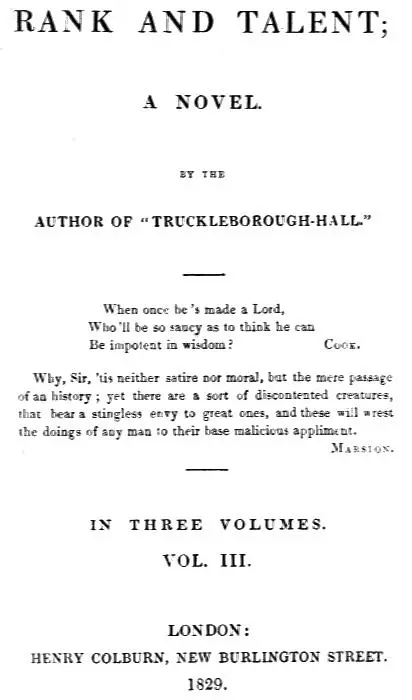
Rank and Talent; A Novel, Vol. 3 (of 3)
William Pitt Scargill
THE CLASSIC COLLECTION · 1829
"Rank and Talent; A Novel, Vol. 2" by William Pitt Scargill is a fictional narrative written in the early 19th century. The novel delves into the societal intricacies of London, exploring themes of class, ambition, and social standing through the character Philip Martindale and his interactions with various figures in high society. The narrative also introduces familial dynamics and romantic elements, particularly regarding the relationships of Martindale and the implications of his ambitious aspirations. The opening of the novel describes the bustling return of society to London after the country season, setting the stage for social rivalries and aspirations. We are introduced to Mr. Martindale, who is preparing to take his daughter Clara to a party hosted by Sir Gilbert Sampson. The dynamic reveals Martindale's cynical perspective on high society and his reluctance to engage with those he considers beneath him, while his cousin Philip faces pressures related to his rank and financial dependencies. Philip's qualms about his status and romantic entanglements foreshadow his struggles to navigate the expectations of aristocracy while exploring the social landscape influenced by wealth and privilege. The exploration of these intertwined relationships creates a rich backdrop for the continuing journey of ambition and class distinction.
Introduction adapted from the source catalogue; source summaries may be automatically generated.
Free to read · English · 56,943 words · No account needed
MAKE TIME FOR A GOOD BOOK
On by default. Untick to stop anonymous reading totals. Each page counts after 10 seconds in view. How this works.
Anonymous counting is on unless you have switched it off.
Very few days after this interview with Sir Gilbert Sampson, the old gentleman received a letter from his cousin Philip, and another also from the bride. These letters were constructed so as to be peculiarly pleasing and flattering to Mr. Martindale; and he thought that it would be a great pity to lose a fine opportunity of advancing the young gentleman to the honor of an earldom. But still there remained on his mind a strong feeling of perplexity as concerned poor Mr. Henderson. It was not quite accordant with the old gentleman's strict notions of honor and steadiness of purpose; but as some benefit might result from the arrangement, it was perhaps better to benefit two parties than one only. Thereupon the matter was presently settled, and Mr. Henderson again disappointed of a living. This disappointment, however, the good man bore with patience; and he was, though with great difficulty and after long and suitable opposition, prevailed upon at last to accept the means of procuring for himself some other living.
And now the daughter of the soap-boiler had become countess, both father and daughter were delighted in the highest degree, nor was Philip himself less pleased. Upon examining, however, his pecuniary resources, the Right Hon. the Earl of Trimmerstone found that his means were not quite adequate to his rank, or equal to his expectations: for the property received with Celestina was rather a large than a small proportion of the wealth of Sir Gilbert Sampson. This was mortifying; but there was still a fine prospect to look forward to in the event of old Mr. Martindale's decease: therefore the Earl and Countess of Trimmerstone resolved to keep up the dignity of their rank at as little expense as possible.
This resolution was certainly very good, but unfortunately it proved to be good for nothing. For in a certain rank there are certain expenses which are absolutely unavoidable; and then it might be naturally supposed that, when Mr. Martindale had made a sacrifice for the purpose of raising his relative's rank, he would alter the tenor of his whimsical will. Under the influence of this consideration, and by the power of unavoidable circumstances, it happened that the Earl of Trimmerstone, though in possession of more ample means than were ever enjoyed by the Hon. Philip Martindale, found himself almost as necessitous and as embarrassed as ever. His most amiable countess loved splendor, and therefore found it to be absolutely necessary. When, therefore, they set up their establishment in town, though they thought that they were using a very high degree of economy, they brought upon themselves the imputation of extravagance, and in fact somewhat more than the imputation. But what could they do? They must live as other persons of the same rank. In addition to the evils of ill-managed expenditure, there arose another very serious difficulty, or rather trouble, to the newly-married pair. The Countess loved splendor, but she had not been properly tutored to manage it; there she was clumsy in display, and tasteless in decoration. She had not the power of carrying off the absurdities of fashion with the proper grace and indifference of right-honorable impudence. Frequently, therefore, his lordship felt ashamed of his countess; and not unfrequently, some of his companions and friends would amuse themselves at his expense; and he always felt himself in jeopardy, as if about to hear the word "soap" mentioned. The Earl of Trimmerstone not finding the Countess much of a companion, sought elsewhere for the pleasures of society. The Countess of Trimmerstone loved not solitude, but unhappily was by no means select in her associates. Being resolved not to be proud, so as to neglect her old acquaintance, her ladyship found it difficult to keep a very choice circle of acquaintance in her new sphere. There were not wanting persons of rank and distinction amidst her visitors and companions, but these were not always of the best kind. In her innocence and good-humor she knew it not, but his lordship did, and he was greatly displeased. Then did her ladyship think that his lordship was very harsh and rigid; and then did his lordship think that he had purchased her ladyship's wealth at too dear a price. We were going to say, that then it was too late to repent; no, it was not too late, we think it was very early to repent in the first year of their married life. Be it late or early, they certainly did repent. Celestina thought that it was not so fine a thing to be a countess as she used to imagine. When she was single, it appeared to her most desirable to be a lady; now she was married, she did not think it would be much increase to her happiness to become a duchess.
Your reading position is saved on this browser. Take it to another device with a library code. Reading pages adapt to text, rather than matching a printed edition.
William Pitt Scargill
William Pitt Scargill
BEHIND THE BOOK
This eBook is for the use of anyone anywhere in the United States and most other parts of the world at no cost and with almost no restrictions whatsoever. You may copy it, give it away or re-use it under the terms of the Project Gutenberg License included with this eBook or online at www.gutenberg.org. If you are not located in the United States, you will have to check the laws of the country where you are located before using this eBook. Read the source licence.
The original source file, including credits and licence, is retained by this library. Request an original-format copy at no charge. Please include the book title and Project Gutenberg identifier #44996.
KEEP YOUR CURIOSITY GOING
Coulson Kernahan

Maurice Baring
Frances Wright
Cécile Tormay

Frederic Jesup Stimson

W. H. P. (William Henry Pope) Jarvis