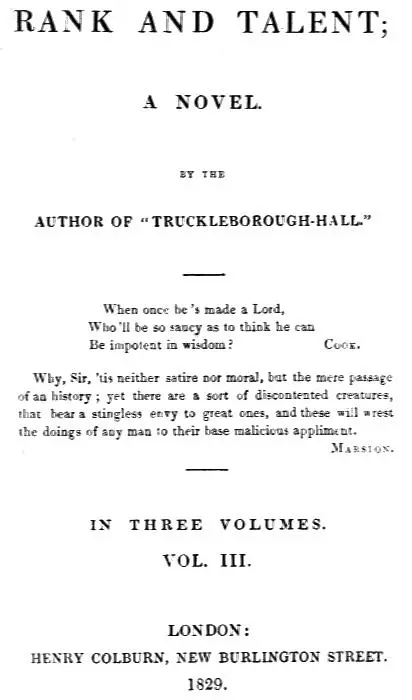
Rank and Talent; A Novel, Vol. 3 (of 3)
William Pitt Scargill
THE CLASSIC COLLECTION · 1829
"Rank and Talent; A Novel, Vol. 2" by William Pitt Scargill is a fictional narrative written in the early 19th century. The novel delves into the societal intricacies of London, exploring themes of class, ambition, and social standing through the character Philip Martindale and his interactions with various figures in high society. The narrative also introduces familial dynamics and romantic elements, particularly regarding the relationships of Martindale and the implications of his ambitious aspirations. The opening of the novel describes the bustling return of society to London after the country season, setting the stage for social rivalries and aspirations. We are introduced to Mr. Martindale, who is preparing to take his daughter Clara to a party hosted by Sir Gilbert Sampson. The dynamic reveals Martindale's cynical perspective on high society and his reluctance to engage with those he considers beneath him, while his cousin Philip faces pressures related to his rank and financial dependencies. Philip's qualms about his status and romantic entanglements foreshadow his struggles to navigate the expectations of aristocracy while exploring the social landscape influenced by wealth and privilege. The exploration of these intertwined relationships creates a rich backdrop for the continuing journey of ambition and class distinction.
Introduction adapted from the source catalogue; source summaries may be automatically generated.
Free to read · English · 56,943 words · No account needed
MAKE TIME FOR A GOOD BOOK
On by default. Untick to stop anonymous reading totals. Each page counts after 10 seconds in view. How this works.
Anonymous counting is on unless you have switched it off.
By more frequent attendance the old gentleman grew less fastidious, and he fancied that he could discern, amidst all the flowery and pretty eloquence of the popular preacher, some symptoms of strong good sense; and he more than suspected that the style was assumed for the sake of rendering that tolerable which otherwise would not be attended to. Pleased with his imagined discovery, he was desirous of being acquainted with Mr. Henderson, and very readily acceded to Lady Woodstock's request to meet him at her house. Judging from his own impression of Mr. Henderson's strength of mind and fulness of information, he thought it not unlikely that he should find in him a fit and proper person to induce Signora Rivolta to look more favorably on the English religion. But the old gentleman was not aware that it is possible for a man to be a popular preacher, and to utter very elegant harangues, and even to display in his composition a sound judgment as well as an elegant taste, but at the same time to be grievously unfurnished with stores of literature, and altogether unexercised in the harsher struggles and conflicts of polemic disputation. This he found to be the case with Mr. Henderson. The worthy preacher was a man of good sense, graceful and agreeable manners, fluent in conversation, well acquainted with all the popular and fashionable topics of conversation, and quite as well satisfied as Mr. Martindale himself of the folly and vanity of the passions and pursuits of the day. One of the two thought that he could not do better than set himself cynically against the world--the other humored its follies; the one did no good by his cynical humor--the other did a little by his management and direction of the prevalent follies. Mr. Henderson, we are inclined to think, judged the wisest of the two. It is not in the power of a weak hand to stop a headstrong horse; but less power than is required to stop the animal, may direct its course. Thus thought the popular preacher. He was as aware as Mr. Martindale that fashion was folly where folly was fashion. He knew that the springs and motives of action must be of a mingled nature: he knew that action was different from contemplation. The latter was pure virtue and reason; the former mingled with passion and folly. From vanity the preacher often extorted liberality. From the pride, the superstition, the caprice, the indulgence of the rich, he was frequently able to extract clothing and food, and medicine for the poor. Well and wisely did he think that if all the benevolence that sprung from mixed motives should immediately cease, and that if nothing were to be done for the miseries and sufferings of humanity but from the purest and most intellectual motives, a mass of good would be withdrawn from society, the absence of which it would painfully and deeply feel. To his view there was some use in splendid hospitals, even in their splendor; and he was not wanting in the ingenuity that could manage to indulge those benevolent ones who delighted in the chiaro oscuro of benevolence, and who wished to have the credit of unostentatious charity, and to make their darkness visible: for if unostentatious benevolence is good, it ought to be known to exist for the sake of example; and as there is much merit in it, that merit should not go unrewarded. Mr. Henderson was also of opinion, if elegant people by going to church could benefit the world by the force of example, it was a pity not to indulge them with something that might render church agreeable and pleasant. The public he knew did not analyse the motives or think of the taste of the church-going gentry; they merely saw and knew the fact, and that fact had its influence on the public mind. It was something to the world that the gentry and nobility should go to church; but it was nothing to the world that the gentry and nobility in going to church should there find gratification of their taste, and be as much delighted with the fine-turned periods and graceful utterance of the preacher, as they are by the elegant evolutions of the opera-dancer. Mr. Henderson in his younger days had been as wise as any mental hero of one-and-twenty, he had seen the nothingness and vanity of the world of fashion, and he had declaimed in his early themes on the dignity of man and the purity of motives; but growing up, he found that he could not model the world according to his own pattern, and instead of turning cynic and snarling at the world by way of teaching it wisdom and sobriety, he became a popular preacher, and he was very much admired, and he enjoyed the admiration, but he could see through it, and he had the good sense not to overvalue himself for it. He had read Mandeville, and he found that the analysis of motive, however agreeable an employment for the mind, was but a thankless task, and that people would not believe what they did not like to believe; and since he had become a father, he found that the best mode of managing children was by flattery, and that the encouraging though not always accurate expression of commendation "There's a good boy!" did much more for the cause of virtue and order than a more strict and book-like kind of philosophy. And so he managed those children of a larger growth, to whose ears his lips distilled the honied eloquence of Sunday exhortation. Such was Mr. Henderson's character; and whether it be good, bad, or indifferent, whether it be execrable or admirable, we decide not. It may however be easily imagined, that with such a character and under such circumstances he would not be offensive to old John Martindale; and it may be also as easily imagined, that he would not be very likely to induce a mind constituted as that of Signora Rivolta to renounce the religion in which she had been educated. Many, however, were the attempts made by Mr. Martindale to introduce and continue discussions for that purpose; and Signora Rivolta could very readily discern the altitude of Mr. Henderson's mind as regarded controversial discussion. It appeared to her, that Mr. Henderson was a person more likely to be converted in Italy than to convert in England.
Your reading position is saved on this browser. Take it to another device with a library code. Reading pages adapt to text, rather than matching a printed edition.
William Pitt Scargill
William Pitt Scargill
BEHIND THE BOOK
This eBook is for the use of anyone anywhere in the United States and most other parts of the world at no cost and with almost no restrictions whatsoever. You may copy it, give it away or re-use it under the terms of the Project Gutenberg License included with this eBook or online at www.gutenberg.org. If you are not located in the United States, you will have to check the laws of the country where you are located before using this eBook. Read the source licence.
The original source file, including credits and licence, is retained by this library. Request an original-format copy at no charge. Please include the book title and Project Gutenberg identifier #44996.
KEEP YOUR CURIOSITY GOING
Coulson Kernahan

Maurice Baring
Frances Wright
Cécile Tormay

Frederic Jesup Stimson

W. H. P. (William Henry Pope) Jarvis