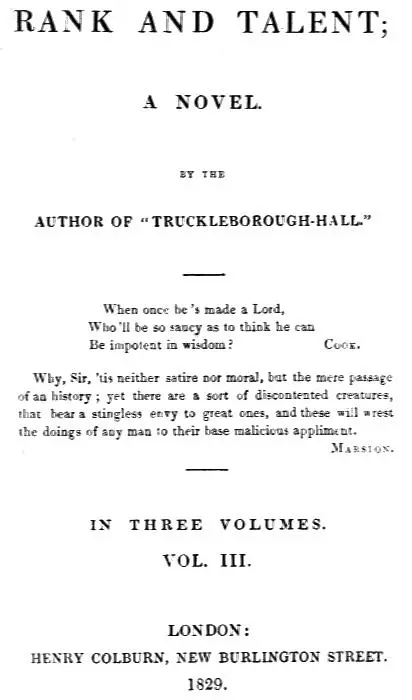
Rank and Talent; A Novel, Vol. 3 (of 3)
William Pitt Scargill
THE CLASSIC COLLECTION · 1829
"Rank and Talent; A Novel, Vol. 2" by William Pitt Scargill is a fictional narrative written in the early 19th century. The novel delves into the societal intricacies of London, exploring themes of class, ambition, and social standing through the character Philip Martindale and his interactions with various figures in high society. The narrative also introduces familial dynamics and romantic elements, particularly regarding the relationships of Martindale and the implications of his ambitious aspirations. The opening of the novel describes the bustling return of society to London after the country season, setting the stage for social rivalries and aspirations. We are introduced to Mr. Martindale, who is preparing to take his daughter Clara to a party hosted by Sir Gilbert Sampson. The dynamic reveals Martindale's cynical perspective on high society and his reluctance to engage with those he considers beneath him, while his cousin Philip faces pressures related to his rank and financial dependencies. Philip's qualms about his status and romantic entanglements foreshadow his struggles to navigate the expectations of aristocracy while exploring the social landscape influenced by wealth and privilege. The exploration of these intertwined relationships creates a rich backdrop for the continuing journey of ambition and class distinction.
Introduction adapted from the source catalogue; source summaries may be automatically generated.
Free to read · English · 56,943 words · No account needed
MAKE TIME FOR A GOOD BOOK
On by default. Untick to stop anonymous reading totals. Each page counts after 10 seconds in view. How this works.
Anonymous counting is on unless you have switched it off.
Now it came to pass that, soon after the arrival in London of Lady Woodstock and her family, and soon as the report was spread abroad that Mr. John Martindale was likely to marry the widow, that the charms of Lady Woodstock's daughters were most loudly blazoned forth, and multitudes began to see beauties of person and mind in these young ladies which they had never seen before. When there appeared a probability that Lady Woodstock was about to become the wife of a very opulent man, and when it was thought as a necessary and natural consequence that her daughters would be handsomely portioned, then, and not till then, was it found out that Lady Woodstock had as choice an assortment of ancestors as any body else; then it was discerned that her daughters were remarkably intelligent and unaffected young women; and then many of her ladyship's old acquaintance who had for some years nearly or totally forgotten her, began to wonder that she never had come up to town before during the season. As yet, however, it was not thought safe for any young gentleman to make formal proposals to any one of the daughters; but the young ladies were by no means neglected. They were not cut either by new or old acquaintance; they never made their appearance without most courteous recognition; and as the younger of the four had scarcely finished her education, but was even in town attended by a music-master at the special appointment of old John Martindale, some songs and some sonatas were dedicated to the young ladies. By degrees, the Woodstocks rose into a species of celebrity. The young ladies did not much affect to set themselves up as literary ladies, but they were perhaps a little proud of being thought not quite so frivolous as the generality of young ladies of the present day. Our readers, we suppose, do not need to be informed that young ladies of the present day are very frivolous; and that they have been so for centuries past, and will be for centuries to come. The times are sadly altered, and so they always will be to the end of time. The daughters of Lady Woodstock were not absolutely blue-stockings. The two eldest had read Locke's Essay on the Human Understanding, and thought it was a book which every body should read. They had also read Paley's Works and Cowper's Poems. The eldest had the reputation of having read Cowper's translation of Homer, though but few gave her credit for that accomplishment. The mother and her four daughters very simultaneously and loudly rebuked the flippancy of the present generation of books. This is also an important and interesting fact which we wish to impress on the minds of our readers, that the modern publications are of a very frivolous and flimsy nature: none of them are worth reading. It is a self-evident maxim--it does not require proof; and if we were to attempt illustration, we should be absolutely overwhelmed with superabundance of materials. Modern publications always have been and always will be worthless. The very words modern and newfangled are in themselves expressions of condemnation. The modern writers merely string together a multitude of words; they have no ideas at all, or if they have by accident any thing like an idea or thought, they overwhelm it with a host of unmeaning words. If Milton's Paradise Lost, or Spenser's Fairy Queen, or Young's Night Thoughts, had been written by any of the writers of the present day, they would have spun the same materials out to a most immoderate and unreasonable length; and if Lord Byron had been the author of the Iliad, he would have made of it a poem as long as Childe Harold; or if any of our modern novel-writers had taken the subject of Clarissa Harlowe, there is every reason to suppose that they would have extended it to the dimensions of Rees's Cyclopedia. The taste of the daughters of Lady Woodstock did not much approve modern literature; and no wonder, when we consider the emptiness and wordiness of the present race of writers; and as to modern periodicals, where is there one that can for a moment compete with what the Lady's Magazine was sixty years ago? But the young ladies were not altogether ignorant of modern literature. They were generally acquainted with the names and titles of new books, and could speak very fluently concerning them at their first appearance, but afterwards they made it a rule to forget them.
Your reading position is saved on this browser. Take it to another device with a library code. Reading pages adapt to text, rather than matching a printed edition.
William Pitt Scargill
William Pitt Scargill
BEHIND THE BOOK
This eBook is for the use of anyone anywhere in the United States and most other parts of the world at no cost and with almost no restrictions whatsoever. You may copy it, give it away or re-use it under the terms of the Project Gutenberg License included with this eBook or online at www.gutenberg.org. If you are not located in the United States, you will have to check the laws of the country where you are located before using this eBook. Read the source licence.
The original source file, including credits and licence, is retained by this library. Request an original-format copy at no charge. Please include the book title and Project Gutenberg identifier #44996.
KEEP YOUR CURIOSITY GOING
Coulson Kernahan

Maurice Baring
Frances Wright
Cécile Tormay

Frederic Jesup Stimson

W. H. P. (William Henry Pope) Jarvis