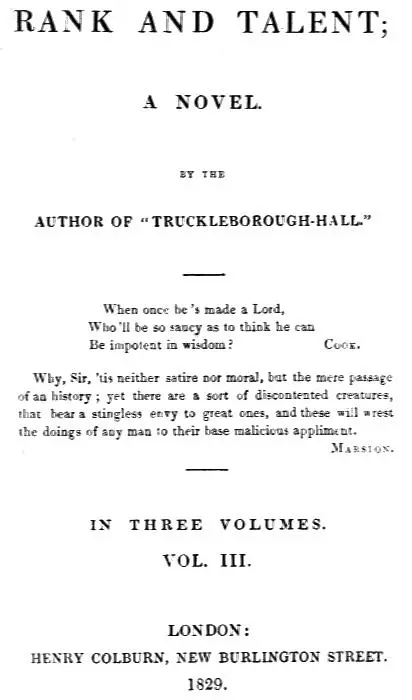
Rank and Talent; A Novel, Vol. 3 (of 3)
William Pitt Scargill
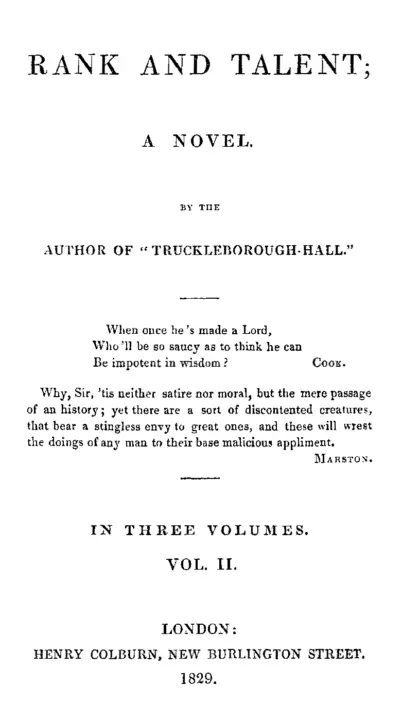
THE CLASSIC COLLECTION · 1829
"Rank and Talent; A Novel, Vol. 2" by William Pitt Scargill is a fictional narrative written in the early 19th century. The novel delves into the societal intricacies of London, exploring themes of class, ambition, and social standing through the character Philip Martindale and his interactions with various figures in high society. The narrative also introduces familial dynamics and romantic elements, particularly regarding the relationships of Martindale and the implications of his ambitious aspirations. The opening of the novel describes the bustling return of society to London after the country season, setting the stage for social rivalries and aspirations. We are introduced to Mr. Martindale, who is preparing to take his daughter Clara to a party hosted by Sir Gilbert Sampson. The dynamic reveals Martindale's cynical perspective on high society and his reluctance to engage with those he considers beneath him, while his cousin Philip faces pressures related to his rank and financial dependencies. Philip's qualms about his status and romantic entanglements foreshadow his struggles to navigate the expectations of aristocracy while exploring the social landscape influenced by wealth and privilege. The exploration of these intertwined relationships creates a rich backdrop for the continuing journey of ambition and class distinction.
Introduction adapted from the source catalogue; source summaries may be automatically generated.
Free to read · English · 56,943 words · No account needed
MAKE TIME FOR A GOOD BOOK
On by default. Untick to stop anonymous reading totals. Each page counts after 10 seconds in view. How this works.
Anonymous counting is on unless you have switched it off.
With an aspect of profound wisdom, and the semblance of close attention, did the ingenious Dr. Crack listen to the elegant Mr. Tippetson's knowing dissertation on the subject of nerves.
"I have taken the greatest pains imaginable, doctor, to get rid of these horrible nervous sensations. I don't think a single medicine has been advertised for the last five years which I have not taken. I have taken balsams, and balms, and syrups, and decoctions, and lozenges, and pills, and steel, and bark, and soda, and cinnamon, besides a great variety of compositions from private and family recipes; I have consulted almost every medical man of any eminence, and I have perseveringly taken all that they have prescribed. Indeed, I have taken so much medicine, that I may be said to have nearly lived upon it. The apothecary's shop has been my kitchen; and yet I seem to be growing worse instead of better. I do think that my complaint is the most obstinate one ever known, nothing will cure it."
That is very true. Mr. Tippetson's is not a singular case, many are the nervous patients whom nothing will cure; but few are those who have the fortitude to take nothing. Dr. Crack's great nostrum was constructed on this principle. He gave or prescribed to his patients that which amounted to nothing; but as it had a name, and he had a fee, and as his patients seemed to themselves to be taking something, their imaginations were amused, and some of them absolutely got well.
Now when the doctor heard the sad story of Mr. Tippetson's nerves, he found that he should have no great difficulty to restore the young gentleman to health. He spoke therefore with great confidence, affirming that his case had been evidently misunderstood and very improperly treated. Then the doctor proceeded to mention the names and cases of several patients of high rank with whom his treatment had been successful; and at length the conversation passed on from nerves to fashionable life. Among other fashionable amusements, mention was made of Mr. Henderson's preaching. Both the doctor and his patient agreed, that it was never worth while to go to church but for the sake of hearing an eloquent and splendid preacher. They also agreed, that Mr. Henderson was a very pleasant gentlemanly man, not at all like a parson. They also coincided in the opinion, that Miss Henderson was pretty and agreeable. Mr. Tippetson thought her something of a blue-stocking, and Dr. Crack thought her a very well-informed and intelligent young lady. Mr. Tippetson, by means of that instinct of which we have spoken above, soon perceived that the doctor was somewhat captivated with the charms of this lady; and having no reason for disliking Miss Henderson, but rather wishing to see her provided with a husband, so as he himself was not the person, he spoke fluently and readily in praise of the young lady, till the ingenious Dr. Crack fancied that the wisest step which he could take would be to make at once an offer of his hand to the daughter of the celebrated and popular Mr. Henderson. It occurred to him also, that by such a connexion his professional notoriety would be increased, and the number of his patients augmented. Thereupon, like those who whistle aloud to keep their courage up, he launched out in praise of the virtues, graces, and beauties of Miss Henderson, till he was astonished that such a paragon of excellence should have remained single so long. And as the next nervous patient that was on his list was Mrs. Henderson, the doctor proceeded to the residence of the great orator, proudly conscious of his own importance, and filled with the thought that the announcement of the marriage of Dr. Crack to Rebecca, eldest daughter, &c., would look mightily magnificent in the eyes of his former humble acquaintance. For though he had dropped all intercourse with the companions and friends of his early youth, he could not help now and then glancing a thought towards them. Oftentimes, when he was admiring and envying the splendid apartments into which some of his professional visits introduced him, he had a thought of his former humble friends, and he said within himself, "How little do they think of the grandeur to which I am introduced!" There is a gratification in greatness from its contrast with littleness. It is a pleasure to look down from an eminence, but it makes weak heads giddy.
Your reading position is saved on this browser. Take it to another device with a library code. Reading pages adapt to text, rather than matching a printed edition.
William Pitt Scargill
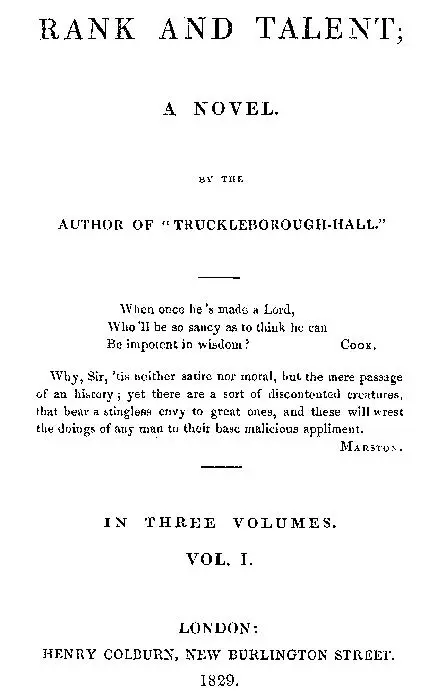
William Pitt Scargill
BEHIND THE BOOK
This eBook is for the use of anyone anywhere in the United States and most other parts of the world at no cost and with almost no restrictions whatsoever. You may copy it, give it away or re-use it under the terms of the Project Gutenberg License included with this eBook or online at www.gutenberg.org. If you are not located in the United States, you will have to check the laws of the country where you are located before using this eBook. Read the source licence.
The original source file, including credits and licence, is retained by this library. Request an original-format copy at no charge. Please include the book title and Project Gutenberg identifier #44996.
KEEP YOUR CURIOSITY GOING
Coulson Kernahan

Maurice Baring
Frances Wright
Cécile Tormay

Frederic Jesup Stimson

W. H. P. (William Henry Pope) Jarvis