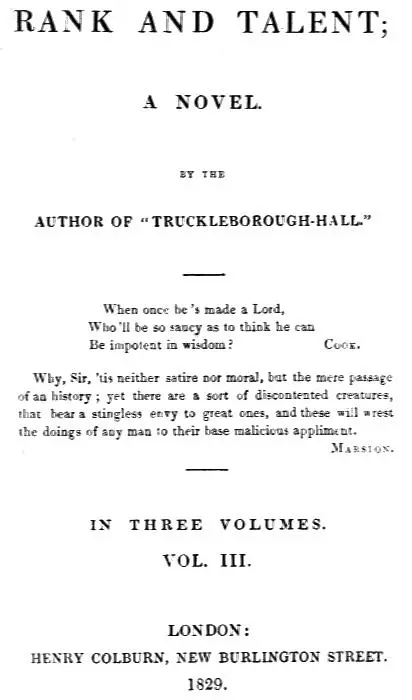
Rank and Talent; A Novel, Vol. 3 (of 3)
William Pitt Scargill
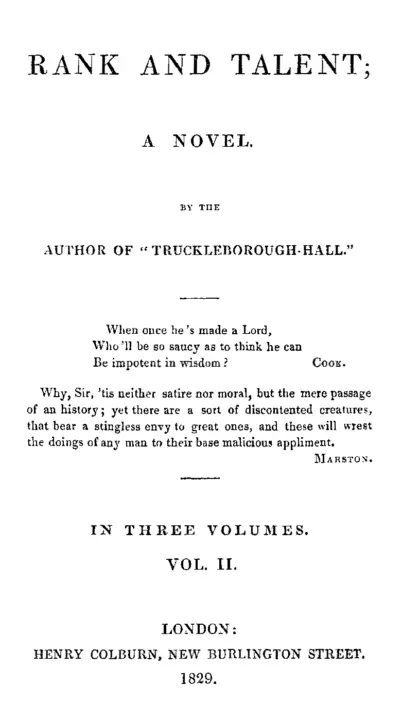
THE CLASSIC COLLECTION · 1829
"Rank and Talent; A Novel, Vol. 2" by William Pitt Scargill is a fictional narrative written in the early 19th century. The novel delves into the societal intricacies of London, exploring themes of class, ambition, and social standing through the character Philip Martindale and his interactions with various figures in high society. The narrative also introduces familial dynamics and romantic elements, particularly regarding the relationships of Martindale and the implications of his ambitious aspirations. The opening of the novel describes the bustling return of society to London after the country season, setting the stage for social rivalries and aspirations. We are introduced to Mr. Martindale, who is preparing to take his daughter Clara to a party hosted by Sir Gilbert Sampson. The dynamic reveals Martindale's cynical perspective on high society and his reluctance to engage with those he considers beneath him, while his cousin Philip faces pressures related to his rank and financial dependencies. Philip's qualms about his status and romantic entanglements foreshadow his struggles to navigate the expectations of aristocracy while exploring the social landscape influenced by wealth and privilege. The exploration of these intertwined relationships creates a rich backdrop for the continuing journey of ambition and class distinction.
Introduction adapted from the source catalogue; source summaries may be automatically generated.
Free to read · English · 56,943 words · No account needed
MAKE TIME FOR A GOOD BOOK
On by default. Untick to stop anonymous reading totals. Each page counts after 10 seconds in view. How this works.
Anonymous counting is on unless you have switched it off.
While thus neglecting his patients to talk sentimentality with Miss Henderson, and swallow boluses of flattery from the fair lips of the lovely daughter of the fashionable preacher, this skilful doctor inadvertently suffered his affections to be fixed, as far as affections like his could be fixed on any one, on the sentimental and scientific young lady. Notoriety was the doctor's great passion. To be distinguished in the world was in his view the sum and supremacy of earthly bliss. Through this passion might his heart be won, and by this principle might he be easily led, either to wisdom or folly as the case might require.
There are always to be found about town, great, lubberly, weak, idle men of family, with whom such men as Dr. Crack may be on most excellent terms. Such a one was Singleton Sloper, fourth or fifth cousin of Lord Sloper. Singleton Sloper was about five-and-thirty years of age; as ignorant as it is possible for any human creature to be. He had not even received the benefit of an education at a public school; but when he was a boy, he did by means of much roaring, blubbering, and grumbling, prevail with his indulgent parents to let him go to a nice, neat, quiet, comfortable, little boarding-school for young gentlemen, where the strictest attention was paid to the health and morals of the pupils, and where the milder arts of persuasion were substituted for the needless severity of public schools. It was one of those schools to which mammas are so partial. The young gentlemen were kept so nicely, and no rude boisterous play was allowed. All the books were so prettily embellished, and the young gentlemen, instead of learning a little Greek and Latin as they do at public schools, were instructed so prettily in all the arts and sciences, that they became in a few years universal philosophers. But we must turn our attention to Mr. Singleton Sloper, who had not, we are sorry to say, profited so much by this excellent system of instruction as young gentlemen usually do. For in general it is found, that though there may be some slight lack of ideas in persons thus instructed, they generally remember some words which might be useful if they knew how to apply them; but Dr. Crack's great friend, Singleton Sloper, had even forgotten all the words which he had learned. He had certainly been very wisely taught by the interrogatory system, which answers finely in the holidays, but unfortunately as Singleton grew up he forgot it, or questions and answers were in his cranium so jumbled together, that he could not tell which was which. Those there are who may be a little surprised that the learned and eloquent Dr. Crack should find pleasure in associating with so stupid a creature as Singleton Sloper. We were astonished when we first heard of it; but the fact is, that the pleasure of an intimacy with a gentleman related to nobility was enough to counterbalance every other consideration. And though Singleton was a sottish, low-minded, and ill-looking being, yet Dr. Crack, who was a smart, spruce dapper-looking, dandy-like animal, was absolutely proud of strutting about in broad daylight with this poor, empty-headed creature. To his capacity and comprehension did the doctor endeavour to adapt himself, and with him would the doctor talk about all the vulgarities and coarsenesses of low-minded, high-born, indolent people. The doctor was really proud of this acquaintance, and to lower people would boast of his intimacy with his friend Sloper. This worthy was not absolutely cut by all of his own rank, because it was possible that in the course of time he might become possessed of large estates and great influence: but such were his low and vulgar habits, that few took much notice of him; therefore, he was accessible to plebeians. Being for his vulgar habits and coarseness of mind and manners treated superciliously by persons of rank with whom his birth gave him a right to be on terms of intimacy and feeling, that his own manners were such as could not recommend him to persons of gentlemanly mind, he was very much addicted to declaim among his vulgar associates on the pride and haughtiness of the great. Dr. Crack too, who had not found rank quite so accessible as he had desired and expected, joined in the declamation, and expressed his contempt for all kinds of pride. It was amusing enough that Dr. Crack, who had consigned to oblivion all his poor little cousin Cricks to the four-and-twentieth ramification of relationship, should turn up his nose at the pomposity and exclusiveness of persons of rank and fortune.
Your reading position is saved on this browser. Take it to another device with a library code. Reading pages adapt to text, rather than matching a printed edition.
William Pitt Scargill
William Pitt Scargill
BEHIND THE BOOK
This eBook is for the use of anyone anywhere in the United States and most other parts of the world at no cost and with almost no restrictions whatsoever. You may copy it, give it away or re-use it under the terms of the Project Gutenberg License included with this eBook or online at www.gutenberg.org. If you are not located in the United States, you will have to check the laws of the country where you are located before using this eBook. Read the source licence.
The original source file, including credits and licence, is retained by this library. Request an original-format copy at no charge. Please include the book title and Project Gutenberg identifier #44996.
KEEP YOUR CURIOSITY GOING
Coulson Kernahan

Maurice Baring
Frances Wright
Cécile Tormay

Frederic Jesup Stimson

W. H. P. (William Henry Pope) Jarvis