THE CLASSIC COLLECTION✦Letters to an UnknownCLASSIC FREE BOOKS
Letters to an Unknown
Prosper Mérimée
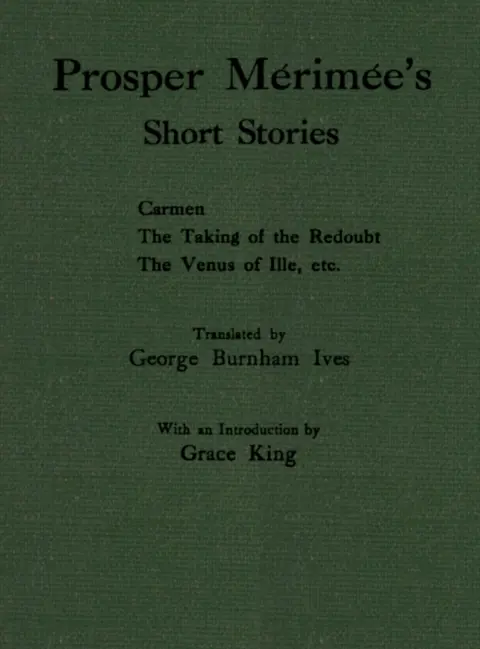
THE CLASSIC COLLECTION · 1903
"Prosper Mérimée's Short Stories" by Prosper Mérimée is a collection of fictional narratives likely written during the mid-19th century. The collection features notable stories like "Carmen," "Mateo Falcone," and "The Venus of Ille," each showcasing Mérimée's mastery of narrative simplicity and vivid character portrayal. The stories explore themes of passion, conflict, and human nature, often set against exotic backdrops, with intriguing characters such as the gypsy Carmen, whose life and actions intricately weave through the moral and social fabric of her time. The opening of "Carmen" sets the stage with a protagonist who is an unnamed narrator, embarking on an archaeological expedition in Andalucía. During his journey, he stumbles upon a mysterious and attractive young man named Don José, who is armed and displays a proud demeanor. Their interaction begins with a casual exchange as they share cigars, leading the narrator to suspect José’s dubious nature as a smuggler or a highwayman. During their conversation, the narrator's guide reveals that José is in fact a notorious bandit with a substantial reward on his head. Ultimately, the opening section teases a budding relationship with the captivating figure of Carmen, hinting at themes of adventure, romance, and moral ambiguity that will unfold as the story progresses.
Introduction adapted from the source catalogue; source summaries may be automatically generated.
Free to read · English · 43,447 words · No account needed
MAKE TIME FOR A GOOD BOOK
On by default. Untick to stop anonymous reading totals. Each page counts after 10 seconds in view. How this works.
Anonymous counting is on unless you have switched it off.
Giuseppa embraced her son and entered her cabin, weeping. She fell on her knees before an image of the Virgin and prayed fervently. Meanwhile Falcone walked some two hundred yards along the path, and did not stop until they reached a narrow ravine into which he descended. He sounded the earth with the butt of his rifle, and found it soft and easy to dig. It seemed to him a suitable spot for his design.
“Fortunato, go and stand by that big stone.”
The child did what he ordered, then knelt.
“Say your prayers.”
“Father, father, don’t kill me!”
“Say your prayers!” Mateo repeated, in a terrible voice.
The child, stammering and sobbing, repeated the Pater and the
Credo. The father, in a loud voice, said Amen! at the end of each
prayer.
“Are those all the prayers you know?”
“I know the Ave Maria, too, father, and the litany my aunt taught me.”
“That’s very long, but no matter.”
The child finished the litany in a feeble voice.
“Have you finished?”
“Oh, father! mercy! forgive me! I won’t do it again! I will pray so hard to my uncle the caporal that he’ll forgive Gianetto!”
He continued to speak; Mateo had cocked his gun, and he took aim at
him, saying:
“May God forgive you!”
The child made a desperate effort to rise and grasp his father’s knees; but he had not time. Mateo fired, and Fortunato fell stark dead.
Without glancing at the body, Mateo returned to his house to fetch a spade, in order to bury his son. He had taken only a few steps, when he met Giuseppa, who was running after them, terrified by the report.
“What have you done?” she cried.
“Justice.”
“Where is he?”
“In the ravine. I am going to bury him. He died the death of a Christian; I will have a mass sung for him. Send word to my son-in-law Tiodoro Bianchi to come and live with us.”
[40] In olden times the caporals were the leaders chosen by the Corsican communes when they rebelled against the feudal lords. To-day the name is sometimes given to a man who, by reason of his property, his alliances, and his clientage, exerts a certain influence and acts as a sort of magistrate in a pieve or a canton. The Corsicans, by an ancient custom, divide themselves into gentlemen (some of whom are magnificoes, others signori), caporali, citizens, plebeians, and foreigners.
[41] The word is in this instance synonymous with outlaw.
[42] A corps levied within a few years by the government and employed on police duty, concurrently with the gendarmerie.
Your reading position is saved on this browser. Take it to another device with a library code. Reading pages adapt to text, rather than matching a printed edition.
BEHIND THE BOOK
This eBook is for the use of anyone anywhere in the United States and most other parts of the world at no cost and with almost no restrictions whatsoever. You may copy it, give it away or re-use it under the terms of the Project Gutenberg License included with this eBook or online at www.gutenberg.org. If you are not located in the United States, you will have to check the laws of the country where you are located before using this eBook. Read the source licence.
The original source file, including credits and licence, is retained by this library. Request an original-format copy at no charge. Please include the book title and Project Gutenberg identifier #67643.
KEEP YOUR CURIOSITY GOING
Coulson Kernahan

Maurice Baring
Frances Wright
Cécile Tormay

Frederic Jesup Stimson

W. H. P. (William Henry Pope) Jarvis