THE CLASSIC COLLECTION✦Letters to an UnknownCLASSIC FREE BOOKS
Letters to an Unknown
Prosper Mérimée
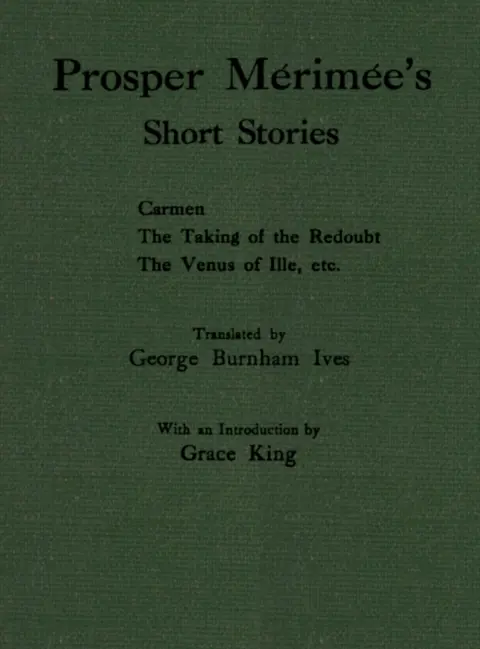
THE CLASSIC COLLECTION · 1903
"Prosper Mérimée's Short Stories" by Prosper Mérimée is a collection of fictional narratives likely written during the mid-19th century. The collection features notable stories like "Carmen," "Mateo Falcone," and "The Venus of Ille," each showcasing Mérimée's mastery of narrative simplicity and vivid character portrayal. The stories explore themes of passion, conflict, and human nature, often set against exotic backdrops, with intriguing characters such as the gypsy Carmen, whose life and actions intricately weave through the moral and social fabric of her time. The opening of "Carmen" sets the stage with a protagonist who is an unnamed narrator, embarking on an archaeological expedition in Andalucía. During his journey, he stumbles upon a mysterious and attractive young man named Don José, who is armed and displays a proud demeanor. Their interaction begins with a casual exchange as they share cigars, leading the narrator to suspect José’s dubious nature as a smuggler or a highwayman. During their conversation, the narrator's guide reveals that José is in fact a notorious bandit with a substantial reward on his head. Ultimately, the opening section teases a budding relationship with the captivating figure of Carmen, hinting at themes of adventure, romance, and moral ambiguity that will unfold as the story progresses.
Introduction adapted from the source catalogue; source summaries may be automatically generated.
Free to read · English · 43,447 words · No account needed
MAKE TIME FOR A GOOD BOOK
On by default. Untick to stop anonymous reading totals. Each page counts after 10 seconds in view. How this works.
Anonymous counting is on unless you have switched it off.
“Away from me!” shouted the outlaw in a voice of thunder. Then, turning to one of the voltigeurs, “Comrade,” he said, “give me a drink.”
The soldier placed his gourd in his hands, and the outlaw drank the water given him by a man with whom he had recently exchanged rifle shots. Then he asked that his hands might be bound so that they would be folded on his breast, instead of behind his back.
“I like to lie comfortably,” he said.
They readily gratified him; then the adjutant gave the signal for departure, bade adieu to Mateo, who made no reply, and marched down at a rapid pace towards the plain.
Nearly ten minutes passed before Mateo opened his mouth. The child glanced uneasily, now at his mother and now at his father, who, leaning upon his gun, gazed at him with an expression of intense wrath.
“You begin well!” said Mateo at last, in a voice which, although calm, was terrifying to one who knew the man.
“Father!” cried the child stepping forward, with tears in his eyes, as if to throw himself at his feet.
But Mateo cried:
“Away from me!”
And the child stopped and stood still, sobbing, a few steps from his
father.
Giuseppa approached. She had spied the watch chain, one end of which protruded from Fortunato’s shirt.
“Who gave you that watch?” she asked in a harsh tone.
“My cousin the adjutant.”
Falcone seized the watch, and hurled it against a stone, breaking it
into a thousand pieces.
“Woman,” he said, “is this child mine?”
Giuseppa’s brown cheeks turned a brick red.
“What do you say, Mateo? Do you know who you’re talking to?”
“Well, this child is the first of his race that ever did an act of
treachery.”
Fortunato’s sobs and hiccoughs redoubled in force, and Falcone still kept his lynx-eyes fastened on him. At last he struck the butt of his gun on the ground, then threw it over his shoulder again and started back toward the maquis, calling to Fortunato to follow him. The child obeyed.
Giuseppa ran after Mateo and grasped his arm.
“He is your son,” she said in a trembling voice, fixing her black eyes on her husband’s, as if to read what was taking place in his mind.
“Let me alone,” replied Mateo, “I am his father.”
Your reading position is saved on this browser. Take it to another device with a library code. Reading pages adapt to text, rather than matching a printed edition.
BEHIND THE BOOK
This eBook is for the use of anyone anywhere in the United States and most other parts of the world at no cost and with almost no restrictions whatsoever. You may copy it, give it away or re-use it under the terms of the Project Gutenberg License included with this eBook or online at www.gutenberg.org. If you are not located in the United States, you will have to check the laws of the country where you are located before using this eBook. Read the source licence.
The original source file, including credits and licence, is retained by this library. Request an original-format copy at no charge. Please include the book title and Project Gutenberg identifier #67643.
KEEP YOUR CURIOSITY GOING
Coulson Kernahan

Maurice Baring
Frances Wright
Cécile Tormay

Frederic Jesup Stimson

W. H. P. (William Henry Pope) Jarvis