THE CLASSIC COLLECTION✦Letters to an UnknownCLASSIC FREE BOOKS
Letters to an Unknown
Prosper Mérimée
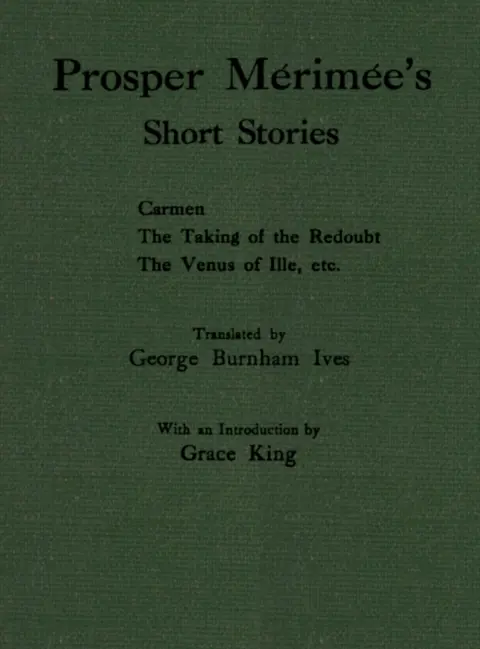
THE CLASSIC COLLECTION · 1903
"Prosper Mérimée's Short Stories" by Prosper Mérimée is a collection of fictional narratives likely written during the mid-19th century. The collection features notable stories like "Carmen," "Mateo Falcone," and "The Venus of Ille," each showcasing Mérimée's mastery of narrative simplicity and vivid character portrayal. The stories explore themes of passion, conflict, and human nature, often set against exotic backdrops, with intriguing characters such as the gypsy Carmen, whose life and actions intricately weave through the moral and social fabric of her time. The opening of "Carmen" sets the stage with a protagonist who is an unnamed narrator, embarking on an archaeological expedition in Andalucía. During his journey, he stumbles upon a mysterious and attractive young man named Don José, who is armed and displays a proud demeanor. Their interaction begins with a casual exchange as they share cigars, leading the narrator to suspect José’s dubious nature as a smuggler or a highwayman. During their conversation, the narrator's guide reveals that José is in fact a notorious bandit with a substantial reward on his head. Ultimately, the opening section teases a budding relationship with the captivating figure of Carmen, hinting at themes of adventure, romance, and moral ambiguity that will unfold as the story progresses.
Introduction adapted from the source catalogue; source summaries may be automatically generated.
Free to read · English · 43,447 words · No account needed
MAKE TIME FOR A GOOD BOOK
On by default. Untick to stop anonymous reading totals. Each page counts after 10 seconds in view. How this works.
Anonymous counting is on unless you have switched it off.
Spain is one of those countries where we find to-day in the greatest numbers those nomads who are scattered over all Europe, and are known by the names of Bohemians, Gitanos, Gypsies, Zigeuner, etc. Most of them live, or rather lead a wandering existence, in the provinces of the south and east, in Andalusia, Estremadura, and the kingdom of Murcia; there are many in Catalonia. These latter often cross the frontier into France. They are to be seen at all the fairs in the Midi. Ordinarily the men carry on the trades of horse-dealer, veterinary, and clipper of mules; they combine therewith the industry of mending kettles and copper implements, to say nothing of smuggling and other illicit traffic. The women tell fortunes, beg, and sell all sorts of drugs, innocent or not.
The physical characteristics of the gypsy are easier to distinguish than to describe, and when you have seen a single one, you can readily pick out a person of that race from a thousand others. Features and expression--these above all else separate them from the natives of the countries where they are found. Their complexion is very dark, always darker than that of the peoples among whom they live. Hence the name Cale--black--by which they often refer to themselves. Their eyes, which are perceptibly oblique, well-shaped, and very black, are shaded by long, thick lashes. One can compare their look to nothing save that of a wild beast. Audacity and timidity are depicted therein at once, and in that respect their eyes express accurately enough the character of the race--crafty, insolent, but naturally afraid of blows, like Panurge. As a general rule, the men are well-knit, slender, and active; I believe that I have never seen a single one overburdened with flesh. In Germany, the gypsy women are often very pretty; beauty is very rare among the gitanas of Spain. When they are very young, they may pass for rather attractive ugly women; but when they have once become mothers, they are repulsive. The uncleanliness of both sexes is beyond belief, and one who has never seen the hair of a gypsy matron would find it hard to form an idea of it, even by imagining it as like the coarsest, greasiest, dustiest horsehair. In some large cities of Andalusia, some of the girls who are a little more attractive than the rest take more care of their persons. They go about dancing for money--dances very like those which are forbidden at our (Parisian) public balls during the Carnival. M. Borrow, an English missionary, the author of two very interesting works on the gypsies of Spain, whom he had undertaken to convert at the expense of the Bible Society, asserts that there is no known instance of a gitana having a weakness for a man not of her race. It seems to me that there is much exaggeration in the eulogium which he bestows on their chastity. In the first place, the great majority of them are in the plight of Ovid’s ugly woman: Casta quam nemo rogavit. As for the pretty ones, they are, like all Spanish women, exacting in the choice of their lovers. A man must please them and deserve them. M. Borrow cites as a proof of their virtue an instance which does honour to his own virtue, and above all to his innocence. An immoral man of his acquaintance, he says, offered several ounces of gold to a pretty gitana, to no purpose. An Andalusian to whom I told this anecdote declared that that same immoral man would have had better luck if he had shown only two or three piastres, and that to offer ounces of gold to a gypsy was as poor a way to persuade her as to promise a million or two to a servant girl at an inn. However that may be, it is certain that the gitanas display a most extraordinary devotion to their husbands. There is no peril or privation which they will not defy, in order to assist them in their need. One of the names by which the gypsies call themselves--romi or spouses--seems to me to bear witness to the respect of the race for the marriage state. In general, we may say that their principal virtue is patriotism, if we may call by that name the fidelity which they observe in their relations with persons of the same origin as themselves, the zeal with which they help one another, and the inviolable secrecy which they maintain in respect to compromising affairs. Indeed, we may remark something similar in all associations that are shrouded in mystery and are outside of the law.
Your reading position is saved on this browser. Take it to another device with a library code. Reading pages adapt to text, rather than matching a printed edition.
BEHIND THE BOOK
This eBook is for the use of anyone anywhere in the United States and most other parts of the world at no cost and with almost no restrictions whatsoever. You may copy it, give it away or re-use it under the terms of the Project Gutenberg License included with this eBook or online at www.gutenberg.org. If you are not located in the United States, you will have to check the laws of the country where you are located before using this eBook. Read the source licence.
The original source file, including credits and licence, is retained by this library. Request an original-format copy at no charge. Please include the book title and Project Gutenberg identifier #67643.
KEEP YOUR CURIOSITY GOING
Coulson Kernahan

Maurice Baring
Frances Wright
Cécile Tormay

Frederic Jesup Stimson

W. H. P. (William Henry Pope) Jarvis