READ · DISCOVER · ENJOYClassic literature · Always free
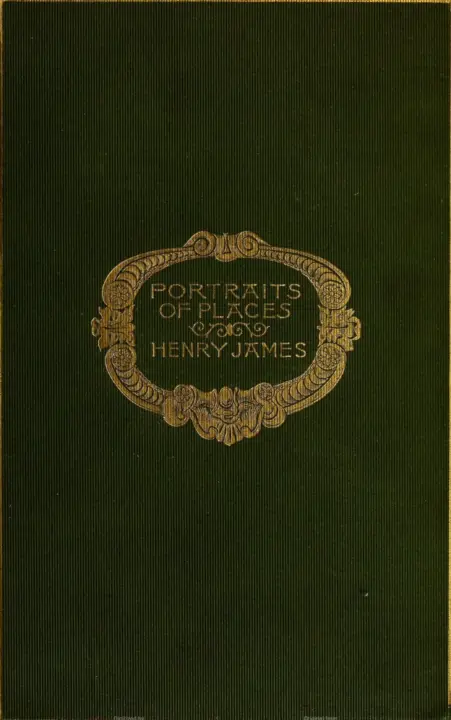
Portraits of places — digital edition cover

THE CLASSIC COLLECTION · 1883

Portraits of places

"Portraits of Places" by Henry James is a collection of essays that captures the author’s reflective travel experiences, likely written in the late 19th century. The essays showcase various cities and locations, focusing on their unique atmospheres and cultural significance, with Venice taking center stage as a prime example of beauty and complexity intertwined with the weight of history. Through James’ intricate observations, readers can anticipate insights into both the charm and the disillusionment that often accompany travel. The opening of the work begins with an affectionate exploration of Venice, where the author expresses both admiration and resignation towards its well-trodden paths and familiar sights. He reflects on the allure of the city that has been celebrated countless times, acknowledging its status as a beloved yet over-visited destination. James embraces the idea of revisiting well-known experiences, finding depth in simple pleasures that Venice offers, such as the vibrant local life and its art. This initial portion sets the stage for a travel narrative that is steeped in nostalgia, as James invites readers to engage with the emotional and intellectual dimensions of travel, while pondering the changes that time inevitably brings to iconic places.

Introduction adapted from the source catalogue; source summaries may be automatically generated.

Start reading ↓

Free to read · English · 102,626 words · No account needed

MAKE TIME FOR A GOOD BOOK

Portraits of places

On by default. Untick to stop anonymous reading totals. Each page counts after 10 seconds in view. How this works.

Anonymous counting is on unless you have switched it off.

Portraits of places

The churches of Venice are rich in pictures, and many a masterpiece lurks in the unaccommodating gloom of side-chapels and sacristies. Many a noble work is perched behind the dusty candles and muslin roses of a scantily-visited altar; some of them, indeed, are hidden behind the altar, in a darkness that can never be explored. The facilities offered you for approaching the picture, in such cases, are a kind of mockery of your irritated desire. You stand on tip-toe on a three-legged stool, you climb a rickety ladder, you almost mount upon the shoulders of the custode. You do everything but see the picture. You see just enough to perceive that it is beautiful. You catch a glimpse of a divine head, of a fig-tree against a mellow sky; but the rest is impenetrable mystery. You renounce all hope, for instance, of approaching the magnificent Cima da Conegliano in San Giovanni in Bragora; and bethinking yourself of the immaculate purity that dwells in the works of this master, you renounce it with chagrin and pain. Behind the high altar, in that church, there hangs a Baptism of Christ, by Cima, which, I believe, has been more or less repainted. You can make the thing out in spots; you can see that it has a fulness of perfection. But you turn away from it with a stiff neck, and promise yourself consolation in the Academy and at the Madonna dell' Orto, where two noble pictures, by the same hand--pictures as clear as a summer twilight--present themselves in better circumstances. It may be said, as a general thing, that you never see the Tintoret. You admire him, you adore him, you think him the greatest of painters, but, in the great majority of cases, you don't see him. This is partly his own fault; so many of his works have turned to blackness and are positively rotting in their frames. At the Scuola di San Rocco, where there are acres of the Tintoret, there is scarcely anything at all adequately visible save the immense "Crucifixion" in the upper story. It is true that in looking at this huge composition you look at many pictures; it has not only a multitude of figures, but a wealth of episodes; and you pass from one of these to the other as if you were "doing" a gallery. Surely, no single picture in the world contains more of human life; there is everything in it, including the most exquisite beauty. It is one of the greatest things of art; it is always interesting. There are pictures by the Tintoret which contain touches more exquisite, revelations of beauty more radiant, but there is no other vision of so intense a reality and execution so splendid. The interest, the impressiveness, of that whole corner of Venice, however melancholy the effect of its gorgeous and ill-lighted chambers, gives a strange importance to a visit to the Scuola. Nothing that all travellers go to see appears to suffer less from the incursions of travellers. It is one of the loneliest booths of the bazaar, and the author of these lines has always had the good fortune, which he wishes to every other traveller, of having it to himself. I think most visitors find the place rather alarming and wicked-looking. They walk about a while among the fitful figures that gleam here and there out of the great tapestry (as it were) with which the painter has hung all the walls, and then, depressed and bewildered by the portentous solemnity of these objects, by strange glimpses of unnatural scenes, by the echo of their lonely footsteps on the vast stone floors, they take a hasty departure, and find themselves again, with a sense of release from danger, and of the genius loci having been a sort of mad white-washer, who worked with a bad mixture, in the bright light of the campo, among the beggars, the orange-vendors, and the passing gondolas. Solemn, indeed, is the place, solemn and strangely suggestive, for the simple reason that we shall scarcely find four walls elsewhere that inclose within a like area an equal quantity of genius. The air is thick with it, and dense and difficult to breathe; for it was genius that was not happy, inasmuch as it lacked the art to fix itself for ever. It is not immortality that we breathe at the Scuola di San Rocco, but conscious, reluctant mortality. Fortunately, however, we have the Ducal Palace, where everything is so brilliant and splendid that the poor dusky Tintoret is lifted in spite of himself into the concert. This deeply original building is, of course, the loveliest thing in Venice, and a morning's stroll there is a wonderful illumination. Cunningly select your hour--half the enjoyment of Venice is a question of dodging--and go at about one o'clock, when the tourists have gone to lunch and the echoes of the charming chambers have gone to sleep among the sunbeams. There is no brighter place in Venice; by which I mean that, on the whole, there is none half so bright. The reflected sunshine plays up through the great windows from the glittering lagoon, and shimmers and twinkles over gilded walls and ceilings. All the history of Venice, all its splendid, stately past, glows around you in a strong sea-light. Every one here is magnificent, but the great Veronese is the most magnificent of all. He swims before you in a silver cloud; he thrones in an eternal morning. The deep blue sky burns behind him, streaked across with milky bars; the white colonnades sustain the richest canopies, under which the first gentlemen and ladies in the world both render homage and receive it. Their glorious garments rustle in the air of the sea, and their sun-lighted faces are the very complexion of Venice. The mixture of pride and piety, of politics and religion, of art and patriotism, gives a magnificent dignity to every scene. Never was a painter more nobly joyous, never did an artist take a greater delight in life, seeing it all as a kind of breezy festival and feeling it through the medium of perpetual success. He revels in the gold-framed ovals of the ceilings, with the fluttering movement of an embroidered banner that tosses itself into the blue. He was the happiest of painters, and he produced the happiest picture in the world. The "Rape of Europa" surely deserves this title; it is impossible to look at it without aching with envy. Nowhere else in art is such a temperament revealed; never did inclination and opportunity combine to express such enjoyment. The mixture of flowers and gems and brocade, of blooming flesh and shining sea and waving groves, of youth, health, movement, desire--all this is the brightest vision that ever descended upon the soul of a painter. Happy the artist who could entertain such a vision; happy the artist who could paint it as the "Rape of Europa" is painted. The Tintoret's visions were not so bright as that; but he had several that were radiant enough. In the room that contains the "Rape of Europa" are several smaller canvases by the greatly more complex genius of the Scuola di San Rocco, which are almost simple in their loveliness, almost happy in their simplicity. They have kept their brightness through the centuries, and they shine with their neighbours in those golden rooms. There is a piece of painting in one of them which is one of the sweetest things in Venice, and which reminds one afresh of those wild flowers of execution that bloom so profusely and so unheeded in the dark corners of all of the Tintoret's work. "Pallas chasing away Mars" is, I believe, the name that is given to the picture; and it represents in fact a young woman of noble appearance administering a gentle push to a fine young man in armour, as if to tell him to keep his distance. It is of the gentleness of this push that I speak, the charming way in which she puts out her arm, with a single bracelet on it, and rests her young hand, with its rosy fingers parted, upon his dark breastplate. She bends her enchanting head with the effort--a head which has all the strange fairness that the Tintoret always sees in women--and the soft, living, flesh-like glow of all these members, over which the brush has scarcely paused in its course, is as pretty an example of genius as all Venice can show. But why speak of the Tintoret when I can say nothing of the great "Paradise," which unfolds its somewhat smoky splendour, and the wonder of its multitudinous circles, in one of the other chambers? If it were not one of the first pictures in the world, it would be about the biggest, and it must be confessed that at first the spectator gets from it chiefly an impression of quantity. Then he sees that this quantity is really wealth; that the dim confusion of faces is a magnificent composition, and that some of the details of this composition are supremely beautiful. It is impossible, however, in a retrospect of Venice, to specify one's happiest hours, though, as one looks backward, certain ineffaceable moments start here and there into vividness. How is it possible to forget one's visits to the sacristy of the Frari, however frequent they may have been, and the great work of John Bellini which forms the treasure of that apartment?

Your reading position is saved on this browser. Take it to another device with a library code. Reading pages adapt to text, rather than matching a printed edition.

More from this author

BEHIND THE WORDS

About Henry James

Henry James (1843–1916). An American-born novelist whose fiction examines consciousness, social conventions and encounters between American and European lives. Explore Hawthorne (English Men of Letters Series), The Diary of a Man of Fifty, Watch and ward and other works in this collection. These books span biography & memoir, essays & ideas, classic fiction.

Explore this author’s books →

THE READERS’ VERDICT

How did this story stay with you?

Not rated yet
Your rating for Portraits of places

Be the first to share your verdict.

One rating per browser, which you can change or remove. A necessary browser identifier remembers your vote. How ratings work

A GOOD STORY DESERVES COMPANY

Pass this book along.

A great read is even better when it’s shared.

SEND A LITTLE INSPIRATION

Share this book

BEHIND THE BOOK

Edition & source details.

Title
Portraits of places
Author
Henry James
First publication (Open Library catalogue match)
1883
Digital edition publisher
Project Gutenberg
Gutenberg release date
2022-09-11
Language
English
Source edition imprint
$aUnited States :$bHoughton, Mifflin and Company,$c1883.
Source identifier
Project Gutenberg #68961
Contributors
No additional named contributors in source metadata

Public-domain source & licence

This eBook is for the use of anyone anywhere in the United States and most other parts of the world at no cost and with almost no restrictions whatsoever. You may copy it, give it away or re-use it under the terms of the Project Gutenberg License included with this eBook or online at www.gutenberg.org. If you are not located in the United States, you will have to check the laws of the country where you are located before using this eBook. Read the source licence.

Full source licence and obtaining an original copy

The original source file, including credits and licence, is retained by this library. Request an original-format copy at no charge. Please include the book title and Project Gutenberg identifier #68961.

the full Project Gutenberg License must appear
prominently whenever any copy of a Project Gutenberg work (any work
on which the phrase “Project Gutenberg” appears, or with which the
phrase “Project Gutenberg” is associated) is accessed, displayed,
performed, viewed, copied or distributed:

This eBook is for the use of anyone anywhere in the United States and most
other parts of the world at no cost and with almost no restrictions
whatsoever. You may copy it, give it away or re-use it under the terms
of the Project Gutenberg™ License included with this eBook or online
at www.gutenberg.org. If you
are not located in the United States, you will have to check the laws
of the country where you are located before using this eBook.

1.E.2. If an individual Project Gutenberg electronic work is
derived from texts not protected by U.S. copyright law (does not
contain a notice indicating that it is posted with permission of the
copyright holder), the work can be copied and distributed to anyone in
the United States without paying any fees or charges. If you are
redistributing or providing access to a work with the phrase “Project
Gutenberg” associated with or appearing on the work, you must comply
either with the requirements of paragraphs 1.E.1 through 1.E.7 or
obtain permission for the use of the work and the Project Gutenberg
trademark as set forth in paragraphs 1.E.8 or 1.E.9.

1.E.3. If an individual Project Gutenberg electronic work is posted
with the permission of the copyright holder, your use and distribution
must comply with both paragraphs 1.E.1 through 1.E.7 and any
additional terms imposed by the copyright holder. Additional terms
will be linked to the Project Gutenberg License for all works
posted with the permission of the copyright holder found at the
beginning of this work.

1.E.4. Do not unlink or detach or remove the full Project Gutenberg
License terms from this work, or any files containing a part of this
work or any other work associated with Project Gutenberg.

1.E.5. Do not copy, display, perform, distribute or redistribute this
electronic work, or any part of this electronic work, without
prominently displaying the sentence set forth in paragraph 1.E.1 with
active links or immediate access to the full terms of the Project
Gutenberg License.

1.E.6. You may convert to and distribute this work in any binary,
compressed, marked up, nonproprietary or proprietary form, including
any word processing or hypertext form. However, if you provide access
to or distribute copies of a Project Gutenberg work in a format
other than “Plain Vanilla ASCII” or other format used in the official
version posted on the official Project Gutenberg website
(www.gutenberg.org), you must, at no additional cost, fee or expense
to the user, provide a copy, a means of exporting a copy, or a means
of obtaining a copy upon request, of the work in its original “Plain
Vanilla ASCII” or other form. Any alternate format must include the
full Project Gutenberg License as specified in paragraph 1.E.1.

1.E.7. Do not charge a fee for access to, viewing, displaying,
performing, copying or distributing any Project Gutenberg works
unless you comply with paragraph 1.E.8 or 1.E.9.

1.E.8. You may charge a reasonable fee for copies of or providing
access to or distributing Project Gutenberg electronic works
provided that:

• You pay a royalty fee of 20% of the gross profits you derive from
the use of Project Gutenberg works calculated using the method
you already use to calculate your applicable taxes. The fee is owed
to the owner of the Project Gutenberg trademark, but he has
agreed to donate royalties under this paragraph to the Project
Gutenberg Literary Archive Foundation. Royalty payments must be paid
within 60 days following each date on which you prepare (or are
legally required to prepare) your periodic tax returns. Royalty
payments should be clearly marked as such and sent to the Project
Gutenberg Literary Archive Foundation at the address specified in
Section 4, “Information about donations to the Project Gutenberg
Literary Archive Foundation.”

• You provide a full refund of any money paid by a user who notifies
you in writing (or by e-mail) within 30 days of receipt that s/he
does not agree to the terms of the full Project Gutenberg™
License. You must require such a user to return or destroy all
copies of the works possessed in a physical medium and discontinue
all use of and all access to other copies of Project Gutenberg™
works.

• You provide, in accordance with paragraph 1.F.3, a full refund of
any money paid for a work or a replacement copy, if a defect in the
electronic work is discovered and reported to you within 90 days of
receipt of the work.

• You comply with all other terms of this agreement for free
distribution of Project Gutenberg™ works.


1.E.9. If you wish to charge a fee or distribute a Project
Gutenberg™ electronic work or group of works on different terms than
are set forth in this agreement, you must obtain permission in writing
from the Project Gutenberg Literary Archive Foundation, the manager of
the Project Gutenberg™ trademark. Contact the Foundation as set
forth in Section 3 below.

1.F.

1.F.1. Project Gutenberg volunteers and employees expend considerable
effort to identify, do copyright research on, transcribe and proofread
works not protected by U.S. copyright law in creating the Project
Gutenberg™ collection. Despite these efforts, Project Gutenberg™
electronic works, and the medium on which they may be stored, may
contain “Defects,” such as, but not limited to, incomplete, inaccurate
or corrupt data, transcription errors, a copyright or other
intellectual property infringement, a defective or damaged disk or
other medium, a computer virus, or computer codes that damage or
cannot be read by your equipment.

1.F.2. LIMITED WARRANTY, DISCLAIMER OF DAMAGES - Except for the “Right
of Replacement or Refund” described in paragraph 1.F.3, the Project
Gutenberg Literary Archive Foundation, the owner of the Project
Gutenberg™ trademark, and any other party distributing a Project
Gutenberg™ electronic work under this agreement, disclaim all
liability to you for damages, costs and expenses, including legal
fees. YOU AGREE THAT YOU HAVE NO REMEDIES FOR NEGLIGENCE, STRICT
LIABILITY, BREACH OF WARRANTY OR BREACH OF CONTRACT EXCEPT THOSE
PROVIDED IN PARAGRAPH 1.F.3. YOU AGREE THAT THE FOUNDATION, THE
TRADEMARK OWNER, AND ANY DISTRIBUTOR UNDER THIS AGREEMENT WILL NOT BE
LIABLE TO YOU FOR ACTUAL, DIRECT, INDIRECT, CONSEQUENTIAL, PUNITIVE OR
INCIDENTAL DAMAGES EVEN IF YOU GIVE NOTICE OF THE POSSIBILITY OF SUCH
DAMAGE.

1.F.3. LIMITED RIGHT OF REPLACEMENT OR REFUND - If you discover a
defect in this electronic work within 90 days of receiving it, you can
receive a refund of the money (if any) you paid for it by sending a
written explanation to the person you received the work from. If you
received the work on a physical medium, you must return the medium
with your written explanation. The person or entity that provided you
with the defective work may elect to provide a replacement copy in
lieu of a refund. If you received the work electronically, the person
or entity providing it to you may choose to give you a second
opportunity to receive the work electronically in lieu of a refund. If
the second copy is also defective, you may demand a refund in writing
without further opportunities to fix the problem.

1.F.4. Except for the limited right of replacement or refund set forth
in paragraph 1.F.3, this work is provided to you ‘AS-IS’, WITH NO
OTHER WARRANTIES OF ANY KIND, EXPRESS OR IMPLIED, INCLUDING BUT NOT
LIMITED TO WARRANTIES OF MERCHANTABILITY OR FITNESS FOR ANY PURPOSE.

1.F.5. Some states do not allow disclaimers of certain implied
warranties or the exclusion or limitation of certain types of
damages. If any disclaimer or limitation set forth in this agreement
violates the law of the state applicable to this agreement, the
agreement shall be interpreted to make the maximum disclaimer or
limitation permitted by the applicable state law. The invalidity or
unenforceability of any provision of this agreement shall not void the
remaining provisions.

1.F.6. INDEMNITY - You agree to indemnify and hold the Foundation, the
trademark owner, any agent or employee of the Foundation, anyone
providing copies of Project Gutenberg™ electronic works in
accordance with this agreement, and any volunteers associated with the
production, promotion and distribution of Project Gutenberg™
electronic works, harmless from all liability, costs and expenses,
including legal fees, that arise directly or indirectly from any of
the following which you do or cause to occur: (a) distribution of this
or any Project Gutenberg work, (b) alteration, modification, or
additions or deletions to any Project Gutenberg work, and (c) any
Defect you cause.

Section 2. Information about the Mission of Project Gutenberg

Project Gutenberg is synonymous with the free distribution of
electronic works in formats readable by the widest variety of
computers including obsolete, old, middle-aged and new computers. It
exists because of the efforts of hundreds of volunteers and donations
from people in all walks of life.

Volunteers and financial support to provide volunteers with the
assistance they need are critical to reaching Project Gutenberg’s
goals and ensuring that the Project Gutenberg collection will
remain freely available for generations to come. In 2001, the Project
Gutenberg Literary Archive Foundation was created to provide a secure
and permanent future for Project Gutenberg and future
generations. To learn more about the Project Gutenberg Literary
Archive Foundation and how your efforts and donations can help, see
Sections 3 and 4 and the Foundation information page at www.gutenberg.org.

Section 3. Information about the Project Gutenberg Literary Archive Foundation

The Project Gutenberg Literary Archive Foundation is a non-profit
501(c)(3) educational corporation organized under the laws of the
state of Mississippi and granted tax exempt status by the Internal
Revenue Service. The Foundation’s EIN or federal tax identification
number is 64-6221541. Contributions to the Project Gutenberg Literary
Archive Foundation are tax deductible to the full extent permitted by
U.S. federal laws and your state’s laws.

The Foundation’s business office is located at 41 Watchung Plaza #516,
Montclair NJ 07042, USA, +1 (862) 621-9288. Email contact links and up
to date contact information can be found at the Foundation’s website
and official page at www.gutenberg.org/contact

Section 4. Information about Donations to the Project Gutenberg
Literary Archive Foundation

Project Gutenberg™ depends upon and cannot survive without widespread
public support and donations to carry out its mission of
increasing the number of public domain and licensed works that can be
freely distributed in machine-readable form accessible by the widest
array of equipment including outdated equipment. Many small donations
($1 to $5,000) are particularly important to maintaining tax exempt
status with the IRS.

The Foundation is committed to complying with the laws regulating
charities and charitable donations in all 50 states of the United
States. Compliance requirements are not uniform and it takes a
considerable effort, much paperwork and many fees to meet and keep up
with these requirements. We do not solicit donations in locations
where we have not received written confirmation of compliance. To SEND
DONATIONS or determine the status of compliance for any particular state
visit www.gutenberg.org/donate.

While we cannot and do not solicit contributions from states where we
have not met the solicitation requirements, we know of no prohibition
against accepting unsolicited donations from donors in such states who
approach us with offers to donate.

International donations are gratefully accepted, but we cannot make
any statements concerning tax treatment of donations received from
outside the United States. U.S. laws alone swamp our small staff.

Please check the Project Gutenberg web pages for current donation
methods and addresses. Donations are accepted in a number of other
ways including checks, online payments and credit card donations. To
donate, please visit: www.gutenberg.org/donate.

Section 5. General Information About Project Gutenberg electronic works

Professor Michael S. Hart was the originator of the Project
Gutenberg concept of a library of electronic works that could be
freely shared with anyone. For forty years, he produced and
distributed Project Gutenberg eBooks with only a loose network of
volunteer support.

Project Gutenberg eBooks are often created from several printed
editions, all of which are confirmed as not protected by copyright in
the U.S. unless a copyright notice is included. Thus, we do not
necessarily keep eBooks in compliance with any particular paper
edition.

Most people start at our website which has the main PG search
facility: www.gutenberg.org.

This website includes information about Project Gutenberg,
including how to make donations to the Project Gutenberg Literary
Archive Foundation, how to help produce our new eBooks, and how to
subscribe to our email newsletter to hear about new eBooks.


KEEP YOUR CURIOSITY GOING

Your next chapter awaits.