THE CLASSIC COLLECTION✦Hawthorne (English Men of Letters Series)CLASSIC FREE BOOKS
Hawthorne (English Men of Letters Series)
Henry James
THE CLASSIC COLLECTION · 1883
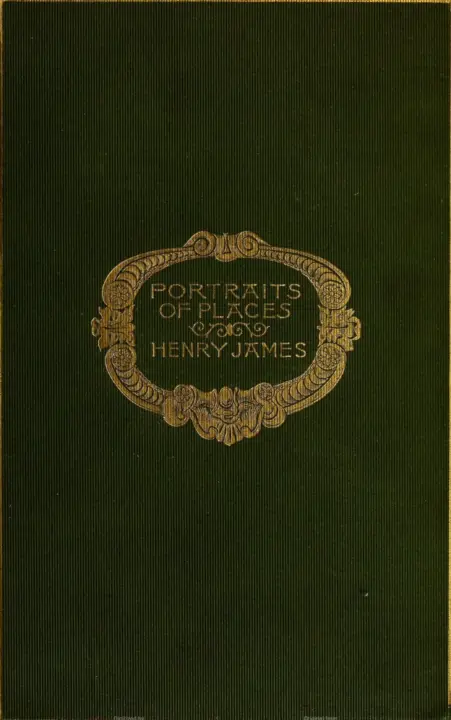
"Portraits of Places" by Henry James is a collection of essays that captures the author’s reflective travel experiences, likely written in the late 19th century. The essays showcase various cities and locations, focusing on their unique atmospheres and cultural significance, with Venice taking center stage as a prime example of beauty and complexity intertwined with the weight of history. Through James’ intricate observations, readers can anticipate insights into both the charm and the disillusionment that often accompany travel. The opening of the work begins with an affectionate exploration of Venice, where the author expresses both admiration and resignation towards its well-trodden paths and familiar sights. He reflects on the allure of the city that has been celebrated countless times, acknowledging its status as a beloved yet over-visited destination. James embraces the idea of revisiting well-known experiences, finding depth in simple pleasures that Venice offers, such as the vibrant local life and its art. This initial portion sets the stage for a travel narrative that is steeped in nostalgia, as James invites readers to engage with the emotional and intellectual dimensions of travel, while pondering the changes that time inevitably brings to iconic places.
Introduction adapted from the source catalogue; source summaries may be automatically generated.
Free to read · English · 102,626 words · No account needed
MAKE TIME FOR A GOOD BOOK
On by default. Untick to stop anonymous reading totals. Each page counts after 10 seconds in view. How this works.
Anonymous counting is on unless you have switched it off.
We can do a thing for the first time but once; it is but once for all that we can have a pleasure in its freshness. This is a law which is not on the whole, I think, to be regretted, for we sometimes learn to know things better by not enjoying them too much. It is certain, however, at the same time, that a traveller who has worked off the primal fermentation of his relish for this inexhaustibly interesting country has by no means entirely drained the cup. After thinking of Italy as historical and artistic, it will do him no great harm to think of her, for a while, as modern, an idea supposed (as a general thing correctly) to be fatally at variance with the Byronic, the Ruskinian, the artistic, poetic, æsthetic manner of considering this fascinating peninsula. He may grant--I don't say it is absolutely necessary--that modern Italy is ugly, prosaic, provokingly out of relation to the diary and the album; it is nevertheless true that, at the point things have come to, modern Italy in a manner imposes herself! I had not been many hours in the country before I became conscious of this circumstance; and I may add that, the first irritation past, I found myself able to accept it. And if we think of it, nothing is more easy to understand than a certain displeasure on the part of the young Italy of to-day at being looked at by all the world as a kind of soluble pigment. Young Italy, preoccupied with its economical and political future, must be heartily tired of being admired for its eyelashes and its pose. In one of Thackeray's novels there is mention of a young artist who sent to the Royal Academy a picture representing "A Contadino dancing with a Trasteverina at the door of a Locanda, to the music of a Pifferaro." It is in this attitude and with these conventional accessories that the world has hitherto seen fit to represent young Italy, and I do not wonder that, if the youth has any spirit, he should at last begin to resent our insufferable æsthetic patronage. He has established a line of tram-cars in Rome, from the Porta del Popolo to the Ponte Molle, and it is on one of these democratic vehicles that I seem to see him taking his triumphant course down the vista of the future. I will not pretend to rejoice with him any more than I really do; I will not pretend, as the sentimental tourists say about it all, as if it were the setting of an intaglio or the border of a Roman scarf, to "like" it. Like it or not, as we may, it is evidently destined to be; I see a new Italy in the future which in many important respects will equal, if not surpass, the most enterprising sections of our native land. Perhaps by that time Chicago and San Francisco will have acquired a pose, and their sons and daughters will dance at the doors of locande. However this may be, a vivid impression of an accomplished schism between the old Italy and the new is, as the French say, le plus clair of a new visit to this ever-suggestive part of the world. The old Italy has become more and more of a museum, preserved and perpetuated in the midst of the new, but without any further relation to it--it must be admitted, indeed, that such a relation is considerable--than that of the stock on his shelves to the shopkeeper, or of the Siren of the South to the showman who stands before his booth. More than once, as we move about nowadays in the Italian cities, there seems to pass before our eyes a vision of the coming years. It represents to our satisfaction an Italy united and prosperous, but altogether commercial. The Italy, indeed, that we sentimentalise and romance about was an ardently mercantile country; though I suppose it loved not its ledgers less, but its frescoes and altar-pieces more. Scattered through this brilliantly economical community--this country of a thousand ports--we see a large number of beautiful buildings, in which an endless series of dusky pictures are darkening, dampening, fading, failing, through the years. At the doors of the beautiful buildings are little turnstiles, at which there sit a great many men in uniform, to whom the visitor pays a ten-penny fee. Inside, in the vaulted and frescoed chambers, the art of Italy lies buried, as in a thousand mausoleums. It is well taken care of; it is constantly copied; sometimes it is "restored"--as in the case of that beautiful boy-figure of Andrea del Sarto, at Florence, which may be seen at the gallery of the Uffizi, with its honourable duskiness quite peeled off and heaven knows what raw, bleeding cuticle laid bare. One evening lately, in Florence, in the soft twilight, I took a stroll among those encircling hills on which the massive villas are mingled with the vaporous olives. Presently I arrived where three roads met at a wayside shrine, in which, before some pious daub of an old-time Madonna, a little votive lamp glimmered through the evening air. The hour, the lovely evening, the place, the twinkling taper, the sentiment of the observer, the thought that some one had been rescued here from an assassin, or from some other peril, and had set up a little grateful altar in consequence, in the yellow-plastered wall of a tangled podere; all this led me to approach the shrine with a reverent, an emotional step. I drew near it, but after a few steps I paused. I became conscious of an incongruous odour; it seemed to me that the evening air was charged with a perfume which, although to a certain extent familiar, had not hitherto associated itself with rustic frescoes and wayside altars. I gently interrogated the atmosphere, and the operation left me no doubts. The odour was that of petroleum; the votive taper was nourished with the national fluid of Pennsylvania. I confess that I burst out laughing, and a picturesque contadino, wending his homeward way in the dusk, stared at me as if I were an iconoclast. If he noticed the petroleum, it was only, I imagine, to sniff it gratefully; but to me the thing served as a symbol of the Italy of the future. There is a horse-car from the Porta del Popolo to the Ponte Molle, and the Tuscan shrines are fed with kerosene.
Your reading position is saved on this browser. Take it to another device with a library code. Reading pages adapt to text, rather than matching a printed edition.
Henry James
Henry James
Henry James

Henry James
BEHIND THE BOOK
This eBook is for the use of anyone anywhere in the United States and most other parts of the world at no cost and with almost no restrictions whatsoever. You may copy it, give it away or re-use it under the terms of the Project Gutenberg License included with this eBook or online at www.gutenberg.org. If you are not located in the United States, you will have to check the laws of the country where you are located before using this eBook. Read the source licence.
The original source file, including credits and licence, is retained by this library. Request an original-format copy at no charge. Please include the book title and Project Gutenberg identifier #68961.
KEEP YOUR CURIOSITY GOING
Wilfrid Scawen Blunt
Wilfrid Scawen Blunt

E. W. (Edgar Watson) Howe

David Patterson (Spirit) Hatch

David Patterson (Spirit) Hatch

David Patterson (Spirit) Hatch