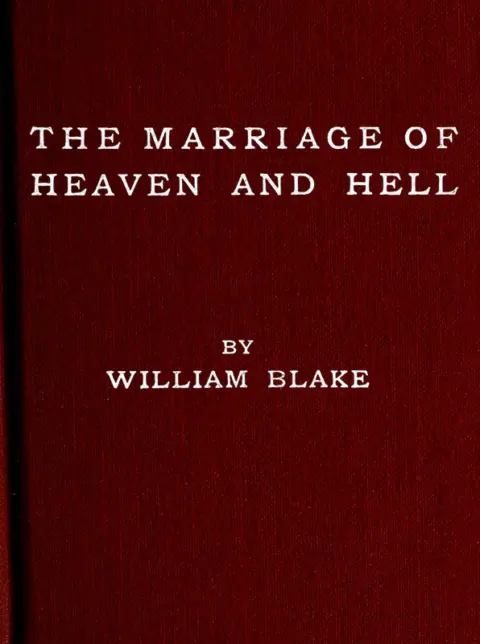
The Marriage of Heaven and Hell
William Blake
THE CLASSIC COLLECTION · 1783
Poems by William Blake. Explore this classic work in a free online edition. Subjects include English poetry -- 19th century; English poetry -- 18th century. Read the locally hosted text below, adjust the reading display, and continue where you left off.
Introduction adapted from the source catalogue; source summaries may be automatically generated.
Free to read · English · 26,448 words · No account needed
MAKE TIME FOR A GOOD BOOK
On by default. Untick to stop anonymous reading totals. Each page counts after 10 seconds in view. How this works.
Anonymous counting is on unless you have switched it off.
And not sit both night and day,
Wiping all our tears away?
O no! never can it be!
Never, never can it be!
He doth give His joy to all:
He becomes an infant small,
He becomes a man of woe,
He doth feel the sorrow too.
Think not thou canst sigh a sigh,
And thy Maker is not by:
Think not thou canst weep a tear,
And thy Maker is not near.
O, He gives to us His joy,
That our grief He may destroy:
Till our grief is fled and gone
He doth sit by us and moan.
Section III
SONGS OF EXPERIENCE
Introduction
Hear the voice of the Bard,
Who present, past, and future, sees;
Whose ears have heard
The Holy Word
That walked among the ancient trees;
Calling the lapsed soul,
And weeping in the evening dew;
That might control
The starry pole,
And fallen, fallen light renew!
“O Earth, O Earth, return!
Arise from out the dewy grass!
Night is worn,
And the morn
Rises from the slumbrous mass.
“Turn away no more;
Why wilt thou turn away?
The starry floor,
The watery shore,
Is given thee till the break of day.”
The Clod and the Pebble
“Love seeketh not itself to please,
Nor for itself hath any care,
But for another gives its ease,
And builds a heaven in hell’s despair.”
So sung a little clod of clay,
Trodden with the cattle’s feet,
But a pebble of the brook
Warbled out these metres meet:
“Love seeketh only Self to please, To bind another to its delight, Joys in another’s loss of ease, And builds a hell in heaven’s despite.”
Holy Thursday
Is this a holy thing to see
In a rich and fruitful land,—
Babes reduced to misery,
Fed with cold and usurous hand?
Is that trembling cry a song?
Can it be a song of joy?
And so many children poor?
It is a land of poverty!
And their sun does never shine,
And their fields are bleak and bare,
And their ways are filled with thorns,
It is eternal winter there.
For where’er the sun does shine,
And where’er the rain does fall,
Babes should never hunger there,
Nor poverty the mind appal.
The Little Girl Lost
In futurity
I prophesy
That the earth from sleep
(Grave the sentence deep)
Shall arise, and seek
For her maker meek;
And the desert wild
Become a garden mild.
In the southern clime,
Where the summer’s prime
Never fades away,
Lovely Lyca lay.
Seven summers old
Lovely Lyca told.
She had wandered long,
Hearing wild birds’ song.
Your reading position is saved on this browser. Take it to another device with a library code. Reading pages adapt to text, rather than matching a printed edition.
William Blake
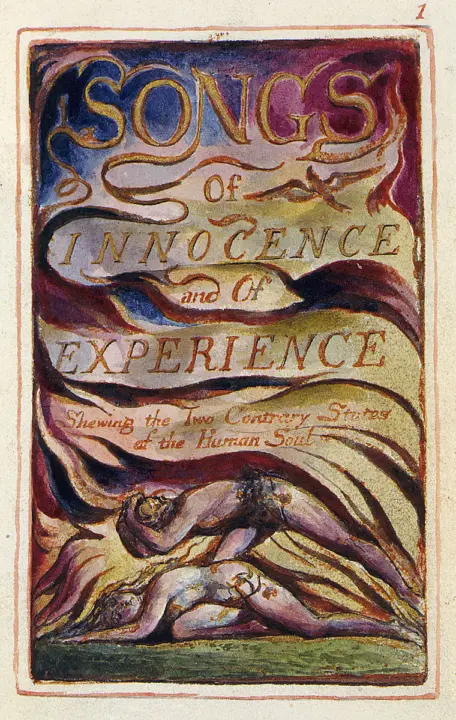
William Blake
BEHIND THE BOOK
This eBook is for the use of anyone anywhere in the United States and most other parts of the world at no cost and with almost no restrictions whatsoever. You may copy it, give it away or re-use it under the terms of the Project Gutenberg License included with this eBook or online at www.gutenberg.org. If you are not located in the United States, you will have to check the laws of the country where you are located before using this eBook. Read the source licence.
The original source file, including credits and licence, is retained by this library. Request an original-format copy at no charge. Please include the book title and Project Gutenberg identifier #79363.
KEEP YOUR CURIOSITY GOING

Eric Mackay
Edmund Gosse
Sophia Margaretta Hensley
Gilbert Parker
George MacDonald

Elizabeth Bibesco