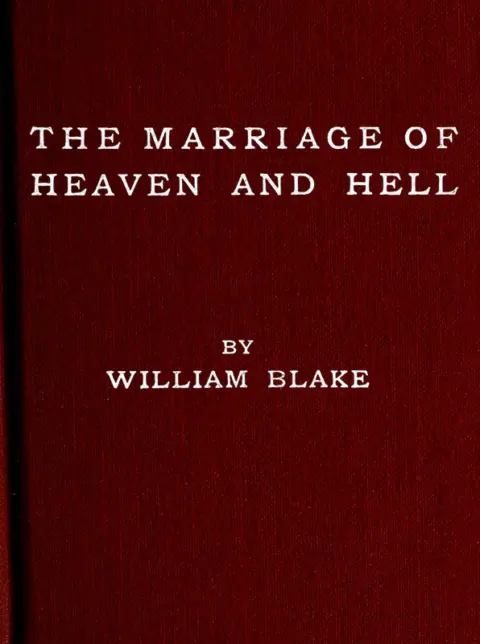
The Marriage of Heaven and Hell
William Blake
THE CLASSIC COLLECTION · 1783
Poems by William Blake. Explore this classic work in a free online edition. Subjects include English poetry -- 19th century; English poetry -- 18th century. Read the locally hosted text below, adjust the reading display, and continue where you left off.
Introduction adapted from the source catalogue; source summaries may be automatically generated.
Free to read · English · 26,448 words · No account needed
MAKE TIME FOR A GOOD BOOK
On by default. Untick to stop anonymous reading totals. Each page counts after 10 seconds in view. How this works.
Anonymous counting is on unless you have switched it off.
Little lamb,
Here I am;
Come and lick
My white neck;
Let me pull
Your soft wool;
Let me kiss
Your soft face;
Merrily, merrily we welcome in the year.
Nurse’s Song
When the voices of children are heard on the green, And laughing is heard on the hill, My heart is at rest within my breast, And everything else is still. “Then come home, my children, the sun is gone down, And the dews of night arise; Come, come, leave off play, and let us away, Till the morning appears in the skies.”
“No, no, let us play, for it is yet day, And we cannot go to sleep; Besides, in the sky the little birds fly, And the hills are all covered with sheep.” “Well, well, go and play till the light fades away, And then go home to bed.” The little ones leaped, and shouted, and laughed, And all the hills echoèd.
Infant Joy
“I have no name;
I am but two days old.”
What shall I call thee?
“I happy am,
Joy is my name.”
Sweet joy befall thee!
Pretty joy!
Sweet joy, but two days old.
Sweet joy I call thee:
Thou dost smile,
I sing the while;
Sweet joy befall thee!
A Dream
Once a dream did weave a shade
O’er my angel-guarded bed,
That an emmet lost its way
Where on grass methought I lay.
Troubled, wildered, and forlorn,
Dark, benighted, travel-worn,
Over many a tangled spray,
All heart-broke, I heard her say:
“Oh, my children! do they cry,
Do they hear their father sigh?
Now they look abroad to see,
Now return and weep for me.”
Pitying, I dropped a tear:
But I saw a glow-worm near,
Who replied, “What wailing wight
Calls the watchman of the night?
“I am set to light the ground,
While the beetle goes his round:
Follow now the beetle’s hum;
Little wanderer, hie thee home!”
Another’s Sorrow
Can I see another’s woe,
And not be in sorrow too?
Can I see another’s grief,
And not seek for kind relief?
Can I see a falling tear,
And not feel my sorrow’s share?
Can a father see his child
Weep, nor be with sorrow filled?
Can a mother sit and hear
An infant groan, an infant fear?
No, no! never can it be!
Never, never can it be!
And can He who smiles on all
Hear the wren with sorrows small,
Hear the small bird’s grief and care,
Hear the woes that infants bear—
And not sit beside the nest,
Pouring pity in their breast,
And not sit the cradle near,
Weeping tear on infant’s tear?
Your reading position is saved on this browser. Take it to another device with a library code. Reading pages adapt to text, rather than matching a printed edition.
William Blake
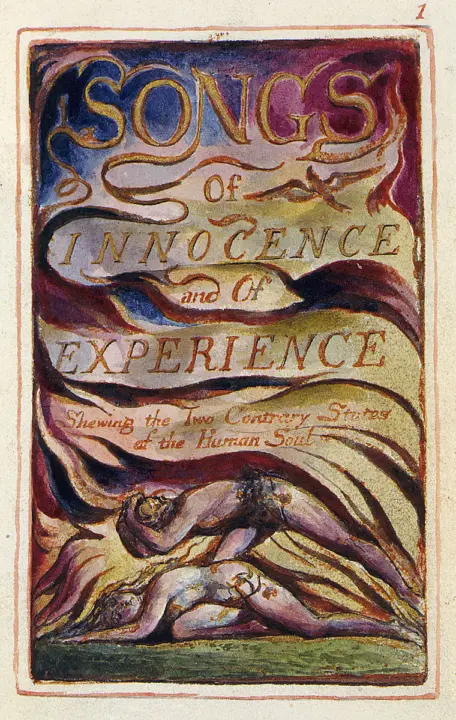
William Blake
BEHIND THE BOOK
This eBook is for the use of anyone anywhere in the United States and most other parts of the world at no cost and with almost no restrictions whatsoever. You may copy it, give it away or re-use it under the terms of the Project Gutenberg License included with this eBook or online at www.gutenberg.org. If you are not located in the United States, you will have to check the laws of the country where you are located before using this eBook. Read the source licence.
The original source file, including credits and licence, is retained by this library. Request an original-format copy at no charge. Please include the book title and Project Gutenberg identifier #79363.
KEEP YOUR CURIOSITY GOING

Eric Mackay
Edmund Gosse
Sophia Margaretta Hensley
Gilbert Parker
George MacDonald

Elizabeth Bibesco