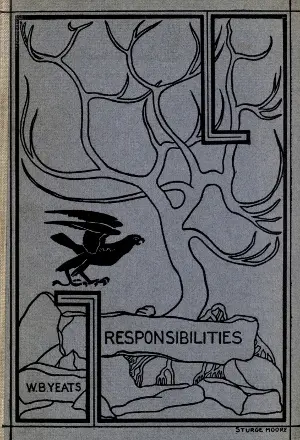
Responsibilities, and other poems
W. B. (William Butler) Yeats
THE CLASSIC COLLECTION · 1907
Plays and controversies by W. B. (William Butler) Yeats. Explore this classic work in a free online edition. Subjects include English drama -- Irish authors -- History and criticism; English drama -- Irish authors; Theater -- Ireland -- History; Abbey Theatre. Read the locally hosted text below, adjust the reading display, and continue where you left off.
Introduction adapted from the source catalogue; source summaries may be automatically generated.
Free to read · English · 85,824 words · No account needed
MAKE TIME FOR A GOOD BOOK
On by default. Untick to stop anonymous reading totals. Each page counts after 10 seconds in view. How this works.
Anonymous counting is on unless you have switched it off.
But if we are to delight our three or four thousand young men and women with a delight that will follow them into their own houses, and if we are to add the countryman to their number, we shall need more than the play, we shall need those other spoken arts. The player rose into importance in the town, but the minstrel is of the country. We must have narrative as well as dramatic poetry, and we are making room for it in the theatre in the first instance, but in this also we must go to an earlier time. Modern recitation is not, like modern theatrical art, an over-elaboration of a true art, but an entire misunderstanding. It has no tradition at all. It is an endeavour to do what can only be done well by the player. It has no relation of its own to life. Some young man in evening clothes will recite to you The Dream of Eugene Aram, and it will be laughable, grotesque and a little vulgar. Tragic emotions that need scenic illusion, a long preparation, a gradual heightening of emotion, are thrust into the middle of our common affairs. That they may be as extravagant, as little tempered by anything ideal or distant as possible, he will break up the rhythm, regarding neither the length of the lines nor the natural music of the phrases, and distort the accent by every casual impulse. He will gesticulate wildly, adapting his movements to the drama as if Eugene Aram were in the room before us, and all the time we see a young man in evening dress who has become unaccountably insane. Nothing that he can do or say will make us forget that he is Mr. Robinson the bank clerk, and that the toes of his boots turn upward. We have nothing to learn here. We must go to the villages or we must go back hundreds of years to Wolfram of Eschenbach and the castles of Thuringia. In this, as in all other arts, one finds its law and its true purpose when one is near the source. The minstrel never dramatised anybody but himself. It was impossible, from the nature of the words the poet had put into his mouth, or that he had made for himself, that he should speak as another person. He will go no nearer to drama than we do in daily speech, and he will not allow you for any long time to forget himself. Our own Raftery will stop the tale to cry, ‘This is what I, Raftery, wrote down in the book of the people’; or, ‘I, myself, Raftery, went to bed without supper that night.’ Or, if it is Wolfram, and the tale is of Gawain or Parzival, he will tell the listening ladies that he sings of happy love out of his own unhappy love, or he will interrupt the story of a siege and its hardships to remember his own house, where there is not enough food for the mice. He knows how to keep himself interesting that his words may have weight--so many lines of narrative, and then a phrase about himself and his emotions. The reciter cannot be a player, for that is a different art; but he must be a messenger, and he should be as interesting, as exciting, as are all that carry great news. He comes from far off, and he speaks of far-off things with his own peculiar animation, and instead of lessening the ideal and beautiful elements of speech he may, if he has a mind to, increase them. He may speak to actual notes as a singer does if they are so simple that he never loses the speaking-voice, and if the poem is long he must do so, or his own voice will become weary and formless. His art is nearer to pattern than that of the player. It is always allusion, never illusion; for what he tells of, no matter how impassioned he may become, is always distant, and for this reason he may permit himself every kind of nobleness. In a short poem he may interrupt the narrative with a burden, which the audience will soon learn to sing, and this burden, because it is repeated and need not tell a story to a first hearing, can have a more elaborate musical notation, can go nearer to ordinary song. Gradually other devices will occur to him--effects of loudness and softness, of increasing and decreasing speed, certain rhythmic movements of his body, a score of forgotten things, for the art of speech is lost, and when we begin at it every day is a discovery. The reciter must be made exciting and wonderful in himself, apart from what he has to tell, and that is more difficult than it was in the middle ages. We are not mysterious to one another; we can come from far off and yet be no better than our neighbours. We are no longer like those Egyptian birds that flew out of Arabia, their claws full of spices; nor can we, like an ancient or mediæval poet, throw into our verses the emotions and events of our lives, or even dramatise, as they could, the life of the minstrel into whose mouth we are to put our words. I can think of nothing better than to borrow from the tellers of old tales, who will often pretend to have been at the wedding of the princess or afterwards ‘when they were throwing out children by the basketful,’ and to give the story-teller definite fictitious personality and find for him an appropriate costume. Many costumes and persons come into my imagination. I imagine an old countryman upon the stage of the theatre or in some little country court-house where a Gaelic society is meeting, and I can hear him say that he is Raftery or a brother, and that he has tramped through France and Spain and the whole world. He has seen everything, and he has all country love-tales at his finger-tips. I can imagine, too--and now the story-teller is more serious and more naked of country circumstance--a jester with black cockscomb and black clothes. He has been in the faery hills; perhaps he is the terrible Amadan-na-Breena himself; or he has been so long in the world that he can tell of ancient battles. It is not as good as what we have lost, but we cannot hope to see in our time, except by some rare accident, the minstrel who differs from his audience in nothing but the exaltation of his mood, and who is yet as exciting and as romantic in their eyes as were Raftery and Wolfram to their people.
Your reading position is saved on this browser. Take it to another device with a library code. Reading pages adapt to text, rather than matching a printed edition.
W. B. (William Butler) Yeats
W. B. (William Butler) Yeats
W. B. (William Butler) Yeats
W. B. (William Butler) Yeats
BEHIND THE BOOK
This eBook is for the use of anyone anywhere in the United States and most other parts of the world at no cost and with almost no restrictions whatsoever. You may copy it, give it away or re-use it under the terms of the Project Gutenberg License included with this eBook or online at www.gutenberg.org. If you are not located in the United States, you will have to check the laws of the country where you are located before using this eBook. Read the source licence.
The original source file, including credits and licence, is retained by this library. Request an original-format copy at no charge. Please include the book title and Project Gutenberg identifier #79460.
KEEP YOUR CURIOSITY GOING
Cécile Tormay

Moritz Busch
John L. Ransom
Frances Wright
Cécile Tormay

Mabel Potter Daggett