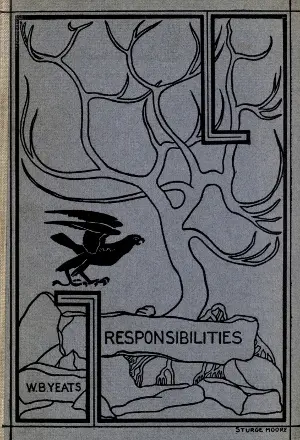
Responsibilities, and other poems
W. B. (William Butler) Yeats
THE CLASSIC COLLECTION · 1907
Plays and controversies by W. B. (William Butler) Yeats. Explore this classic work in a free online edition. Subjects include English drama -- Irish authors -- History and criticism; English drama -- Irish authors; Theater -- Ireland -- History; Abbey Theatre. Read the locally hosted text below, adjust the reading display, and continue where you left off.
Introduction adapted from the source catalogue; source summaries may be automatically generated.
Free to read · English · 85,824 words · No account needed
MAKE TIME FOR A GOOD BOOK
On by default. Untick to stop anonymous reading totals. Each page counts after 10 seconds in view. How this works.
Anonymous counting is on unless you have switched it off.
All that love the arts or love dignity in life have at one time or another noticed these things, and some have wondered why the world has for some three or four centuries sacrificed so much, and with what seems a growing recklessness, to create an intellectual aristocracy, a leisured class--to set apart, and above all others, a number of men and women who are not very well pleased with one another or the world they have to live in. It is some comparison, like this that I have made, which has been the origin, as I think, of most attempts to revive some old language in which the general business of the world is no longer transacted. The Provençal movement, the Welsh, the Czech, have all, I think, been attempting, when we examine them to the heart, to restore what is called a more picturesque way of life--that is to say, a way of life in which the common man has some share in imaginative art. That this is the decisive element in the attempt to revive and to preserve the Irish language I am very certain. A language enthusiast does not put it that way to himself; he says, rather, ‘If I can make the people talk Irish again they will be the less English’; but if you talk to him till you have hunted the words into their burrow you will find that the word ‘Ireland’ means to him a form of life delightful to his imagination, and that the word ‘England’ suggests to him a cold, joyless, irreligious and ugly life. The life of the villages, with its songs, its dances and its pious greetings, its conversations full of vivid images shaped hardly more by life itself than by innumerable forgotten poets, all that life of good nature and improvisation grows more noble as he meditates upon it, for it mingles with the middle ages until he no longer can see it as it is but as it was, when it ran, as it were, into a point of fire in the courtliness of king’s houses. He hardly knows whether what stirred him yesterday was that old fiddler, playing an almost-forgotten music on a fiddle mended with twine, or a sudden thought of some king that was of the blood of that old man, some O’Loughlin or O’Bryne, listening amid his soldiers, he and they at the one table, they too, lucky, bright-eyed, while the minstrel sang of angry Cuchulain, or of him men called ‘Golden salmon of the sea, clean hawk of the air.’ It will not please him, however, if you tell him that he is fighting the modern world, which he calls ‘England,’ as Mistral and his fellows called it Paris, and that he will need more than language if he is to make the monster turn up its white belly. And yet the difference between what the word England means and all that the word Gaelic suggests is greater than any that could have been before the imagination of Mistral. Ireland, her imagination at its noon before the birth of Chaucer, has created the most beautiful literature of a whole people that has been anywhere since Greece and Rome, while English literature, the greatest of all literatures but that of Greece, is yet the literature of a few. Nothing of it but a handful of ballads about Robin Hood has come from the folk or belongs to them rightly, for the good English writers, with a few exceptions that seem accidental, have written for a small cultivated class; and is not this the reason? Irish poetry and Irish stories were made to be spoken or sung, while English literature, alone of great literatures, because the newest of them all, has all but completely shaped itself in the printing-press. In Ireland to-day the old world that sang and listened is, it may be for the last time in Europe, face to face with the world that reads and writes, and their antagonism is always present under some name or other in Irish imagination and intellect. I myself cannot be convinced that the printing-press will be always victor, for change is inconceivably swift, and when it begins--well, as the proverb has it, everything comes in at the hole. The world soon tires of its toys, and our exaggerated love of print and paper seems to me to come out of passing conditions and to be no more a part of the final constitution of things than the craving of a woman in child-bed for green apples. When a man takes a book into the corner, he surrenders so much life for his knowledge, so much, I mean, of that normal activity that gives him life and strength; he lays away his own handiwork and turns from his friend, and if the book is good he is at some pains to press all the little wanderings and tumults of the mind into silence and quiet. If the reader be poor, if he has worked all day at the plough or the desk, he will hardly have strength enough for any but a meretricious book; nor is it only when the book is on the knees that his own life must be given for it. For a good and sincere book needs the preparation of the peculiar studies and reveries that prepare for good taste, and make it easier for the mind to find pleasure in a new landscape; and all these reveries and studies have need of so much time and thought that it is almost certain a man cannot be a successful doctor, or engineer, or Cabinet Minister, and have a culture good enough to escape the mockery of the ragged art student who comes of an evening sometimes to borrow a half-sovereign. The old culture came to a man at his work; it was not at the expense of life, but an exaltation of life itself; it came in at the eyes as some civic ceremony sailed along the streets, or as we arrayed ourselves before the looking-glass; or it came in at the ears in a song as we bent over the plough or the anvil, or at that great table where rich and poor sat down together and heard the minstrel bidding them pass around the wine-cup and say a prayer for Gawain[12] dead. Certainly it came without a price; it did not take one from one’s friends and one’s handiwork: but it was like a good woman who gives all for love and is never jealous and is ready to do all the talking when we are tired.
Your reading position is saved on this browser. Take it to another device with a library code. Reading pages adapt to text, rather than matching a printed edition.
W. B. (William Butler) Yeats
W. B. (William Butler) Yeats
W. B. (William Butler) Yeats
W. B. (William Butler) Yeats
BEHIND THE BOOK
This eBook is for the use of anyone anywhere in the United States and most other parts of the world at no cost and with almost no restrictions whatsoever. You may copy it, give it away or re-use it under the terms of the Project Gutenberg License included with this eBook or online at www.gutenberg.org. If you are not located in the United States, you will have to check the laws of the country where you are located before using this eBook. Read the source licence.
The original source file, including credits and licence, is retained by this library. Request an original-format copy at no charge. Please include the book title and Project Gutenberg identifier #79460.
KEEP YOUR CURIOSITY GOING
Cécile Tormay

Moritz Busch
John L. Ransom
Frances Wright
Cécile Tormay

Mabel Potter Daggett