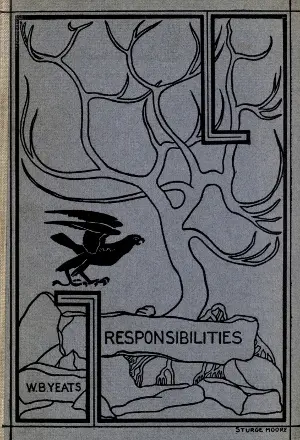
Responsibilities, and other poems
W. B. (William Butler) Yeats
THE CLASSIC COLLECTION · 1907
Plays and controversies by W. B. (William Butler) Yeats. Explore this classic work in a free online edition. Subjects include English drama -- Irish authors -- History and criticism; English drama -- Irish authors; Theater -- Ireland -- History; Abbey Theatre. Read the locally hosted text below, adjust the reading display, and continue where you left off.
Introduction adapted from the source catalogue; source summaries may be automatically generated.
Free to read · English · 85,824 words · No account needed
MAKE TIME FOR A GOOD BOOK
On by default. Untick to stop anonymous reading totals. Each page counts after 10 seconds in view. How this works.
Anonymous counting is on unless you have switched it off.
I have been asked to put into this year’s Samhain Miss Horniman’s letter offering us the use of the Abbey Theatre. I have done this, but as Miss Horniman begins her letter by stating that she has made her offer out of ‘great sympathy with the Irish National Theatre Company as publicly explained by Mr. Yeats on various occasions,’ she has asked me to go more into detail as to my own plans and hopes than I have done before. I think they are the plans and hopes of my fellow-dramatists, for we are all of one movement, and have influenced one another, and have in us the spirit of our time. I discussed them all very shortly in last Samhain. And I know that it was that Samhain, and a certain speech I made in front of the curtain, that made Miss Horniman entrust us with her generous gift. But last Samhain is practically out of print, and my speech has gone even out of my own memory. I will repeat, therefore, much that I have said already, but adding a good deal to it.
First. Our plays must be literature or written in the spirit of literature. The modern theatre has died away to what it is because the writers have thought of their audiences instead of their subject. An old writer saw his hero, if it was a play of character, or some dominant passion, if it was a play of passion, like Phèdre or Andromaque, moving before him, living with a life he did not endeavour to control. The persons acted upon one another as they were bound by their natures to act, and the play was dramatic, not because he had sought out dramatic situations for their own sake, but because will broke itself upon will and passion upon passion. Then the imagination began to cool, the writer began to be less alive, to seek external aids, remembered situations, tricks of the theatre, that had proved themselves again and again. His persons no longer will have a particular character, but he knows that he can rely upon the incidents, and he feels himself fortunate when there is nothing in his play that has not succeeded a thousand times before the curtain has risen. Perhaps he has even read a certain guide-book to the stage published in France, and called The Thirty-six Situations of Drama. The costumes will be magnificent, the actresses will be beautiful, the Castle in Spain will be painted by an artist upon the spot. We will come from his play excited if we are foolish, or can condescend to the folly of others, but knowing nothing new about ourselves, and seeing life with no new eyes and hearing it with no new ears. The whole movement of theatrical reform in our day has been a struggle to get rid of this kind of play, and the sincere play, the logical play, that we would have in its place, will always seem, when we hear it for the first time, undramatic, unexciting. It has to stir the heart in a long-disused way, it has to awaken the intellect to a pleasure that ennobles and wearies. I was at the first performance of an Ibsen play given in England. It was The Doll’s House, and at the fall of the curtain I heard an old dramatic critic say, ‘It is but a series of conversations terminated by an accident.’ So far, we here in Dublin mean the same thing as do Mr. Max Beerbohm, Mr. Walkley, and Mr. Archer, who are seeking to restore sincerity to the English stage, but I am not certain that we mean the same thing all through. The utmost sincerity, the most unbroken logic, give me, at any rate, but an imperfect pleasure if there is not a vivid and beautiful language. Ibsen has sincerity and logic beyond any writer of our time, and we are all seeking to learn them at his hands; but is he not a good deal less than the greatest of all times, because he lacks beautiful and vivid language? ‘Well, well, give me time and you shall hear all about it. If only I had Peter here now,’ is very like life, is entirely in its place where it comes, and when it is united to other sentences exactly like itself, one is moved, one knows not how, to pity and terror, and yet not moved as if the words themselves could sing and shine. Mr. Max Beerbohm wrote once that a play cannot have style because the people must talk as they talk in daily life. He was thinking, it is obvious, of a play made out of that typically modern life where there is no longer vivid speech. Blake says that a work of art must be minutely articulated by God or man, and man has too little help from that occasional collaborateur when he writes of people whose language has become abstract and dead. Falstaff gives one the sensation of reality, and when one remembers the abundant vocabulary of a time when all but everything present to the mind was present to the senses, one imagines that his words were but little magnified from the words of such a man in real life. Language was still alive then, alive as it is in Gaelic to-day, as it is in English-speaking Ireland where the Schoolmaster or the newspaper has not corrupted it. I know that we are at the mere beginning, laboriously learning our craft, trying our hands in little plays for the most part, that we may not venture too boldly in our ignorance; but I never hear the vivid, picturesque, ever-varied language of Mr. Synge’s persons without feeling that the great collaborateur has his finger in our business. May it not be that the only realistic play that will live as Shakespeare has lived, as Calderon has lived, as the Greeks have lived, will arise out of the common life, where language is as much alive as if it were new come out of Eden? After all, is not the greatest play not the play that gives the sensation of an external reality but the play in which there is the greatest abundance of life itself, of the reality that is in our minds? Is it possible to make a work of art, which needs every subtlety of expression if it is to reveal what hides itself continually, out of a dying, or at any rate a very ailing, language? and all language but that of the poets and of the poor is already bedridden. We have, indeed, persiflage, the only speech of educated men that expresses a deliberate enjoyment of words: but persiflage is not a true language. It is impersonal; it is not in the midst but on the edge of life; it covers more character than it discovers: and yet, such as it is, all our comedies are made out of it.
Your reading position is saved on this browser. Take it to another device with a library code. Reading pages adapt to text, rather than matching a printed edition.
W. B. (William Butler) Yeats
W. B. (William Butler) Yeats
W. B. (William Butler) Yeats
W. B. (William Butler) Yeats
BEHIND THE BOOK
This eBook is for the use of anyone anywhere in the United States and most other parts of the world at no cost and with almost no restrictions whatsoever. You may copy it, give it away or re-use it under the terms of the Project Gutenberg License included with this eBook or online at www.gutenberg.org. If you are not located in the United States, you will have to check the laws of the country where you are located before using this eBook. Read the source licence.
The original source file, including credits and licence, is retained by this library. Request an original-format copy at no charge. Please include the book title and Project Gutenberg identifier #79460.
KEEP YOUR CURIOSITY GOING
Cécile Tormay

Moritz Busch
John L. Ransom
Frances Wright
Cécile Tormay

Mabel Potter Daggett