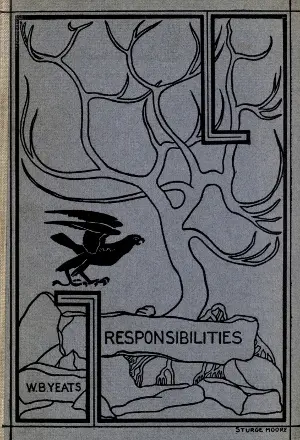
Responsibilities, and other poems
W. B. (William Butler) Yeats
THE CLASSIC COLLECTION · 1907
Plays and controversies by W. B. (William Butler) Yeats. Explore this classic work in a free online edition. Subjects include English drama -- Irish authors -- History and criticism; English drama -- Irish authors; Theater -- Ireland -- History; Abbey Theatre. Read the locally hosted text below, adjust the reading display, and continue where you left off.
Introduction adapted from the source catalogue; source summaries may be automatically generated.
Free to read · English · 85,824 words · No account needed
MAKE TIME FOR A GOOD BOOK
On by default. Untick to stop anonymous reading totals. Each page counts after 10 seconds in view. How this works.
Anonymous counting is on unless you have switched it off.
I would not be trying to form an Irish National Theatre if I did not believe that there existed in Ireland, whether in the minds of a few people or of a great number I do not know, an energy of thought about life itself, a vivid sensitiveness as to the reality of things, powerful enough to overcome all those phantoms of the night. Everything calls up its contrary, unreality calls up reality, and, besides, life here has been sufficiently perilous to make men think. I do not think it a national prejudice that makes me believe we are harder, a more masterful race than the comfortable English of our time, and that this comes from an essential nearness to reality of those few scattered people who have the right to call themselves the Irish race. It is only in the exceptions, in the few minds, where the flame has burnt as it were pure, that one can see the permanent character of a race. If one remembers the men who have dominated Ireland for the last hundred and fifty years, one understands that it is strength of personality, the individualising quality in a man, that stirs Irish imagination most deeply in the end. There is scarcely a man who has led the Irish people, at any time, who may not give some day to a great writer precisely that symbol he may require for the expression of himself. The critical mind of Ireland is far more subjugated than the critical mind of England by the phantoms and misapprehensions of politics and social necessity, but the life of Ireland has rejected them more resolutely. Indeed, it is in life itself in England that one finds the dominion of what is not human life.
We have no longer in any country a literature as great as the literature of the old world, and that is because the newspapers, all kinds of second-rate books, the preoccupation of men with all kinds of practical changes, have driven the living imagination out of the world. I have read hardly any books this summer but Cervantes and Boccaccio and some Greek plays. I have felt that these men, divided from one another by so many hundreds of years, had the same mind. It is we who are different; and then the thought would come to me, that has come to me so often before, that they lived at times when the imagination turned to life itself for excitement. The world was not changing quickly about them. There was nothing to draw their imagination from the ripening of the fields, from the birth and death of their children, from the destiny of their souls, from all that is the unchanging substance of literature. They had not to deal with the world in such great masses that it could only be represented to their minds by figures and by abstract generalisations. Everything that their minds ran on came to them vivid with the colour of the senses, and when they wrote it was out of their own rich experience, and they found their symbols of expression in things that they had known all their life long. Their very words were more vigorous than ours, for their phrases came from a common mint, from the market, or the tavern, or from the great poets of a still older time. It is the change, that followed the Renaissance and was completed by newspaper government and the scientific movement, that has brought upon us all these phrases and generalisations, made by minds that would grasp what they have never seen. Yesterday I went out to see the reddening apples in the garden, and they faded from my imagination sooner than they would have from the imagination of that old poet, who made the songs of the seasons for the Fianna, or out of Chaucer’s, that celebrated so many trees. Theories, opinions, these opinions among the rest, flowed in upon me and blotted them away. Even our greatest poets see the world with preoccupied minds. Great as Shelley is, those theories about the coming changes of the world, which he has built up with so much elaborate passion, hurry him from life continually. There is a phrase in some old cabalistic writer about man falling into his own circumference, and every generation we get further away from life itself, and come more and more under the influence which Blake had in his mind when he said, ‘Kings and Parliament seem to me something other than human life.’ We lose our freedom more and more as we get away from ourselves, and not merely because our minds are overthrown by abstract phrases and generalisations, reflections in a mirror that seem living, but because we have turned the table of value upside down, and believe that the root of reality is not in the centre but somewhere in that whirling circumference. How can we create like the ancients, while innumerable considerations of external probability or social utility destroy the seeming irresponsible creative power that is life itself? Who to-day could set Richmond’s and Richard’s tents side by side on the battlefield, or make Don Quixote, mad as he was, mistake a windmill for a giant in broad daylight? And when I think of free-spoken Falstaff I know of no audience, but the tinkers of the roadside, that could encourage the artist to an equal comedy. The old writers were content if their inventions had but an emotional and moral consistency, and created out of themselves a fantastic, energetic, extravagant art. A Civilisation is very like a man or a woman, for it comes in but a few years into its beauty, and its strength, and then, while many years go by, it gathers and makes order about it, the strength and beauty going out of it the while, until in the end it lies there with its limbs straightened out and a clean linen cloth folded upon it. That may well be, and yet we need not follow among the mourners, for it may be, before they are at the tomb, a messenger will run out of the hills and touch the pale lips with a red ember, and wake the limbs to the disorder and the tumult that is life. Though he does not come, even so we will keep from among the mourners and hold some cheerful conversation among ourselves; for has not Virgil, a knowledgeable man and a wizard, foretold that other Argonauts shall row between cliff and cliff, and other fair-haired Achæans sack another Troy?
Your reading position is saved on this browser. Take it to another device with a library code. Reading pages adapt to text, rather than matching a printed edition.
W. B. (William Butler) Yeats
W. B. (William Butler) Yeats
W. B. (William Butler) Yeats
W. B. (William Butler) Yeats
BEHIND THE BOOK
This eBook is for the use of anyone anywhere in the United States and most other parts of the world at no cost and with almost no restrictions whatsoever. You may copy it, give it away or re-use it under the terms of the Project Gutenberg License included with this eBook or online at www.gutenberg.org. If you are not located in the United States, you will have to check the laws of the country where you are located before using this eBook. Read the source licence.
The original source file, including credits and licence, is retained by this library. Request an original-format copy at no charge. Please include the book title and Project Gutenberg identifier #79460.
KEEP YOUR CURIOSITY GOING
Cécile Tormay

Moritz Busch
John L. Ransom
Frances Wright
Cécile Tormay

Mabel Potter Daggett