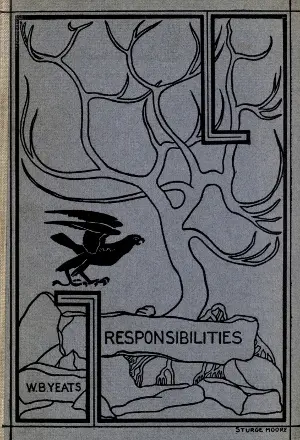
Responsibilities, and other poems
W. B. (William Butler) Yeats
THE CLASSIC COLLECTION · 1907
Plays and controversies by W. B. (William Butler) Yeats. Explore this classic work in a free online edition. Subjects include English drama -- Irish authors -- History and criticism; English drama -- Irish authors; Theater -- Ireland -- History; Abbey Theatre. Read the locally hosted text below, adjust the reading display, and continue where you left off.
Introduction adapted from the source catalogue; source summaries may be automatically generated.
Free to read · English · 85,824 words · No account needed
MAKE TIME FOR A GOOD BOOK
On by default. Untick to stop anonymous reading totals. Each page counts after 10 seconds in view. How this works.
Anonymous counting is on unless you have switched it off.
When one all but despairs, as one does at times, of Ireland welcoming a National Literature in this generation, it is because we do not leave ourselves enough of time, or of quiet, to be interested in men and women. A writer in The Leader, who is unknown to me, elaborates this argument in an article full of beauty and dignity. He is speaking of our injustice to one another and he says that we are driven into injustice ‘not wantonly but inevitably, and at call of the exacting qualities of the great things. Until this latter dawning, the genius of Ireland has been too preoccupied really to concern itself about men and women; in its drama they play a subordinate part, born tragic comedians though all the sons and daughters of the land are. A nation is the heroic theme we follow, a mourning, wasted land its moving spirit; the impersonal assumes personality for us.’ When I wrote my Countess Cathleen, I thought, of course, chiefly of the actual picture that was forming before me, but there was a secondary meaning that came into my mind continuously: ‘It is the soul of one that loves Ireland,’ I thought, ‘plunging into unrest, seeming to lose itself, to bargain itself away to the very wickedness of the world, and to surrender what is eternal for what is temporary,’ and I know that this meaning seemed natural to others, for that great orator, J. F. Taylor, who was not likely to have searched very deeply into any work of mine, for he cared little for mine, or, indeed, any modern work, turned the play into such a parable in one of his speeches.
There is no use being angry with necessary conditions, or failing to see that a man who is busy with some reform that can only be carried out in a flame of energetic feeling, will not only be indifferent to what seems to us the finer kind of thinking, but that he will support himself by generalisations that seem untrue to the man of letters. A little play, The Rising of the Moon, which is in the present number of Samhain, and is among those we are to produce during the winter, has, for instance, roused the suspicions of a very resolute leader of the people, who has a keen eye for rats behind the arras. A Fenian ballad-singer partly converts a policeman, and is it not unwise under any circumstances to show a policeman in so favourable a light? It is well known that many of the younger policemen were Fenians: but it is necessary that the Dublin crowds should be kept of so high a heart that they will fight the police at any moment. Are not morals greater than literature? Others have objected to Mr. Synge’s Shadow of the Glen because Irish women, being more chaste than those of England and Scotland, are a valuable part of our national argument. Mr. Synge should not, it is said by some, have chosen an exception for the subject of his play, for who knows but the English may misunderstand him? Some even deny that such a thing could happen at all, while others that know the country better, or remember the statistics, say that it could but should never have been staged. All these arguments, by their methods, even more than by what they have tried to prove, misunderstand how literature does its work. Men of letters have sometimes said that the characters of a romance or of a play must be typical. They mean that the character must be typical of something which exists in all men because the writer has found it in his own mind. It is one of the most inexplicable things about human nature that a writer, with a strange temperament, an Edgar Allan Poe, let us say, made what he is by conditions that never existed before, can create personages and lyric emotions, which startle us by being at once bizarre and an image of our own secret thoughts. Are we not face to face with the microcosm, mirroring everything in universal nature? It is no more necessary for the characters created by a romance writer, or a dramatist, to have existed before, than for his own personality to have done so; characters and personality alike, as is perhaps true in the instance of Poe, may draw half their life not from the solid earth, but from some dreamy drug. This is true even of historical drama, for it was Goethe, the founder of the historical drama of Germany, who said, ‘We do the people of history the honour of naming after them the creations of our own minds.’ All that a dramatic writer need do is to persuade us, during the two hours’ traffic of the stage, that the events of his play did really happen. He must know enough of the life of his country, or of history, to create this illusion, but no matter how much he knows, he will fail if his audience is not ready to give up something of the dead letter. If his mind is full of energy he will not be satisfied with little knowledge, but he will be far more likely to alter incidents and characters, wilfully even as it may seem, than to become a literal historian. It was one of the complaints against Shakespeare, in his own day, that he made Sir John Falstaff out of a praiseworthy old Lollard preacher. One day, as he sat over Holinshed’s History of England, he persuaded himself that Richard the Second, with his French culture, ‘his too great friendliness to his friends,’ his beauty of mind, and his fall before dry, repelling Bolingbroke, would be a good image for an accustomed mood of fanciful, impracticable lyricism in his own mind. The historical Richard has passed away for ever and the Richard of the play lives more intensely, it seems, than did ever living man. Yet Richard the Second, as Shakespeare made him, could never have been born before the Renaissance, before the Italian influence, or even one hour before the innumerable streams that flowed in upon Shakespeare’s mind; the innumerable experiences we can never know, brought Shakespeare to the making of him. He is typical not because he ever existed, but because he has made us know of something in our own minds we had never known of had he never been imagined.
Your reading position is saved on this browser. Take it to another device with a library code. Reading pages adapt to text, rather than matching a printed edition.
W. B. (William Butler) Yeats
W. B. (William Butler) Yeats
W. B. (William Butler) Yeats
W. B. (William Butler) Yeats
BEHIND THE BOOK
This eBook is for the use of anyone anywhere in the United States and most other parts of the world at no cost and with almost no restrictions whatsoever. You may copy it, give it away or re-use it under the terms of the Project Gutenberg License included with this eBook or online at www.gutenberg.org. If you are not located in the United States, you will have to check the laws of the country where you are located before using this eBook. Read the source licence.
The original source file, including credits and licence, is retained by this library. Request an original-format copy at no charge. Please include the book title and Project Gutenberg identifier #79460.
KEEP YOUR CURIOSITY GOING
Cécile Tormay

Moritz Busch
John L. Ransom
Frances Wright
Cécile Tormay

Mabel Potter Daggett