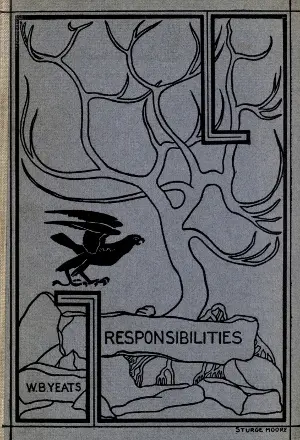
Responsibilities, and other poems
W. B. (William Butler) Yeats
THE CLASSIC COLLECTION · 1907
Plays and controversies by W. B. (William Butler) Yeats. Explore this classic work in a free online edition. Subjects include English drama -- Irish authors -- History and criticism; English drama -- Irish authors; Theater -- Ireland -- History; Abbey Theatre. Read the locally hosted text below, adjust the reading display, and continue where you left off.
Introduction adapted from the source catalogue; source summaries may be automatically generated.
Free to read · English · 85,824 words · No account needed
MAKE TIME FOR A GOOD BOOK
On by default. Untick to stop anonymous reading totals. Each page counts after 10 seconds in view. How this works.
Anonymous counting is on unless you have switched it off.
[The performance of Mr. Synge’s Shadow of the Glen started a quarrel with the extreme national party, and the following paragraphs are from letters written in the play’s defence. The organ of the party was at the time The United Irishman, but the first serious attack began in The Independent. The United Irishman, however, took up the quarrel, and from that time on has attacked almost every play produced at our theatre, and the suspicion it managed to arouse among the political clubs against Mr. Synge especially led a few years later to the organised attempt to drive The Playboy of the Western World from the stage.--W. B. Y., 1908.]
When we were all fighting about the selection of books for the New Irish Library some ten years ago, we had to discuss the question, What is National Poetry? In those days a patriotic young man would have thought but poorly of himself if he did not believe that The Spirit of the Nation was great lyric poetry, and a much finer kind of poetry than Shelley’s Ode to the West Wind, or Keats’s Ode on a Grecian Urn. When two or three of us denied this, we were told that we had effeminate tastes or that we were putting Ireland in a bad light before her enemies. If one said that The Spirit of the Nation was but salutary rhetoric, England might overhear us and take up the cry. We said it, and who will say that Irish literature has not a greater name in the world to-day than it had ten years ago?
To-day there is another question that we must make up our minds about, and an even more pressing one, What is a National Theatre? A man may write a book of lyrics if he have but a friend or two that will care for them, but he cannot write a good play if there are not audiences to listen to it. If we think that a national play must be as near as possible a page out of The Spirit of the Nation put into dramatic form, and mean to go on thinking it to the end, then we may be sure that this generation will not see the rise in Ireland of a theatre that will reflect the life of Ireland as the Scandinavian theatre reflects the Scandinavian life. The brazen head has an unexpected way of falling to pieces. We have a company of admirable and disinterested players, and the next few months will, in all likelihood, decide whether a great work for this country is to be accomplished. The poetry of Young Ireland, when it was an attempt to change or strengthen opinion, was rhetoric; but, it became poetry when patriotism was transformed into a personal emotion by the events of life, as in that lamentation written by Doheny ‘on his keeping’ among the hills. Literature is always personal, always one man’s vision of the world, one man’s experience, and it can only be popular when men are ready to welcome the visions of others. A community that is opinion-ridden, even when those opinions are in themselves noble, is likely to put its creative minds into some sort of prison. If creative minds preoccupy themselves with incidents from the political history of Ireland, so much the better, but we must not enforce them to select those incidents. If, in the sincere working-out of their plot, they alight on a moral that is obviously and directly serviceable to the National cause, so much the better, but we must not force that moral upon them. I am a Nationalist, and certain of my intimate friends have made Irish politics the business of their lives, and this made certain thoughts habitual with me, and an accident made these thoughts take fire in such a way that I could give them dramatic expression. I had a very vivid dream one night, and I made Cathleen ni Houlihan out of this dream. But if some external necessity had forced me to write nothing but drama with an obviously patriotic intention, instead of letting my work shape itself under the casual impulses of dreams and daily thoughts, I would have lost, in a short time, the power to write movingly upon any theme. I could have aroused opinion; but I could not have touched the heart, for I would have been busy at the oakum-picking that is not the less mere journalism for being in dramatic form. Above all, we must not say that certain incidents which have been a part of literature in all other lands are forbidden to us. It may be our duty, as it has been the duty of many dramatic movements, to bring new kinds of subjects into the theatre, but it cannot be our duty to make the bounds of drama narrower. For instance, we are told that the English theatre is immoral, because it is preoccupied with the husband, the wife, and the lover. It is, perhaps, too exclusively preoccupied with that subject, and it is certain it has not shed any new light upon it for a considerable time, but a subject that inspired Homer and about half the great literature of the world will, one doubts not, be a necessity to our National Theatre also. Literature is, to my mind, the great teaching power of the world, the ultimate creator of all values, and it is this, not only in the sacred books whose power everybody acknowledges, but by every movement of imagination in song or story or drama that height of intensity and sincerity has made literature at all. Literature must take the responsibility of its power, and keep all its freedom: it must be like the spirit and like the wind that bloweth where it listeth; it must claim its right to pierce through every crevice of human nature, and to describe the relation of the soul and the heart to the facts of life and of law, and to describe that relation as it is, not as we would have it be; and in so far as it fails to do this it fails to give us that foundation of understanding and charity for whose lack our moral sense can be but cruelty. It must be as incapable of telling a lie as nature, and it must sometimes say before all the virtues, ‘The greatest of these is charity.’ Sometimes the patriot will have to falter and the wife to desert her home, and neither be followed by divine vengeance or man’s judgement. At other moments it must be content to judge without remorse, compelled by nothing but its own capricious spirit that has yet its message from the foundation of the world. Aristophanes held up the people of Athens to ridicule, and even prouder of that spirit than of themselves, they invited the foreign ambassadors to the spectacle.
Your reading position is saved on this browser. Take it to another device with a library code. Reading pages adapt to text, rather than matching a printed edition.
W. B. (William Butler) Yeats
W. B. (William Butler) Yeats
W. B. (William Butler) Yeats
W. B. (William Butler) Yeats
BEHIND THE BOOK
This eBook is for the use of anyone anywhere in the United States and most other parts of the world at no cost and with almost no restrictions whatsoever. You may copy it, give it away or re-use it under the terms of the Project Gutenberg License included with this eBook or online at www.gutenberg.org. If you are not located in the United States, you will have to check the laws of the country where you are located before using this eBook. Read the source licence.
The original source file, including credits and licence, is retained by this library. Request an original-format copy at no charge. Please include the book title and Project Gutenberg identifier #79460.
KEEP YOUR CURIOSITY GOING
Cécile Tormay

Moritz Busch
John L. Ransom
Frances Wright
Cécile Tormay

Mabel Potter Daggett