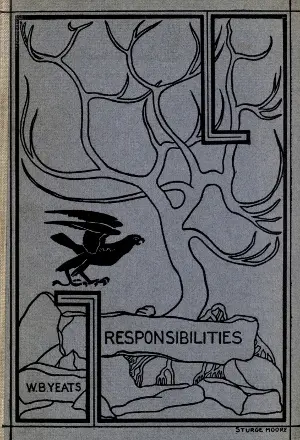
Responsibilities, and other poems
W. B. (William Butler) Yeats
THE CLASSIC COLLECTION · 1907
Plays and controversies by W. B. (William Butler) Yeats. Explore this classic work in a free online edition. Subjects include English drama -- Irish authors -- History and criticism; English drama -- Irish authors; Theater -- Ireland -- History; Abbey Theatre. Read the locally hosted text below, adjust the reading display, and continue where you left off.
Introduction adapted from the source catalogue; source summaries may be automatically generated.
Free to read · English · 85,824 words · No account needed
MAKE TIME FOR A GOOD BOOK
On by default. Untick to stop anonymous reading totals. Each page counts after 10 seconds in view. How this works.
Anonymous counting is on unless you have switched it off.
For the harp an ordinary zither, such as shown in the design of the musician, can be used. The strings, beginning by the lower ones, are grouped in nine or ten chords of four notes consisting of: the key-note, two strings in unison giving the fifth above, and the octave of the key-note.
Ex.:
[Musical example showing, in bass clef, the note D, G in two octaves, and then D again.]
Beyond these chords there are seven double strings tuned to any pentatonic scale that suits the play.
The tuning of the chords and free strings would be altered according to the performance, and several flutes giving different scales would be required.
The same chords and scales should be used throughout any one play.
The instruments are distributed as follows: one musician plays the drum and gong, one the flute, the singer takes the harp.
The drum and the gong must be used at times during the performance to emphasise the spoken word; no definite notation of this can be given, and it is left to the imagination and taste of the musician.
[Three musical examples. The first two are for the harp, showing, first, the chords, and second, the free strings. The second is for the flute.]
To be sung without accompaniment as they unfold the curtain.
I call to the eye of the mind
A well long choked up and dry
And boughs long stripped by the wind,
And I call to the mind’s eye
Pallor of an ivory face,
Its lofty dissolute air,
A man climbing up to a place
The salt sea wind has swept bare.
What were his life soon done!
Would he lose by that or win?
A mother that saw her son
Doubled over a speckled shin,
Cross-grained with ninety years,
Would cry, ‘How little worth
Were all my hopes and fears
And the hard pain of his birth!’
To be sung as they sit down
The boughs of the hazel shake,
The sun goes down in the west.
The heart would be always awake,
The heart would turn to its rest.
‘Why should I sleep?’ the heart cries. ‘For the wind, the salt wind, the sea wind, Is beating a cloud through the skies; I would wander always like the wind.’
‘O wind, O salt wind, O sea wind!’
Cries the heart, ‘it is time to sleep;
Why wander and nothing to find?
Better grow old and sleep.’
To begin when the Young Man says:
“Ah, you have looked at her....”]
Your reading position is saved on this browser. Take it to another device with a library code. Reading pages adapt to text, rather than matching a printed edition.
W. B. (William Butler) Yeats
W. B. (William Butler) Yeats
W. B. (William Butler) Yeats
W. B. (William Butler) Yeats
BEHIND THE BOOK
This eBook is for the use of anyone anywhere in the United States and most other parts of the world at no cost and with almost no restrictions whatsoever. You may copy it, give it away or re-use it under the terms of the Project Gutenberg License included with this eBook or online at www.gutenberg.org. If you are not located in the United States, you will have to check the laws of the country where you are located before using this eBook. Read the source licence.
The original source file, including credits and licence, is retained by this library. Request an original-format copy at no charge. Please include the book title and Project Gutenberg identifier #79460.
KEEP YOUR CURIOSITY GOING
Cécile Tormay

Moritz Busch
John L. Ransom
Frances Wright
Cécile Tormay

Mabel Potter Daggett