
Letters to a Friend, Written to Mrs. Ezra S. Carr, 1866-1879
John Muir
THE CLASSIC COLLECTION · 1922
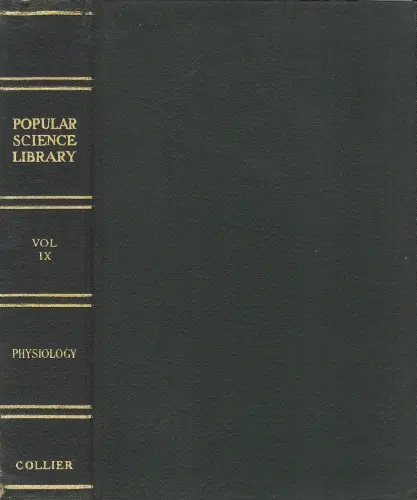
"Physiology: The Science of the Body" by Ernest G. Martin is a scientific publication likely written in the early 20th century. This work delves into the complex mechanisms that govern the human body, focusing on how the biological systems function to sustain life. It aims to provide readers with a foundational understanding of physiology, emphasizing the significance of bodily activities and the principles of hygiene related to health. The opening of the book introduces the fundamental concepts of physiology, starting with the signs of life and differentiating the criteria for determining whether an entity is living. Martin explores various attributes of living organisms, notably motion and the distinction between living beings and mechanical objects. He presents intriguing thought experiments regarding how extraterrestrial observers might misinterpret machines as living entities. The author further develops the discussion by introducing cellular structures such as protoplasm and the various types of cells, asserting that life consists of the interactions and functions of these cellular components. Through these details, Martin sets the stage for a comprehensive exploration of the physiological principles that underlie human life.
Introduction adapted from the source catalogue; source summaries may be automatically generated.
Free to read · English · 99,052 words · No account needed
MAKE TIME FOR A GOOD BOOK
On by default. Untick to stop anonymous reading totals. Each page counts after 10 seconds in view. How this works.
Anonymous counting is on unless you have switched it off.
A peculiarity of the structures that we are talking about now is that we have very little voluntary control over them. This contrasts sharply with the completeness of our control over the activities of our skeletal muscles. With very few exceptions we can start, stop, or regulate skeletal muscle activities at pleasure, but the activities of our smooth muscles and of our glands are not under our control in the same way. We cannot cause ourselves to turn pale by an act of the will, nor can we set the stomach to working when we wish. This latter inability is a real misfortune, for there are many cases of acute indigestion that are due to stagnation of the stomach, and if we could set the stomach into operation at will, these would be avoided. Since we have not this voluntary control, it is of the utmost importance for us to learn how the control is really carried on, so that the motions necessary to health can be induced in a normal manner.
To a very large extent the smooth muscles and glands are subject to reflex control; that is, nervous disturbances coming in from the sense organs pass over by way of connecting nerve cells to the nerve pathways leading out to the smooth muscles or to the glands. Examples of this kind of control are seen in the paling of the skin, when one is chilly, or its flushing, when one is warm; in the copious secretion of saliva into the mouth that one can get by chewing a rubber band; or in the secretion of tears that comes when the front of the eye is hit.
A second kind of control of the smooth muscles and glands is their control through the emotions. We have already given illustrations of this in the paling of the skin when one is frightened, or the erection of the hairs in the tail of an angry cat. For a long time it has been known that most of our emotions, if not all of them, are accompanied by some sort of bodily change; laughter and crying are familiar illustrations. To a certain extent, as in these instances, skeletal muscles share in the bodily effects of emotions, but their most important examples are found in the smooth muscles and glands. Every serious display of emotion is accompanied by a discharge of nervous disturbances into some of the smooth muscles or some of the glands. This fact has long been known, but its meaning has become clear only very recently. Before attempting to explain this, an additional word will be necessary about the nervous control of smooth muscles. These muscles differ from skeletal muscles in one important particular, which is this: when a skeletal muscle is aroused to contraction, it will relax as soon as the stream of nervous disturbances stops. To keep it in contraction a continuous stream must come into it through the nervous system. This is not true of smooth muscle. When a smooth muscle has been caused to contract, it is very likely to stay contracted without further action on the part of the nervous system. In fact, in very many cases another kind of nervous disturbance must be sent into it in order to make it relax. This means that the smooth muscles, or at least most of them, have two sets of nerves coming to them; one set which causes them to contract, the other set which causes them to relax. Both these sets of nerves are of the type described above as supplying the smooth muscles and glands. A good illustration of the double action is found in the stomach. There is one set of nerves whose activity causes the walls of the stomach to perform the churning motions which go on ordinarily during digestion. There is another set of nerves whose effect upon the stomach is to cause all motions in it to stop. This same double arrangement of nerves is found in many of our most important smooth muscle organs. We said a moment ago that every emotional display is accompanied by an outflow of nervous disturbances to the smooth muscle or gland structures. We now see that what happens in the body is determined by which of the possible pathways is followed by the nervous disturbance. One turns pale, when frightened, because in the emotion of fright the nervous discharge is over the nerves that cause the blood vessels of the face to contract. The mouth waters at the sight of delicious food, because the pleasurable emotions aroused thereby cause the nerves to the salivary glands to become active. As was said a moment ago, for a long time there seemed to be no rhyme or reason about these emotional reactions. Why, for example, should worry cause the muscles of the stomach to stop completely, thus bringing on thousands of attacks of acute indigestion? We now have a clue to the meaning of these facts, which is about as follows: The emotions are to be looked upon as part of the machinery by which bodily well-being is promoted. Emotions of pleasure signify that matters are progressing favorably, and the nervous discharges accompanying these emotions are those in accord with well-being. For example, the activities of the alimentary tract in digestion are of a kind that prosper when the body as a whole is well off. Disagreeable emotions, on the other hand, are associated with the necessity for self-preservation. Thus anger or fear arise in the presence of an emergency calling either for combat or flight. The nervous discharges that accompany these emotions are found on analysis to bring about bodily changes whose effect is to prepare the body successfully for one or the other. This is best shown by actually naming over some of the bodily changes that occur. We may begin with the top of the head and work down. The hair stands on end; this is of no importance in human beings, but in many animals contributes materially to the ferocity of the appearance. The pupils are dilated, aiding vision; the face is pale, and the mouth is dry; not because these in themselves are of importance but because they represent a diversion of energy from unimportant to important parts of the body. The blood that ordinarily flows through the face is shunted out of it into the brain and muscles, where it will really help in the emergency. The activity of the salivary glands is stopped to free the energy that they would consume for use in the brain or muscles. The heart beat is quickened; this again, by making the circulation more efficient, helps the animal to fight effectively. The activity of the stomach is suspended for the same reason as is that of the salivary glands. What we have is a marshaling of the bodily forces into the organs which are of immediate importance in meeting the emergency; namely, the nervous system and the muscles. The other parts of the body, which are necessary in the long run, are allowed to stop functioning for the moment. This behavior of the body in an emergency illustrates better than anything else could the point that our muscles, nerves, and sense organs make up the really important parts of us and the rest of the body has simply the duty of keeping these in good order. In time of emergency all the energies are devoted to the task of keeping these parts of us at highest efficiency, however bad may be the effect on the other less necessary organs; so it is that one who worries himself into an attack of indigestion is really preparing for an emergency by sacrificing the less essential for the more essential activities. The practical difficulty in this is that the worry almost always fails to be of use, either because the expected emergency does not arise at all or else arises so far in the future that the immediate bodily changes caused by the worry do no good. Evidently worry is an emotion to be combated. The old adage about not crossing the bridge until it is reached has really a great deal more to do with the preservation of health than most of us realize.
Your reading position is saved on this browser. Take it to another device with a library code. Reading pages adapt to text, rather than matching a printed edition.
BEHIND THE BOOK
This eBook is for the use of anyone anywhere in the United States and most other parts of the world at no cost and with almost no restrictions whatsoever. You may copy it, give it away or re-use it under the terms of the Project Gutenberg License included with this eBook or online at www.gutenberg.org. If you are not located in the United States, you will have to check the laws of the country where you are located before using this eBook. Read the source licence.
The original source file, including credits and licence, is retained by this library. Request an original-format copy at no charge. Please include the book title and Project Gutenberg identifier #48024.
KEEP YOUR CURIOSITY GOING
John Muir

Asa Gray
Asa Gray

Florence Nightingale
Elizabeth Robins Pennell
Denison Olmsted