
Letters to a Friend, Written to Mrs. Ezra S. Carr, 1866-1879
John Muir
THE CLASSIC COLLECTION · 1922
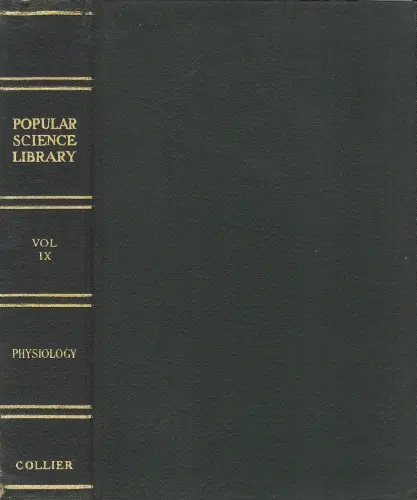
"Physiology: The Science of the Body" by Ernest G. Martin is a scientific publication likely written in the early 20th century. This work delves into the complex mechanisms that govern the human body, focusing on how the biological systems function to sustain life. It aims to provide readers with a foundational understanding of physiology, emphasizing the significance of bodily activities and the principles of hygiene related to health. The opening of the book introduces the fundamental concepts of physiology, starting with the signs of life and differentiating the criteria for determining whether an entity is living. Martin explores various attributes of living organisms, notably motion and the distinction between living beings and mechanical objects. He presents intriguing thought experiments regarding how extraterrestrial observers might misinterpret machines as living entities. The author further develops the discussion by introducing cellular structures such as protoplasm and the various types of cells, asserting that life consists of the interactions and functions of these cellular components. Through these details, Martin sets the stage for a comprehensive exploration of the physiological principles that underlie human life.
Introduction adapted from the source catalogue; source summaries may be automatically generated.
Free to read · English · 99,052 words · No account needed
MAKE TIME FOR A GOOD BOOK
On by default. Untick to stop anonymous reading totals. Each page counts after 10 seconds in view. How this works.
Anonymous counting is on unless you have switched it off.
In the last two chapters we have talked about the arrangement of the nervous system and its working as seen in simple reflex actions, and the special activities of the brain which make up the intellectual processes and the emotions. Before we can leave the subject of nervous activity, there are some special kinds of reflexes to be spoken of, and there are also some additional things to say about the working of the emotions. When we speak of special reflex actions we have in mind some of the most useful of our own reflexes. They are not different from the simple reflexes that are described in Chapter X, except that they involve a larger number of sense organs and many muscles, and are correspondingly more complicated. Furthermore, on account of this complication a special part of the nervous system is devoted to carrying them on. Back in Chapter VIII, under the heading of motion, the different types of bodily movement were listed. Chief of these was the act of locomotion; that is, the means by which we get from one place to another, an act which is, of course, of prime importance in maintaining life, since it is concerned both with the securing of food and the escaping of harm. Locomotion is performed in a number of different ways; in ourselves, walking, running, leaping, swimming, riding a bicycle are all forms of locomotion. Any of these acts, as stated in Chapter VIII, requires the accurate timing and accurate grading of the contractions of a great many different muscles. As we saw in that same chapter there are special sense organs which furnish the information upon which this accurate control of the muscles of locomotion is based. We have now to consider the part played by the nervous system in carrying it on. Whenever one starts to walk or to perform any of the other acts of locomotion, nervous disturbances will be set up in great quantity from the organs of muscle and joint sense in the parts of the body that are active, and also from the organs of equilibrium in the ear. It is necessary that the whole volume of nervous disturbance that is pouring into the central nervous system from these sources be translated into a series of streams of disturbances passing out over the motor nerves to cause the muscles to work just as they should in performing the act. All this is reflex in the strict sense. That is to say, the muscular action follows the arousing of the sense organs with no more delay than is necessary for the passage of the nervous disturbance. The work of transforming the incoming stream into a suitable outgoing stream is performed by a part of the brain about which little has been said thus far, namely the cerebellum. This is connected with other parts of the central nervous system in such a way that pathways from organs of equilibrium and from the organs of muscle and joint sense lead into it. From it in turn come a great many connecting nerve cells whose axons pass along the spinal cord and form nerve junctions with the motor nerve cells; and so nervous disturbances coming from the cerebellum can arouse the muscles to activity. We all know that walking or any other locomotor act, after it has once been learned, is carried on successfully without our performing any intellectual work in connection with it. What we do have to do is to start the act, and this is done through a discharge from the cerebrum; either some sense organ is aroused and sends a disturbance into the cerebrum, which arouses in us an association which indicates the necessity for going somewhere, or else a pure memory not stimulated from outside has the same effect. In either case the nervous disturbance passes over from the cell where the association resides to the motor area, and from there down to start the act of walking; but as soon as it is started, the reflex takes hold and carries it on without any further thought on our part except as some additional associations enter to cause us to change or perhaps to stop the action. It is possible that the complex muscular acts which we group under the head of grasping are operated in similar fashion. For example, the act of writing is essentially a modified grasping movement. When we are writing we think not about the muscular movements but about the sense of what is being written, and it may be that the actual control of the muscles in this case is something like that which we know exists in locomotion, although this is by no means certain. It is of course a very great advantage to us to have these complicated activities, which we are performing so constantly, carried on as reflexes without conscious effort on our part. If we had to think about the movement of every muscle, whenever we started to walk, our minds would be so taken up with the act itself that there would be no freedom for anything else; but since the reflex machinery takes care of these muscular movements for us, our minds are left free to deal with other matters at the same time as the muscular actions are going on.
Your reading position is saved on this browser. Take it to another device with a library code. Reading pages adapt to text, rather than matching a printed edition.
BEHIND THE BOOK
This eBook is for the use of anyone anywhere in the United States and most other parts of the world at no cost and with almost no restrictions whatsoever. You may copy it, give it away or re-use it under the terms of the Project Gutenberg License included with this eBook or online at www.gutenberg.org. If you are not located in the United States, you will have to check the laws of the country where you are located before using this eBook. Read the source licence.
The original source file, including credits and licence, is retained by this library. Request an original-format copy at no charge. Please include the book title and Project Gutenberg identifier #48024.
KEEP YOUR CURIOSITY GOING
John Muir

Asa Gray
Asa Gray

Florence Nightingale
Elizabeth Robins Pennell
Denison Olmsted