THE CLASSIC COLLECTION✦By the gods belovedCLASSIC FREE BOOKS
By the gods beloved
Emmuska Orczy, Baroness Orczy
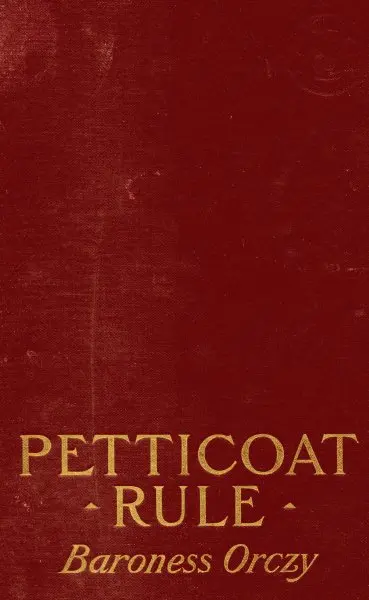
THE CLASSIC COLLECTION · 1909
"Petticoat Rule" by Baroness Emmuska Orczy is a historical novel written during the early 20th century. The story unfolds against the backdrop of 18th-century France, intertwining themes of love, ambition, and political intrigue. At its heart are Lydie d'Aumont, the passionate daughter of the French Prime Minister, and Charles Edward Stuart, the exiled English claimant to the throne, as well as other intrigues involving the lavish court where they navigate their fates. The opening of the novel begins with a farewell banquet held in honor of Charles Edward Stuart at the Château d'Aumont. Conversations at the banquet showcase the vibrant dynamics of the French court, where Lydie d'Aumont's spirited interactions with characters like the Marquise de Pompadour highlight her assertive nature and political awareness. As tensions rise regarding the aspirational causes for which the guests toast, the gathering reveals the broader implications of loyalty and ambition, signaling the intertwining fates of its characters as they maneuver through personal desires and political alliances. Lydie's strong-willed personality stands in contrast to others in the court, setting the stage for potential conflicts and relationships that will develop as the story progresses.
Introduction adapted from the source catalogue; source summaries may be automatically generated.
Free to read · English · 97,797 words · No account needed
MAKE TIME FOR A GOOD BOOK
On by default. Untick to stop anonymous reading totals. Each page counts after 10 seconds in view. How this works.
Anonymous counting is on unless you have switched it off.
"Nay! he is a gallant youth," he said reassuringly, "and knows exactly how to hold his tongue, but Belle-Isle and de Lugeac had to be taught a lesson . . . and 'twas well learned I'll warrant you. . . . As for Gaston. . . ."
"Yes! M. le Duc? what of M. le Comte de Stainville?"
"He hath left the Court momentarily . . . somewhat in disgrace . . . 'twas a monstrous encounter, milor," added the Duke gravely. "Had Gaston killed you it had been murder, for you never meant to shoot, so says de Mortémar."
The sick man's head turned restlessly on the pillow.
"De Mortémar's tongue hath run away with him," he said impatiently.
"The account of the duel . . . nothing more, on my honour," rejoined the Duke. "No woman's name has been mentioned, but I fear me the Court and public have got wind of the story of a conspiracy against the Stuart prince, and connect the duel with that event--hence your popularity, milor," continued the older man with a sigh, "and Gaston's disgrace."
"His Majesty's whipping-boy, eh? the scapegoat in the aborted
conspiracy?"
"Poor Gaston! You bear him much ill-will, milor, no doubt?"
"I? None, on my honour."
M. le Duc hesitated a while, a troubled look appeared on his handsome
face.
"Lydie," he said tentatively. "Milor, she left Paris that night alone . . . and travelled night and day to reach Le Havre in time to help you and to thwart Gaston . . . she had been foolish of course, but her motives were pure . . . milor, she is my child and . . ."
"She is my wife, M. le Duc," interrupted Lord Eglinton gravely; "I need no assurance of her purity even from her father."
There was such implicit trust, such complete faith expressed in those few simple words, that instinctively M. le Duc d'Aumont felt ashamed that he could ever have misunderstood his daughter. He was silent for a moment or two, then he said more lightly:
"His Majesty is much angered of course."
"Against me, I hope," rejoined Eglinton.
"Aye!" sighed the Duke. "King Louis is poorer by fifteen million
livres by your act, milor."
"And richer by the kingdom of honour. As for the millions, M. le Duc, I'll place them myself at His Majesty's service. My château and dependencies of Choisy are worth that," added milor lightly. "As soon as this feeble hand can hold a pen, I'll hand them over to the crown of France as a free gift."
"You will do that, milor?" gasped the Duke, who could scarce believe
his ears.
"'Tis my firm intention," rejoined the sick man with a smile.
Your reading position is saved on this browser. Take it to another device with a library code. Reading pages adapt to text, rather than matching a printed edition.
Emmuska Orczy, Baroness Orczy
Emmuska Orczy, Baroness Orczy
Emmuska Orczy, Baroness Orczy
Emmuska Orczy, Baroness Orczy
BEHIND THE BOOK
This eBook is for the use of anyone anywhere in the United States and most other parts of the world at no cost and with almost no restrictions whatsoever. You may copy it, give it away or re-use it under the terms of the Project Gutenberg License included with this eBook or online at www.gutenberg.org. If you are not located in the United States, you will have to check the laws of the country where you are located before using this eBook. Read the source licence.
The original source file, including credits and licence, is retained by this library. Request an original-format copy at no charge. Please include the book title and Project Gutenberg identifier #34660.
KEEP YOUR CURIOSITY GOING
Cécile Tormay

Moritz Busch
Coulson Kernahan
John L. Ransom

Maurice Baring
Frances Wright