THE CLASSIC COLLECTION✦By the gods belovedCLASSIC FREE BOOKS
By the gods beloved
Emmuska Orczy, Baroness Orczy
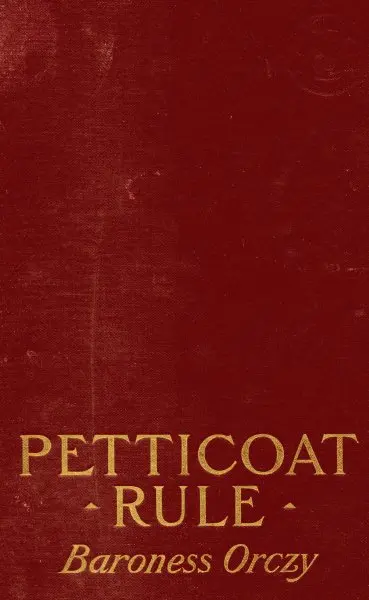
THE CLASSIC COLLECTION · 1909
"Petticoat Rule" by Baroness Emmuska Orczy is a historical novel written during the early 20th century. The story unfolds against the backdrop of 18th-century France, intertwining themes of love, ambition, and political intrigue. At its heart are Lydie d'Aumont, the passionate daughter of the French Prime Minister, and Charles Edward Stuart, the exiled English claimant to the throne, as well as other intrigues involving the lavish court where they navigate their fates. The opening of the novel begins with a farewell banquet held in honor of Charles Edward Stuart at the Château d'Aumont. Conversations at the banquet showcase the vibrant dynamics of the French court, where Lydie d'Aumont's spirited interactions with characters like the Marquise de Pompadour highlight her assertive nature and political awareness. As tensions rise regarding the aspirational causes for which the guests toast, the gathering reveals the broader implications of loyalty and ambition, signaling the intertwining fates of its characters as they maneuver through personal desires and political alliances. Lydie's strong-willed personality stands in contrast to others in the court, setting the stage for potential conflicts and relationships that will develop as the story progresses.
Introduction adapted from the source catalogue; source summaries may be automatically generated.
Free to read · English · 97,797 words · No account needed
MAKE TIME FOR A GOOD BOOK
On by default. Untick to stop anonymous reading totals. Each page counts after 10 seconds in view. How this works.
Anonymous counting is on unless you have switched it off.
De Mortémar had stowed the packet carefully away inside his coat, Gaston keenly watching his antagonist the while.
"Are you ready, milor?" he asked now with marked insolence of manner.
"At your service," replied the other quietly. "M. de Mortémar, will
you give the word?"
The two men stood opposite to one another, a table not four feet wide between them. Each held a pistol in his left hand. Of these one was loaded, the other not. De Mortémar had cleared the table, pushing aside the decanter of wine, the tureen of soup, the glasses. The window was still open, and from that outside world which to these men here present seemed so far away, there came the sound of the old church belfry tolling the hour of eight, and still from afar that melancholy tune, the Norman ditty sung by young throats:
"C'est les Normands, qu'à dit ma mère,
"C'est les Normands qu'ont conquis l'Angleterre!"
"Fire!" said de Mortémar.
Two arms were raised. Eye was fixed to eye for one brief second, then lowered for the aim. There was a slight dull sound, then a terrible curse muttered below the breath, as the pistol which Gaston de Stainville had vainly tried to fire dropped from his hand.
Had his excitement blinded him when he chose his weapon, or was it just fate, ruthless, inscrutable, that had placed the loaded pistol in Lord Eglinton's hand?
"A blank!" he shouted with a blasphemous oath. "À vous, milor! Curse you, why don't you fire?"
"Fire, milor, in Heaven's name," said Mortémar, who was as pale as death. "'Tis cruelty to prolong."
But Eglinton too had dropped his arm.
"M. le Comte de Stainville," he said calmly, "before I use this weapon against you, as I would against a mad dog, I'll propose a bargain for your acceptance."
"You'd buy that packet of precious documents from me, eh?" sneered Gaston savagely, "nay, milor, 'tis no use offering millions to a dying man. . . . Shoot, shoot, milor! the widowed Comtesse de Stainville will deal with those documents and no one else. . . . They are not for sale, I tell you, not for all your millions now!"
"Not even for this pistol, M. le Comte?"
And calm, serene with that whimsical smile again playing round the corners of his expressive mouth, Lord Eglinton offered the loaded pistol to his enemy.
"My life? . . ." stammered Gaston, "you would? . . ."
"Nay, mine, M. le Comte," rejoined milor. "I'll not stir from this spot. I offer you this pistol and you shall use it at your pleasure, after you have handed me that packet of letters."
Your reading position is saved on this browser. Take it to another device with a library code. Reading pages adapt to text, rather than matching a printed edition.
Emmuska Orczy, Baroness Orczy
Emmuska Orczy, Baroness Orczy
Emmuska Orczy, Baroness Orczy
Emmuska Orczy, Baroness Orczy
BEHIND THE BOOK
This eBook is for the use of anyone anywhere in the United States and most other parts of the world at no cost and with almost no restrictions whatsoever. You may copy it, give it away or re-use it under the terms of the Project Gutenberg License included with this eBook or online at www.gutenberg.org. If you are not located in the United States, you will have to check the laws of the country where you are located before using this eBook. Read the source licence.
The original source file, including credits and licence, is retained by this library. Request an original-format copy at no charge. Please include the book title and Project Gutenberg identifier #34660.
KEEP YOUR CURIOSITY GOING
Cécile Tormay

Moritz Busch
Coulson Kernahan
John L. Ransom

Maurice Baring
Frances Wright